
The Vital Role of Creative Thinking in NID Studio Tests
The National Institute of Design (NID) is known for its rigorous selection process. While the Design Aptitude Test (DAT) Prelims assess your observational and analytical skills, the Studio Test is where your tactile and creative skills are put to the ultimate test. It is not just about how well you can draw; it is about how you think, innovate, and solve problems under pressure. To excel, aspirants must cultivate a mindset that looks beyond the obvious. This involves a mix of divergent thinking, material handling, and effective communication through three-dimensional forms. At myentrance.in, we understand that this journey requires consistent practice, which is why our latest pattern mock tests are designed to simulate this environment precisely.
Top Creative Thinking Exercises for Aspirants
Developing a creative edge requires deliberate practice. Here are several exercises designed to stretch your imagination and prepare you for the current syllabus requirements of the NID Studio Test.
1. The 30 Circles Challenge
Originally developed by Bob McKim and popularized by Tim Brown of IDEO, this exercise is perfect for boosting creative fluency. Draw 30 circles on a sheet of paper. Your goal is to turn as many of those circles as possible into recognizable objects in under two minutes. Think of a clock, a pizza, a planet, or a human eye. This exercise forces you to move past your first few ideas and find unique associations, a skill highly valued in the NID entrance process.
2. The SCAMPER Technique
SCAMPER is an acronym for Substitute, Combine, Adapt, Modify, Put to another use, Eliminate, and Reverse. Use this technique to rethink everyday objects. For example, if you are given a plastic bottle, how could you substitute its material? How could you combine it with a bicycle? How could you reverse its function? Applying SCAMPER helps you generate a wide range of solutions for the material handling tasks often found in the latest pattern exams.
3. Forced Connections
Take two completely unrelated objects, such as a stapler and a sunflower. Now, try to create a new product that combines elements of both. This exercise develops your ability to see patterns and connections where others see none. In the Studio Test, you might be given random materials like wire, straws, and cloth to create a conceptual model. Forced connection exercises prepare you for these unconventional challenges.
Mastering Material Handling
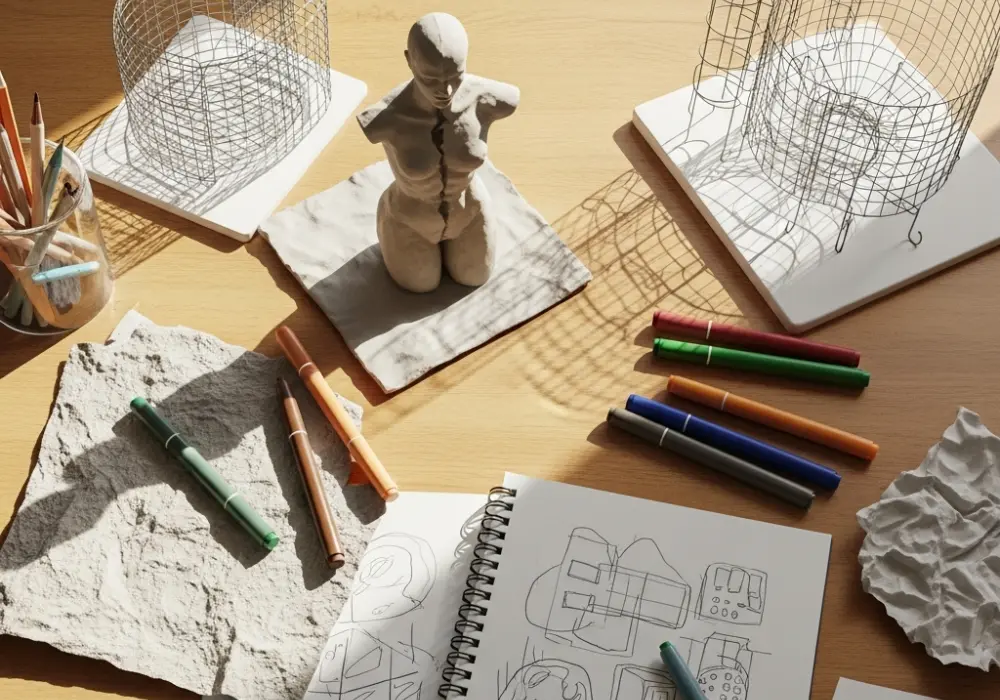
The Studio Test often involves creating 3D models from materials like clay, wire, paper, or scrap. Understanding the properties of these materials is crucial. Clay allows for organic shapes, while wire is excellent for linear structures and skeletons. Paper can be folded (origami) or pulped. Practicing with these mediums helps you understand their limitations and strengths. When you use the mock tests on myentrance.in, you get exposure to the types of prompts that require these specific material skills.
Comparing Core Skills for the Studio Test
The following table outlines the different domains you will be tested on and how to focus your preparation efforts:
| Test Component | Primary Skill Evaluated | Complexity Level | Practice Material |
|---|---|---|---|
| Model Making | 3D Visualization & Dexterity | High | Clay, Wire, Cardboard |
| Doodling & Illustration | Speed & Concept Communication | Medium | Fine-liners, Charcoal |
| Observation Test | Sensory Awareness | High | Everyday Objects |
| Thematic Appreciation | Narrative Building | Medium | Storyboards, Paper |
Strategic Use of Mock Tests
Preparation is incomplete without simulated pressure. The mock tests available at myentrance.in are curated by design experts to mirror the latest pattern of the NID DAT. These tests help you manage your time effectively, ensuring you do not spend too much time on ideation and too little on execution. By regularly attempting these tests, you build the stamina required for the multi-hour Studio Test session. Remember, the goal is to show the examiners not just a finished product, but a clear, innovative thought process.
Essential Tips for the Exam Day
- Read the Brief Twice: Many students fail because they misunderstand the prompt. Spend the first five minutes analyzing the requirements.
- Sketch Before You Build: Spend a few minutes making rough thumbnails. It is easier to correct a drawing than a clay model.
- Focus on Neatness: Even the most creative idea can lose marks if the execution is messy. Ensure your joints are clean and your structures are stable.
- Manage Your Workspace: Keep your desk organized. A cluttered space often leads to a cluttered mind and lost tools.
Frequently Asked Questions (FAQ)
What is the most important part of the NID Studio Test?
While execution is important, the examiners are primarily looking for your ability to innovate and your unique approach to problem-solving. Your thought process and how you interpret the brief are the most critical components.
Can I bring my own materials to the Studio Test?
Generally, NID provides all necessary materials for the test. However, you should always check the latest admit card instructions for any specific tools like pencils, erasers, or cutters that you might be allowed to carry.
How should I prepare for the interview round?
The interview is often about your portfolio and your passion for design. Be ready to explain the ‘why’ behind your work. Practicing with the study material on myentrance.in can help you articulate your design philosophy more clearly.
Is drawing skill the only thing that matters?
No, drawing is just one way to communicate. In the Studio Test, your ability to manipulate 3D materials and your sensitivity to aesthetics, ergonomics, and functionality are equally, if not more, important.





