
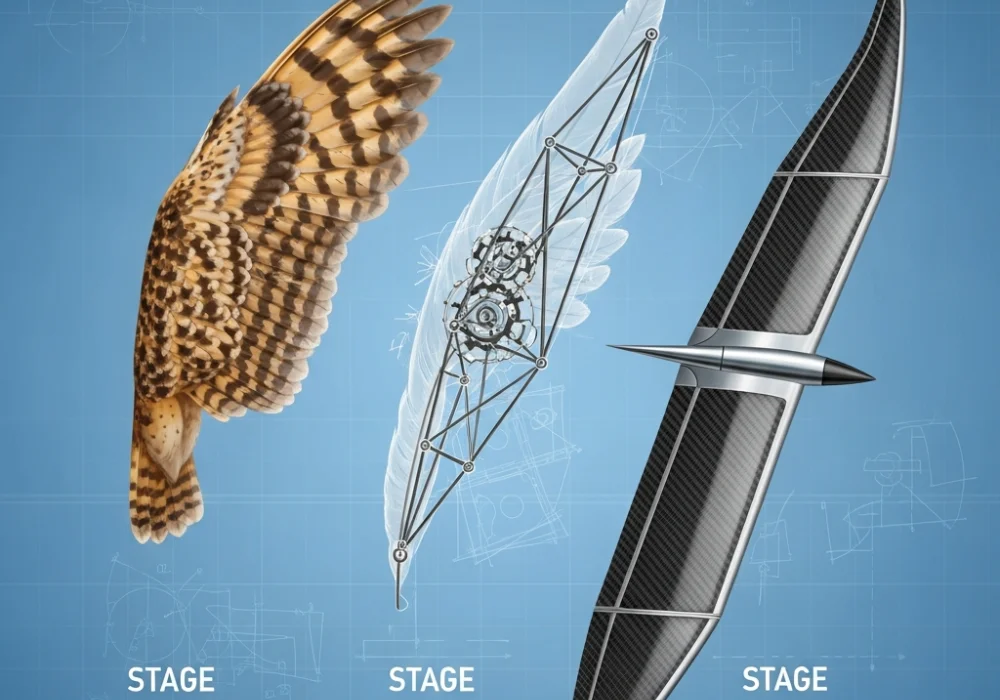
Deciphering Visual Metamorphosis: From Nature to Machine
In the realm of the National Institute of Design (NID) Design Aptitude Test (DAT), visual metamorphosis is not merely a drawing exercise; it is a profound test of your logical evolution, spatial reasoning, and understanding of structural mechanics. One of the most recurring themes in Previous Year Questions involves the transition from organic, biological forms to rigid, man-made geometric structures. Specifically, the transformation of a natural bird wing into a geometric mechanical glider stands as the ultimate challenge for aspiring designers. This guide breaks down the core principles of this metamorphosis, providing you with ‘Ninja Shortcuts’ to crack these questions in record time.
Understanding the Logic of Metamorphosis
The examiners are looking for ‘Visual Continuity.’ You cannot simply draw a bird in Frame 1 and a plane in Frame 5. You must show the how and why. The feathers must logically become slats; the bones must become trusses; the organic curves must crystallize into geometric angles. This is the essence of design thinking.
💡 Pro-Tip: The ‘Anchor Point’ Rule
Always identify the ‘Hinge Point’ of the wing (the shoulder/elbow). Keep this anchor point consistent across all frames to maintain spatial orientation and avoid confusing the examiner.
Question 1: The Transition of Structural Integrity
Problem: In 5 frames, show the metamorphosis of a Golden Eagle’s wing into a stealth-tech mechanical glider wing. Focus on the internal skeletal shift.
The Traditional Method
Students usually spend 15 minutes meticulously drawing individual feathers in Frame 1, only to realize they don’t know how to turn a ‘soft’ feather into a ‘hard’ metallic plate. This leads to a messy Frame 3 where the wing looks like a hybrid mess with no clear logic.
The 30-Second Ninja Shortcut: The ‘Wireframe Overlay’
Don’t draw the bird first. Draw a geometric skeleton (a series of connected lines and circles) that mimics the wing’s anatomy. Frame 1: Soften the lines. Frame 5: Extrude the lines into 3D metallic beams. Frames 2, 3, and 4 are just the gradual thickening of these lines.
💡 Click to Reveal Core Concept
Organic forms are ‘Additive’ (grown), while mechanical forms are ‘Assembly’ (bolted). The middle frames should show organic parts becoming modular segments.
Question 2: Aerodynamic Surface Evolution
Problem: Depict the transformation of primary feathers into aerodynamic control surfaces (flaps/ailerons) of a glider in 4 steps.
The Traditional Method
Drawing each feather transitioning into a square. This looks repetitive and lacks ‘Design Flair.’ It ignores the fact that a glider wing is a single cohesive unit, not a collection of loose parts.
The 30-Second Ninja Shortcut: ‘Negative Space Merging’
Instead of drawing the feathers, draw the gaps between them. In Frame 1, the gaps are organic and varying. In Frame 2, make the gaps perfectly straight. In Frame 3, close the gaps 80% to form ‘slats.’ In Frame 4, seal them completely into a mechanical wing with ‘panel lines’ where the feathers used to be.
Question 3: Materiality and Texture Shift
Problem: Show how the soft down feathers of a wing morph into a carbon-fiber composite texture of a high-performance glider.
The Traditional Method
Shading the whole wing as feathers and then using a ruler to draw grids for carbon fiber. This creates a visual disconnect and wastes precious time on rendering.
The 30-Second Ninja Shortcut: ‘Pattern Decimation’
Use the ‘Hatching’ technique. Frame 1: Random, soft organic hatch. Frame 2: Organize the hatch into a rhythmic wave. Frame 3: Turn the wave into a zig-zag. Frame 4: Tighten the zig-zag into a 45-degree cross-hatch (the classic carbon fiber look). This shows a logical evolution of pattern.
💡 Pro-Tip: Light Logic
Feathers absorb light; metal reflects it. Ensure your final frame has a ‘specular highlight’ (a bright white strip) to instantly signal a mechanical surface to the grader.
Question 4: The Joint Kinematics Challenge
Problem: Visualize the ‘Wrist’ of a bird transforming into the ‘Hydraulic Actuator’ of a glider’s folding wing mechanism.
The Traditional Method
Drawing a realistic bird anatomy and then trying to draw a complex engine. Most students fail because they don’t understand how a hydraulic piston works.
The 30-Second Ninja Shortcut: ‘The Piston Proxy’
Think of the bird’s muscle as a cylinder. In the transition frames, simply draw a circle (the pivot) and two rectangles (the pistons). The muscle ‘stiffens’ into the cylinder, and the tendon ‘hardens’ into the piston rod. This functional substitution is the key to high scores in Previous Year Questions.
Question 5: Proportional Abstraction
Problem: Transform a high-aspect-ratio Albatross wing into a wide-span solar-powered geometric glider.
The Traditional Method
Changing the length of the wing in every frame. This makes the metamorphosis look like the object is ‘growing’ rather than ‘evolving.’
The 30-Second Ninja Shortcut: ‘The Enclosing Box’
Draw a faint bounding box that represents the final glider’s dimensions. Keep the bird’s wing tips touching the edges of this box from Frame 1. This ensures that the Scale remains constant while the Form changes. It shows incredible spatial control.
Cheat Sheet: Quick Revision Formulas
| Biological Element | Mechanical Transition | Geometric Primitive |
|---|---|---|
| Feathers | Ailerons / Slats | Trapezoids / Rectangles |
| Humerus Bone | Main Spar / Truss | Cylinders / I-Beams |
| Joint / Elbow | Hydraulic Pivot | Concentric Circles |
| Skin Membrane | Carbon Fiber Panel | Planes / Polygons |
| Curved Leading Edge | Swept-back Wing | Acute Angles |
- Rule of 5: Always aim for 5 frames unless specified otherwise. Frame 3 is your ‘Hybrid’ hero.
- Line Weight: Organic = Variable, hand-drawn lines. Mechanical = Consistent, technical lines.
- Shadow Evolution: Transition from soft, blended shadows (organic) to sharp, ‘cel-shaded’ shadows (mechanical).
Need Personalized Guidance for NID DAT?
Don’t let complex metamorphosis questions stand between you and your dream design school. Our experts are here to provide free guidance, mock tests, and portfolio reviews.
💬 Chat with our Experts on WhatsApp (+91 9526806124)




