
Decoding Service Design: Reducing Food Wastage in Urban Apartment Complexes
Service design is more than just drawing a product; it is about designing an entire ecosystem of experiences, interactions, and logistics. In the NID DAT exam, questions regarding urban sustainability—specifically food wastage—are common. These questions test your ability to think systemically, empathize with diverse stakeholders, and visualize a multi-step solution clearly. This guide breaks down how to approach these complex service-oriented problems using frameworks derived from Previous Year Questions analysis.
Understanding the Core Concept: The Service Ecosystem
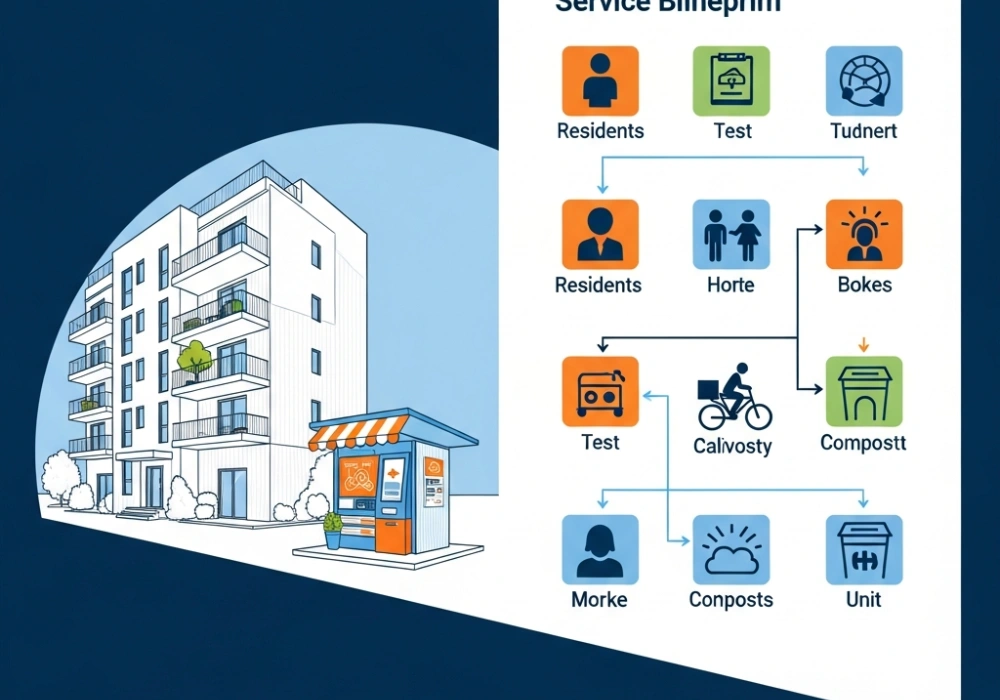
When we talk about food wastage in an urban apartment complex, the problem isn’t just ‘throwing food away.’ It involves procurement, storage, cooking habits, disposal systems, and community dynamics. To solve this, you must look at the User Journey (from the resident’s perspective) and the Service Blueprint (the behind-the-scenes logistics).
💡 Pro-Tip: What is a Touchpoint?
A touchpoint is any point of interaction between the service provider and the user. In an apartment complex, this could be a mobile app, a physical collection bin, a notice board, or even a conversation with the building security guard.
Simulated Question 1: The Resident’s Donation Journey
Question: Visualize a 4-step sequence for a busy professional living in a high-rise who wants to donate surplus untouched food to a community kitchen via an automated system.
The Traditional Method
Most students spend 15 minutes drawing highly detailed interior scenes of a kitchen. They focus on the facial expressions of the character and the aesthetics of the food container. While artistic, it often fails to communicate the ‘system’ effectively.
The 30-Second Ninja Shortcut: The ‘Action-Reaction’ Frame
Focus on the Hand-Interface Interaction. Don’t draw the whole room. Draw a close-up of a hand clicking ‘Donate’ on a phone (Action), then a close-up of a smart locker opening (Reaction). Use arrows to show movement and labels like ‘Step 1: Notify’ and ‘Step 2: Deposit’.
💡 Click to Reveal: The Visualization Secret
In NID DAT, clarity beats beauty. Use thick outlines for the main objects and light grey for the background to make the service flow pop.
Simulated Question 2: Stakeholder Interdependence Map
Question: Identify and visualize the relationships between four key stakeholders in an apartment composting service: The Resident, the Facility Manager, the Local Farmer, and the Waste Collector.
The Traditional Method
Drawing four separate portraits of people and writing a paragraph about each. This doesn’t show service design; it shows character design. It ignores the flow of value.
The 30-Second Ninja Shortcut: The ‘Circular Flow’ Diagram
Place the ‘Composting Unit’ in the center. Draw four icons around it. Use double-sided arrows. Resident gives ‘Waste’ -> gets ‘Incentive points’. Farmer gives ‘Knowledge’ -> gets ‘Organic Compost’. This ‘Circular Map’ immediately signals to the NID examiners that you understand the Circular Economy.
Simulated Question 3: The UI/UX Touchpoint
Question: Design the interface of a ‘Smart Bin’ located in the apartment lobby that informs residents about the impact of their food saving efforts.
The Traditional Method
Designing a screen full of buttons and text. This is hard to read and doesn’t visualize the ‘impact’ which is the emotional hook of the service.
The 30-Second Ninja Shortcut: The ‘Gamified Metric’
Use a visual metaphor. Instead of writing ‘You saved 5kg of food’, show a visual of a ‘Tree Growing’ or a ‘Meter Filling Up’. Use high-contrast icons. This shows you understand Nudge Theory—using design to influence positive behavior.
💡 Concept Check: What is Nudge Theory?
Nudge theory is a design approach that subtly steers people toward better decisions without forcing them. Example: Placing the donation bin right next to the elevator makes it the easiest choice.
Simulated Question 4: Logistics and the ‘Last Mile’
Question: Visualize how food collected from 50 different apartments is transported to a central city NGO without spoilage.
The Traditional Method
Drawing a big truck. This ignores the ‘Urban’ context where trucks might not fit or might be inefficient for small quantities of food.
The 30-Second Ninja Shortcut: The ‘Modular Carrier’
Visualize a modular, insulated crate system that fits onto electric cycles or small EVs. Show a ‘Cut-section’ of the crate with ice packs or vacuum seals. This demonstrates Technical Feasibility and Spatial Awareness.
Simulated Question 5: Solving a Service Failure
Question: What happens when the community food fridge is full? Visualize the backup plan.
The Traditional Method
Drawing a sad person walking away with their food. This identifies a problem but doesn’t offer a Service Design solution.
The 30-Second Ninja Shortcut: The ‘Dynamic Redirection’
Draw a sensor on the fridge that sends a ‘Full’ signal to a central app. The app immediately displays a map of the next nearest fridge or triggers a ‘Flash Sale’ notification for the apartment residents to take the food at a discount. This is Real-time Problem Solving.
Service Design Cheat Sheet for NID DAT
| Element | NID Examiner’s Expectation | Ninja Tip |
|---|---|---|
| User Persona | Empathy for the urban dweller | Show the ‘Pain Point’ (e.g., lack of time) |
| Touchpoints | Physical & Digital integration | Use icons for Wifi/Bluetooth to show connectivity |
| Sustainability | Environmentally friendly solutions | Include a ‘Waste-to-Wealth’ loop |
| Visualization | Clarity of flow | Number your panels (1, 2, 3, 4) clearly |
Ready to Crack the NID DAT?
Service design is a high-scoring area if you can visualize the invisible threads that connect people and systems. If you’re struggling with sketching these flows or need more Previous Year Questions breakdowns, we are here to help!
💬 Chat with our Experts on WhatsApp (+91 9526806124)




