
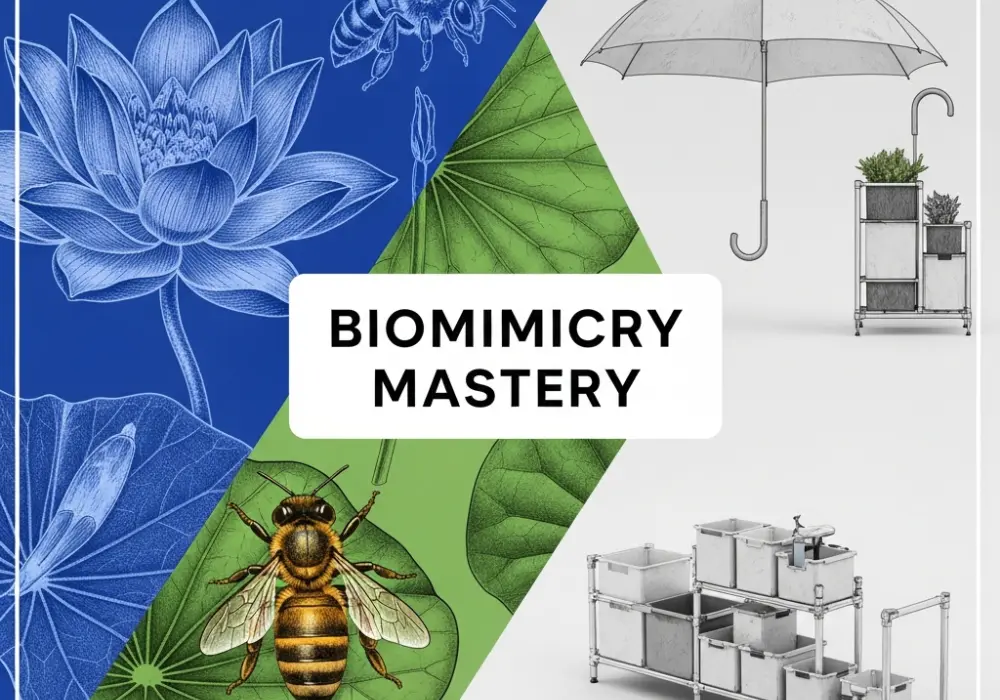
Decoding the Art of Biomimicry in NID DAT Product Redesign
For any aspiring designer eyeing a seat at the National Institute of Design (NID), the Design Aptitude Test (DAT) is the ultimate hurdle. One of the most recurring and challenging themes in the Design Problem Solving section involves taking a mundane, everyday object and redesigning it into a multi-functional tool using the principles of Biomimicry. Biomimicry is not just about making something look like an animal; it is about emulating nature’s time-tested patterns and strategies to solve human design challenges. In this massive guide, we will decode five simulated scenarios based on Previous Year Questions to help you master this critical topic.
Why Biomimicry Matters in Product Redesign
In the NID DAT, evaluators are not just looking for a pretty sketch. They are looking for your ability to observe nature, extract a functional logic, and apply it to a human-centric problem. When you transform an object into a multi-functional tool, you demonstrate ‘Design Thinking’—the ability to add value while maintaining efficiency. Let us dive into the deep analysis of simulated challenges based on Previous Year Questions.
Question 1: The Desktop Organizer Redesign
The Challenge: Redesign a standard plastic pen stand into a modular, multi-functional desktop workstation tool using the structural logic of a Honeycomb (Beehive).
The Traditional Method
Most students will simply draw a hexagonal pen stand. They might add a few slots for a phone or a paperclip. While this uses the ‘shape’ of a honeycomb, it fails to capture the ‘functional essence.’ The traditional approach focuses on the aesthetic of the hexagon rather than the efficiency of the structure. The result is often a bulky, static object that takes up too much space.
The 30-Second Ninja Shortcut
The Concept: Structural Optimization and Modular Growth. Instead of drawing a fixed box, focus on the ‘Shared Wall’ principle of a beehive. In 30 seconds, visualize a ‘tessellation.’ Your design should consist of interlocking hexagonal units that can be added or removed. The Multi-functionality: Use one cell for pens, another with a padded interior for a phone (using the hexagon’s depth), and a shallow cell with a magnetic base for pins. Key Insight: Mention ‘Material Efficiency’—honeycombs use the least amount of wax to provide maximum storage. This shows the examiner you understand the ‘Why’ behind the ‘What’.
Question 2: The Urban Rain-Gear Redesign
The Challenge: Based on the water-shedding properties of the Lotus Leaf, redesign a standard handheld umbrella into a hands-free multi-functional shield for urban commuters.
The Traditional Method
The average candidate will draw an umbrella with a fancy handle or perhaps a backpack-mounted pole. They will write about ‘waterproof fabric’ and call it a day. This approach is superficial because it doesn’t solve the core issues of wind resistance or the ‘wet-umbrella-mess’ once the user gets indoors.
The 30-Second Ninja Shortcut
The Concept: The Lotus Effect (Ultrahydrophobicity) and Self-Cleaning. Visualize a wearable ‘Pod’ or a ‘Collar-Shield.’ Instead of just a fabric canopy, propose a surface texture with microscopic bumps (papillae) that prevent water from sticking. The Multi-functionality: Since water rolls off instantly, the shield can be folded into a dry carry-bag or used as a clean seat cover on public transport. Ninja Tip: Use the term ‘Nanostructure.’ Tell the examiner that the redesign allows for a ‘Dry-Touch’ experience, eliminating the need for plastic covers. This addresses environmental concerns—a huge plus in NID DAT.
Question 3: The Portable Lighting Tool Redesign
The Challenge: Redesign a standard emergency flashlight into a multi-functional camping tool inspired by the Firefly (Bioluminescence).
The Traditional Method
Students usually design a flashlight that glows brighter or has a green tint. They might add a hook to hang it. This is a basic addition of features rather than a redesign of the lighting mechanism itself. It ignores the firefly’s energy efficiency and signal-based communication.
The 30-Second Ninja Shortcut
The Concept: Cold Light and Signal Modulation. Focus on the firefly’s ‘Lantern’—a specialized organ that reflects and amplifies light. The Multi-functionality: Redesign the flashlight with a 360-degree ‘Reflective Chamber’ that can be expanded to work as a soft-light lantern for reading or collapsed for a focused beam. Add a ‘Pulse-Mode’ inspired by firefly mating signals for emergency SOS signaling. Ninja Insight: Mention ‘Heat Management.’ Fireflies produce light with zero heat. Propose a design with integrated cooling fins that look like the firefly’s abdominal segments to keep the LED components durable.
Question 4: The Handheld Gardening Tool Redesign
The Challenge: Transform a standard hand trowel (shovel) into a multi-functional planting and soil-health tool inspired by the Mole’s Paw.
The Traditional Method
A typical response involves making the shovel wider or sharper. Maybe adding a ruler on the side to measure depth. This is a linear improvement of an existing tool, not a biomimetic transformation.
The 30-Second Ninja Shortcut
The Concept: Power-Digging and Soil Aeration. The mole’s paw is built for lateral force and displacement. Redesign the tool with a ‘Palm-Grip’ instead of a vertical handle, allowing the user to use their pectoral muscles (just like a mole). The Multi-functionality: Integrate ‘Claw-Tines’ on the edges of the shovel head. When the user rotates the tool, it switches from a digger to an aerator. Ninja Tip: Add a ‘Sieve-Perforation’ on the blade inspired by the mole’s ability to filter soil from debris. This turns a simple shovel into a digging, aerating, and filtering multi-tool.
Question 5: The Commuter Footwear Redesign
The Challenge: Redesign a standard pair of sneakers into a multi-functional urban survival tool inspired by the Mountain Goat’s Hooves.
The Traditional Method
Most candidates will simply design a shoe with ‘good grip’ or a rugged sole. They might make it look like a goat’s hoof aesthetically. This fails to address the unique mechanical dual-nature of a goat’s hoof, which is both hard for grip and soft for suction.
The 30-Second Ninja Shortcut
The Concept: Dual-Density Traction and Adaptive Balance. Goats have a hard outer rim and a soft inner pad. Redesign the sneaker sole with a ‘Bi-focal’ split. The Multi-functionality: The outer rim provides stability for walking on concrete, while the soft inner core can be pressurized (using a small air-pump mechanism) to become a ‘Climbing Pad’ for steep urban stairs or slippery surfaces. Ninja Insight: Suggest that the shoe can be converted into a ‘Compact Storage’ unit where the hollow heel (inspired by the hoof’s arch) holds emergency items like a multi-tool or a first-aid kit. This shows your ability to utilize every cubic centimeter of a product’s volume.
Cheat Sheet: Quick Revision for Biomimicry Redesign
Use this table to quickly reference biological inspirations for common design problems encountered in Previous Year Questions.
| Biological Inspiration | Key Design Principle | Potential Application |
|---|---|---|
| Shark Skin (Denticles) | Drag Reduction / Anti-bacterial | Vehicle bodies, Hospital surfaces |
| Kingfisher Beak | Aerodynamic Piercing | High-speed fans, Transportation noses |
| Burr Seeds (Velcro) | Mechanical Adhesion | Fasteners, Modular assembly tools |
| Bird Bones | Hollow Strength (Lighter) | Portable furniture, Drone frames |
| Elephant Trunk | Degrees of Freedom / Prehensile | Robotic arms, Multi-angle lamps |
| Termite Mounds | Passive Ventilation | Eco-friendly housing, Computer cooling |
Expert Tips for the NID DAT Exam
- Label Everything: Your sketch is only 50% of the answer. Use clear, crisp annotations to explain the ‘Biomimetic Logic.’
- Show the Transformation: If the question asks for a multi-functional tool, draw it in at least two different ‘states’ (e.g., collapsed vs. expanded).
- Think Sustainability: Nature doesn’t create waste. Mentioning how your redesign uses fewer materials or is biodegradable will always fetch extra marks.
- Practice the ’30-Second Brainstorm’: For any object around you, think: ‘How would a spider build this?’ or ‘How would a tortoise protect this?’ This mental exercise is key to cracking Previous Year Questions.
By studying these breakdowns of Previous Year Questions, you are moving beyond simple drawing and into the realm of ‘Strategic Design.’ Remember, the NID DAT evaluates your brain as much as your hand. Master the logic of nature, and you will master the exam.
🚀 Ready to Ace the NID DAT?
Confused about a design concept? Want your sketches reviewed by experts who have cracked the NID themselves? Don’t leave your preparation to chance. Get personalized guidance, exclusive mock tests, and the latest insights into Previous Year Questions analysis.





