
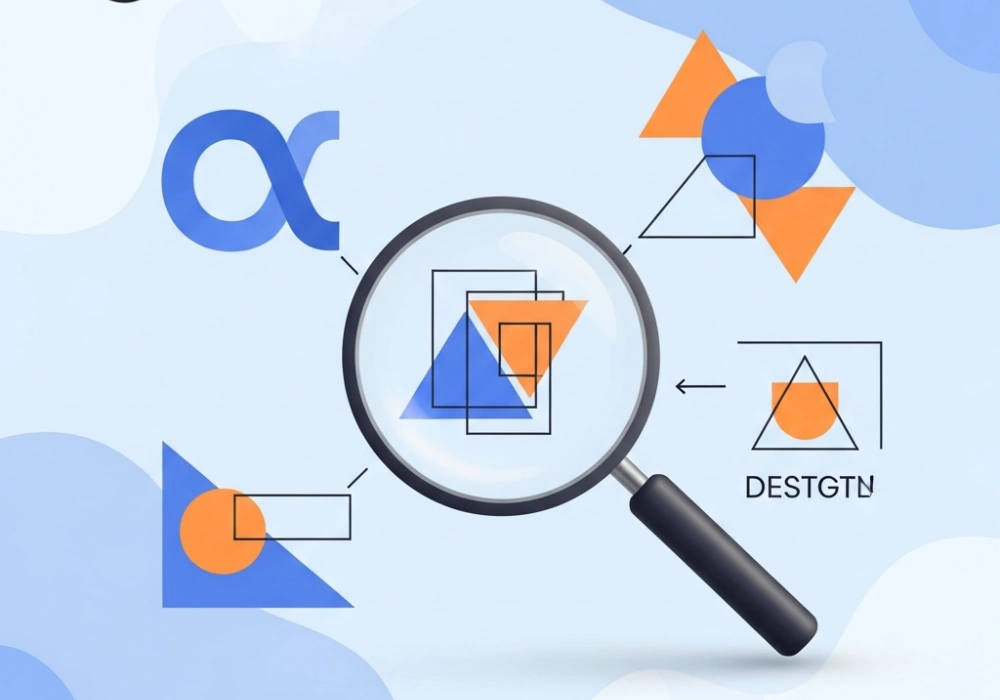
The Ultimate Decoder: Gestalt Principles in Logo Design
Welcome, future designers! If you are aiming for the National Institute of Design (NID), you already know that the Design Aptitude Test (DAT) is not just about drawing; it is about visual intelligence. One of the most recurring themes in NID DAT Previous Year Questions is the application of Gestalt Principles in logos and symbols. This topic is the ‘bread and butter’ of the visual perception section.
Gestalt, a German word meaning ‘form’ or ‘shape’, refers to a theory of mind developed by Berlin psychologists in the 1920s. The core idea is simple: ‘The whole is other than the sum of its parts.’ When you look at a logo, your brain does not see individual lines and dots first; it sees a unified whole. NID examiners love testing whether you can reverse-engineer this process. In this guide, we will break down five high-yield simulated questions based on trends from Previous Year Questions to help you master these visual tricks.
💡 Pro-Tip: Why NID asks this?
Designers must communicate complex ideas through simple forms. By testing Gestalt principles, NID evaluates your ability to perceive hierarchy, balance, and hidden meanings—essential skills for any branding or communication designer.
1. The Power of Closure: Identifying Hidden Shapes
Scenario: You are presented with a symbol consisting of four separate, curved black shapes arranged in a circular formation. The shapes do not touch, but they seem to outline the silhouette of a panda. Which Gestalt principle is primarily responsible for the viewer perceiving the animal?
Traditional Method
A student might look at the gaps and try to measure the distance between the arcs. They might analyze the symmetry of the black fragments or look for the ‘outline’ of the panda. This involves a slow, analytical breakdown of every white space and black curve, wasting precious minutes during the exam.
30-Second Ninja Shortcut
Look for incomplete paths. If your brain is ‘filling in the blanks’ to complete a familiar shape (like the panda or a circle), it is 100% the Law of Closure. Your brain hates incomplete information and will automatically bridge the gaps to create a meaningful whole. Whenever you see a ‘disjointed’ logo that feels ‘whole’, Closure is your answer.
💡 Hidden Answer & Concept
Answer: Law of Closure. The core concept is that humans perceive objects such as shapes, letters, and pictures as being whole when they are not complete. In NID DAT Previous Year Questions, this is often seen in marks that use white space to define the interior of a subject.
2. Figure-Ground Relationship: The ‘Negative Space’ Trick
Scenario: A famous logistics logo features the letters ‘E’ and ‘x’. Between the ‘E’ and the ‘x’, an arrow is clearly visible in the white space. What is the name of the principle where the background becomes a meaningful element?
Traditional Method
The student spends time trying to read the typography first, then the colors, and then finally notices the arrow. They might confuse this with ‘Continuity’ because the arrow points forward. This leads to indecision between two principles.
30-Second Ninja Shortcut
Focus on the ‘Flip-Flop’ effect. If the background (white) is just as important as the foreground (colored letters), you are looking at Figure-Ground. Ask yourself: ‘Can I see two different things depending on what I focus on?’ If yes, it is Figure-Ground. In design exams, whenever white space creates a new shape, choose Figure-Ground.
💡 Hidden Answer & Concept
Answer: Figure-Ground. This principle refers to the eye’s ability to separate varying levels of focus. We perceive an object (figure) against a background (ground). Clever designers like those featured in Previous Year Questions use this to hide secondary meanings in plain sight.
3. Law of Continuity: Guiding the Eye
Scenario: A logo for a digital streaming platform consists of a series of dots that gradually decrease in size and form a curved line leading towards a ‘Play’ button. Which principle ensures the eye follows this specific path?
Traditional Method
Analyzing each dot individually as a separate element. The student might think it is ‘Proximity’ because the dots are close together. However, Proximity only explains grouping, not the *flow* or *direction* of the vision.
30-Second Ninja Shortcut
Look for the ‘Visual Slide’. If your eye is being ‘pushed’ or ‘pulled’ along a specific path (straight or curved), it is the Law of Continuity. Elements arranged in a line or curve are perceived as more related than elements not on the line. If there is a sense of movement or directionality, Continuity is the winner.
💡 Hidden Answer & Concept
Answer: Continuity. This principle states that the human eye follows the smoothest path when looking at lines, regardless of how the lines were actually drawn. This is vital in NID DAT Previous Year Questions for questions involving logos that imply speed or progress.
4. Similarity and Proximity: The ‘Group Effort’
Scenario: An multinational conglomerate’s logo is composed of 25 small, distinct icons (like a bee, a hand, a leaf) arranged tightly together to form the shape of a large capital letter ‘U’. Which two Gestalt principles work together here?
Traditional Method
Over-analyzing the meaning of each individual icon (the bee means nature, the hand means service). While this is good for design theory, for the identification question, it is a distraction. You might miss the grouping principle while focused on the icons.
30-Second Ninja Shortcut
Ask: ‘What makes them a group?’ If they are grouped because they are close together, it is Proximity. If they are grouped because they look similar (even if they are different icons, they have the same color/style), it is Similarity. In this specific ‘U’ logo, the tightness of the arrangement makes them a single unit. That is Proximity.
💡 Hidden Answer & Concept
Answer: Proximity and Similarity. Proximity occurs when elements are placed close together; they tend to be perceived as a group. Similarity occurs when items look alike. NID often mixes these to test if you can distinguish between ‘closeness’ and ‘appearance’.
5. Law of Common Fate: Synchronized Movement
Scenario: A sports brand logo features three slanted parallel lines that appear to be ‘racing’ towards the right. Even though they are separate bars, they feel like a single unit of action. This is an example of?
Traditional Method
Confusing this with ‘Parallelism’ or simple ‘Similarity’. While they are similar in shape, the key here is the *implied motion* in a specific direction.
30-Second Ninja Shortcut
Look for ‘Birds of a feather’. If things are moving (or pointing) in the same direction, they have a ‘Common Fate’. Think of a flock of birds flying—they are individual units, but because they move together, we see them as one ‘V’ shape. In NID DAT Previous Year Questions, any logo with ‘speed lines’ or directional arrows uses Common Fate.
💡 Hidden Answer & Concept
Answer: Common Fate. This principle states that objects are perceived as lines that move along the smoothest path. Elements that move in the same direction are perceived as more related than elements that are stationary or move in different directions.
Cheat Sheet: Quick Revision for NID DAT
Memorize this table to quickly distinguish between principles during the exam pressure.
| Principle | Visual Cue | Ninja Keyword |
|---|---|---|
| Closure | Gaps in a shape that the brain fills | Filling Blanks |
| Figure-Ground | Negative space forming an image | Hidden Image |
| Continuity | Lines or dots leading the eye | The Eye-Trail |
| Similarity | Elements that look the same | Matching Looks |
| Proximity | Elements placed close together | Closeness |
| Common Fate | Elements moving in one direction | Directional Flow |
Final Strategy for Logo Identification
When you encounter a logo question in NID DAT, do not panic. Follow this three-step process:
- Squint your eyes: This blurs the details and helps you see the primary ‘Gestalt’ or form first.
- Identify the ‘Primary’ vs ‘Secondary’ shape: Is there a hidden arrow? That is Figure-Ground. Is it a circle made of squares? That is Closure.
- Eliminate the distractors: Most students fail by picking ‘Symmetry’ for everything. Remember, Symmetry is a principle, but it is rarely the core ‘trick’ of a modern logo.
By practicing with Previous Year Questions, you will begin to notice that NID has a pattern. They love logos that reward the viewer for looking twice. Mastering Gestalt is about training your brain to see that ‘second look’ immediately.
Ready to Ace your NID DAT Prep?
Don’t let tricky visual perception questions hold you back. Get personalized guidance, more solved Previous Year Questions, and exclusive mock tests today!
💬 Chat with our Experts on WhatsApp (+91 9526806124)




