
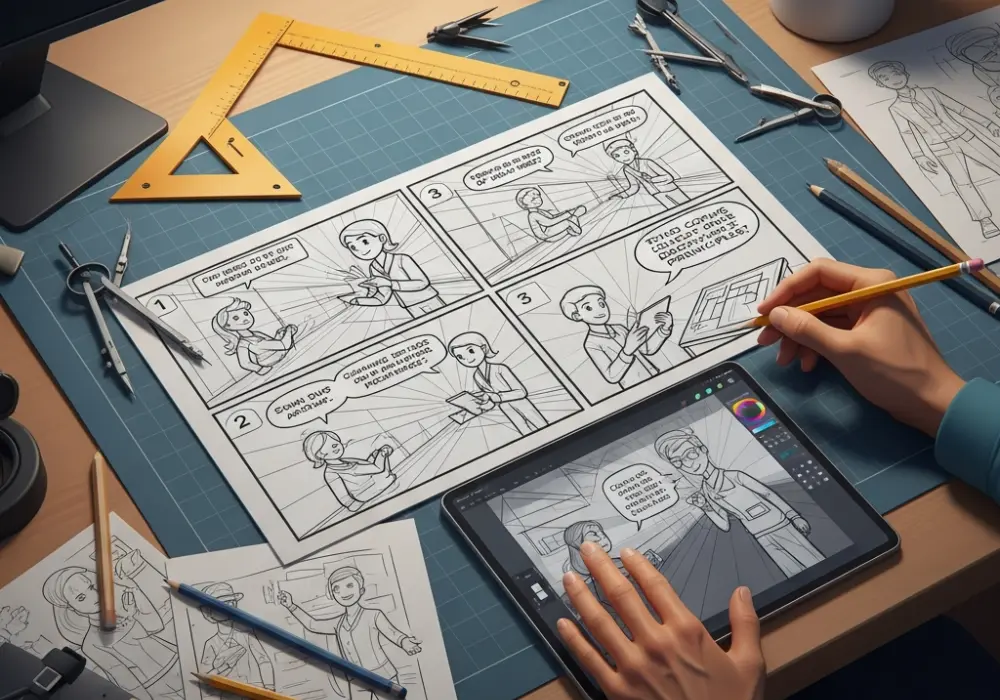
NID DAT Previous Year Questions Decoder: Mastering the Art of 4-Frame Visual Narratives
Welcome to the ultimate guide for conquering one of the most challenging and high-weightage sections of the National Institute of Design (NID) Design Aptitude Test (DAT). If you are aiming for a seat in one of India’s premier design institutes, you already know that storytelling isn’t just about drawing well—it is about visual communication. The four-frame narrative question is a staple in the examination, testing your ability to maintain character continuity, handle complex perspective shifts, and deliver a logical climax within a strictly limited space.
Theoretical Foundations of Sequential Narrative
Before we dive into the simulated questions based on Previous Year Questions, we must understand why NID examiners love this format. Sequential art is the grammar of design. It requires a student to demonstrate spatial reasoning, empathy (through character emotions), and temporal logic (the passage of time). Perspective in these frames acts as the ‘camera lens,’ and character continuity acts as the ‘anchor’ that keeps the viewer engaged without confusion.
A common pitfall is ‘static storytelling,’ where all frames look identical except for a minor hand movement. To score high, you must utilize Dynamic Framing: shifting from a wide shot to a close-up, or moving the horizon line to change the viewer’s emotional response. Let’s break down how to handle these challenges through our expert analysis.
Detailed Breakdown of Simulated Questions
Question 1: The Mechanical Transformation
The Task: Illustrate a scenario where a child’s paper boat transforms into a giant steamship as it travels down a rainwater puddle. Show the transition in four frames.
The Traditional Method
Most students spend 15 minutes meticulously drawing the textures of the water and the folds of the paper boat. By the third frame, they realize the ship doesn’t fit the box, and in the fourth frame, the child is missing or looks like a different person entirely. The perspective stays flat, usually a side profile, making the story feel like a 2D side-scroller game.
The 30-Second Ninja Shortcut
The ‘Scale-Shift’ Strategy: Use a fixed ‘Reference Object’ in all four frames—in this case, the edge of the puddle or a nearby leaf. Frame 1: High-angle shot (looking down) showing the small boat. Frame 2: Eye-level shot, the boat begins to glow or expand. Frame 3: Low-angle shot (worm’s eye view) where the ship looms large over the frame. Frame 4: Extreme long shot showing the massive ship sailing out of a now-oceanic puddle. By changing the camera angle from high to low, you subconsciously signal ‘growth’ and ‘power’ to the examiner.
Question 2: Character Continuity in Motion
The Task: A character wearing a striped t-shirt and a cap is trying to catch a bus. In the third frame, the character trips, and in the fourth, they miss the bus but find something interesting on the ground.
The Traditional Method
Students often forget the stripes on the t-shirt by frame three or change the cap’s color. They focus so much on the action of ‘tripping’ that the character’s facial features change drastically, making it look like a different person is falling. This is a fatal error in character continuity.
The 30-Second Ninja Shortcut
The ‘Key Feature Anchor’ Technique: Identify three non-negotiable features: the stripes, the cap, and perhaps a specific hair tuft. Even if you draw the character as a silhouette in Frame 3 to show motion, keep the cap flying off in the same direction. Use ‘Motion Lines’ to indicate speed rather than drawing every muscle. In Frame 4, bring the focus back to the character’s face with a close-up, ensuring the nose shape and cap (now on the ground) remain consistent.
Question 3: The Perspective of the Inanimate
The Task: Show the journey of a key being dropped from a balcony and eventually being found by a stray cat in four frames.
The Traditional Method
Drawing the balcony, then the air, then the ground, and then the cat. The ‘camera’ stays at the same distance, making the key look like a tiny, insignificant dot that is hard to track. The narrative lacks impact because we don’t feel the ‘fall’.
The 30-Second Ninja Shortcut
The ‘Point-of-View (POV) Flip’: Frame 1: View from the balcony looking down (the key is in the foreground, large). Frame 2: Mid-air shot, looking up at the balcony getting smaller. Frame 3: Impact frame—extreme close-up of the key hitting the dust, sending up a small cloud. Frame 4: Over-the-shoulder shot from the cat’s perspective looking at the key. This shift in perspective makes the inanimate object the ‘hero’ of the story.
Question 4: Complex Environmental Interaction
The Task: An elderly person is trying to open a jammed jar of pickles. The fourth frame should show a surprising result.
The Traditional Method
Drawing the person sitting at a table in all four frames. The struggle is shown only through ‘sweat drops.’ The background remains static, and the storytelling feels sluggish.
The 30-Second Ninja Shortcut
The ‘Zoom-In/Zoom-Out’ Rhythm: Frame 1: Medium shot (person holding the jar). Frame 2: Close-up of the hands, showing the strain (veins popping, tight grip). Frame 3: Extreme close-up of the jar lid finally cracking or the glass shattering. Frame 4: Wide shot showing the pickle juice everywhere, but the person happily eating a single pickle. Changing the ‘zoom’ level keeps the examiner’s eye moving and emphasizes the physical effort.
Question 5: Abstract Narrative Translation
The Task: Visualize the concept of ‘Envy’ using a person and a mirror in four frames.
The Traditional Method
Drawing a person looking in a mirror and frowning. Frame 2: They look again. Frame 3: They look again. It’s repetitive and fails to capture the ‘concept.’ NID Previous Year Questions often use abstract prompts to test your lateral thinking.
The 30-Second Ninja Shortcut
The ‘Metaphorical Continuity’ Hack: Use color or texture as your continuity tool. Frame 1: A person looks at their reflection, which looks vibrant. Frame 2: The person starts ‘clawing’ at the reflection’s clothes. Frame 3: The reflection turns gray and ‘cracks’ while the person starts turning a sickly green. Frame 4: The person is now inside the mirror, looking out at their original self. This uses the ‘Space’ of the mirror to tell a story of replacement and jealousy, going beyond a literal interpretation.
Cheat Sheet: Quick Revision Formulas
| Narrative Element | The Gold Standard Rule | Expert Tip |
|---|---|---|
| Character Consistency | Maintain 3 core visual ‘tags’ (e.g., glasses, scarf, hair). | Draw a quick 5-second thumbnail ‘model sheet’ on your rough work margin. |
| Perspective | Never use the same horizon line for more than 2 frames. | Use ‘Worm’s Eye’ for climax and ‘Bird’s Eye’ for establishing the scene. |
| Flow | Follow the ‘Z-pattern’ of eye movement (Top Left to Bottom Right). | Ensure the action in Frame 1 leads the eye toward the boundary of Frame 2. |
| Climax | The 4th frame must provide a ‘Payoff’ or a twist. | Contrast the 4th frame’s composition drastically from the first 3. |
- Rule of Thirds: Place your main character on the imaginary vertical lines of the frame for a professional look.
- Tangent Avoidance: Ensure lines don’t awkwardly touch the frame edges, which creates visual ‘static.’
- Temporal Gap: Each ‘gutter’ (space between frames) should represent a specific jump in time. Keep these jumps consistent.
Conclusion
Mastering the four-frame narrative for the NID DAT requires a blend of technical drawing skills and cinematic thinking. By analyzing these simulated questions based on Previous Year Questions, you can see that the difference between an average and an exceptional score lies in perspective choices and character stability. Practice these shortcuts, keep your characters consistent, and don’t be afraid to move the ‘camera’ around!
Struggling with your NID Portfolio or Design Sketches?
Our mentors are here to help you crack the NID DAT with personalized feedback and exclusive mock tests!
💬 Chat with our Experts on WhatsApp (+91 9526806124)




