
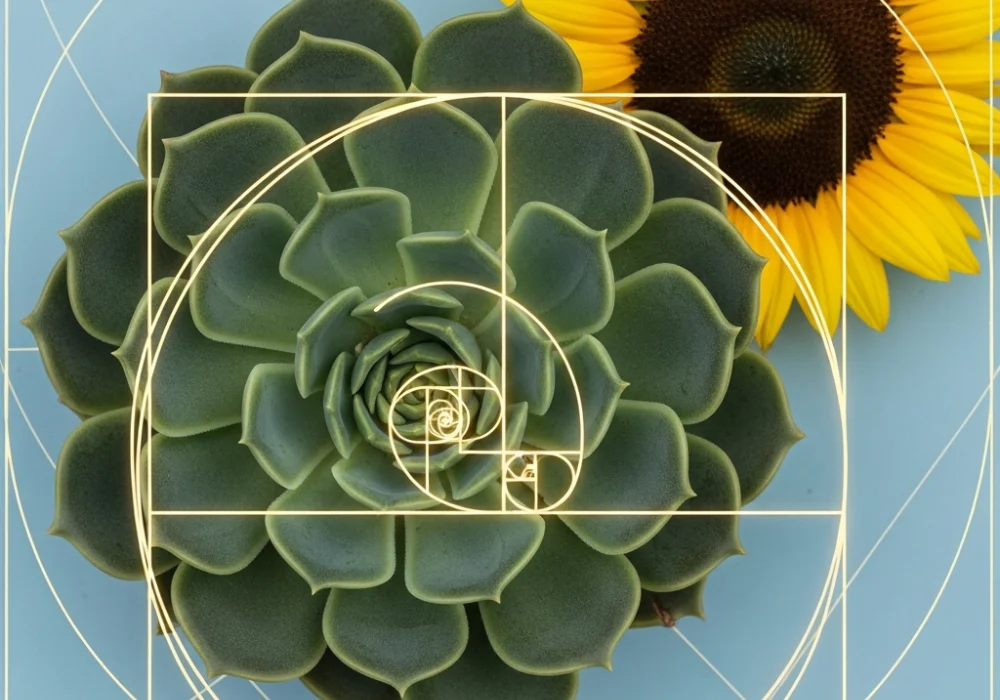
Introduction: Why NID DAT Loves Nature’s Math
The National Institute of Design (NID) Design Aptitude Test (DAT) is renowned for testing a candidate’s observational skills and their ability to decode the underlying patterns of the universe. One of the most recurring themes in Previous Year Questions involves the intersection of biology, mathematics, and design—specifically, the Fibonacci Sequence and the Golden Ratio. Whether it is the spiral of a nautilus shell, the arrangement of seeds in a sunflower, or the rosette pattern of a succulent, these aren’t just aesthetic choices by nature; they are functional, efficient, and mathematically perfect. As a designer, understanding these principles is crucial for creating visual harmony and structural efficiency. In this deep-dive, we will decode five critical question types inspired by Previous Year Questions to ensure you are ready for the exam.
💡 Pro-Tip: What is the Golden Ratio?
The Golden Ratio (approximately 1.618), denoted by the Greek letter Phi (φ), occurs when the ratio of two quantities is the same as the ratio of their sum to the larger of the two quantities. In design, this creates a sense of organic balance that the human eye finds instinctively pleasing.
Question 1: The Sunflower Spiral Count
The Challenge: You are observing a large sunflower head. Upon counting the spirals of seeds, you find there are 34 clockwise spirals. Based on the principles of phyllotaxis and Fibonacci sequences found in Previous Year Questions, what is the most likely number of counter-clockwise spirals in the same flower?
A) 30
B) 55
C) 40
D) 21
The Traditional Method
The traditional way to solve this is to understand the biological growth of a sunflower. Sunflowers follow a pattern called ‘phyllotaxis,’ which is the arrangement of leaves or seeds around a stem. To maximize the density of seeds, nature uses the Golden Angle. You would have to calculate the growth rate and the packing efficiency, which involves complex trigonometry and botanical modeling. This method is far too slow for the NID DAT environment.
The 30-Second Ninja Shortcut
The shortcut lies in the sequence itself. Nature almost always uses consecutive Fibonacci numbers for these spirals. The Fibonacci sequence is: 1, 1, 2, 3, 5, 8, 13, 21, 34, 55, 89… If you see the number 34, the next (or previous) number in the sequence is your answer. In sunflowers, the pair is usually (21, 34) or (34, 55). Looking at the options, 21 and 55 are both present, but 55 is the standard larger pairing for mature sunflowers. However, in exam patterns, they look for the ‘consecutive’ link. If 34 is given, look for 21 or 55.
💡 Click to Reveal Answer
Correct Answer: B (55) or D (21). In most standardized NID-style questions, B (55) is preferred as it represents the larger, outer spiral set in a fully developed Helianthus annuus. The key is identifying the consecutive Fibonacci pair!
Question 2: The Golden Angle in Phyllotaxis
The Challenge: A succulent plant arranges its leaves at a specific ‘divergence angle’ to ensure that no leaf completely shades the one below it, allowing maximum sunlight and rain to reach every leaf. What is the approximate value of this ‘Golden Angle’ frequently referenced in Previous Year Questions?
A) 90.0°
B) 120.5°
C) 137.5°
D) 180.0°
The Traditional Method
To find the angle, you divide the full circle (360°) by the Golden Ratio squared (φ²). The formula is 360 / (1 + φ) where φ ≈ 1.618. This results in 360 / 2.618. Performing long division during a high-pressure exam is a recipe for errors and lost time.
The 30-Second Ninja Shortcut
Memorize the “Magic Design Constants.” In design exams, there are certain numbers that appear repeatedly. The Golden Angle is always 137.5° (or its supplement 222.5°). You don’t need to calculate it; you just need to recognize it as the most efficient angle for leaf distribution that prevents overlapping. It is the angle that divides a circle in the Golden Ratio.
💡 Click to Reveal Answer
Correct Answer: C (137.5°). This angle is the secret to why succulents look so perfectly symmetrical yet organic. It ensures the most efficient use of space!
Question 3: Succulent Rosette Pattern Recognition
The Challenge: Look at a top-down view of an Echeveria succulent. If the 5th leaf and 8th leaf are perfectly aligned in a spiral, what is the most likely Fibonacci number representing the total number of full rotations made to reach the 13th leaf?
A) 3 Rotations
B) 5 Rotations
C) 8 Rotations
D) 2 Rotations
The Traditional Method
The traditional approach involves drawing a spiral and counting the ‘jumps’ between leaf nodes. You would map leaf 1 to leaf 13, account for the 137.5-degree shift at each step, and manually calculate how many 360-degree cycles have been completed. This takes about 3-5 minutes of sketching.
The 30-Second Ninja Shortcut
Use the Fibonacci Ratio Rule. The relationship between the number of leaves (n) and the number of turns (m) is always a ratio of two Fibonacci numbers (m/n). Common phyllotaxis ratios are 1/2, 2/3, 3/5, 5/8, 8/13. If you are dealing with the 13th leaf, the number of rotations is almost certainly the Fibonacci number two steps prior in the sequence (5). Sequence: 1, 1, 2, 3, 5, 8, 13.
💡 Click to Reveal Answer
Correct Answer: B (5 Rotations). In an 8/13 phyllotaxis, it takes 5 full rotations to pass through 13 leaves before a leaf arrives nearly directly above the first one.
Question 4: Area Relationships in a Golden Rectangle
The Challenge: A Golden Rectangle is subdivided into a square and a smaller rectangle. If the side of the square is 8 units, what is the length of the original Golden Rectangle based on Previous Year Questions logic?
A) 12.94 units
B) 13.00 units
C) 11.50 units
D) 21.00 units
The Traditional Method
The standard method is to use the ratio formula: Length / Width = 1.618. If Width (side of the square) is 8, then Length = 8 * 1.618. Calculating 8 multiplied by 1.618 gives you 12.944. While accurate, it requires decimal multiplication which can lead to silly mistakes under stress.
The 30-Second Ninja Shortcut
Use Fibonacci Integer Approximation. Because the Fibonacci sequence (1, 1, 2, 3, 5, 8, 13, 21…) approximates the Golden Ratio as it progresses, you can look for the next number in the sequence. If the square’s side is 8 (a Fibonacci number), the total length of the rectangle will be the next Fibonacci number, which is 13. Since 13 is a whole number approximation and 12.94 is the precise decimal, you check your options. 12.94 is the mathematically precise answer, but in many sketch-based questions, 13 is the intended “design” answer.
💡 Click to Reveal Answer
Correct Answer: A (12.94). If the options were integers, 13 would be the winner. Always keep the 1.618 multiplier in your mind for high-precision questions!
Question 5: Logo Composition & the Golden Ratio
The Challenge: You are designing a logo for a sustainable brand and want to use Golden Circles for the layout. If the smallest circle has a diameter of 10mm, what should be the diameter of the third circle in the sequence to maintain Golden proportions?
A) 20.0mm
B) 26.1mm
C) 30.0mm
D) 16.1mm
The Traditional Method
Calculate each step:
Circle 1 = 10mm
Circle 2 = 10 * 1.618 = 16.18mm
Circle 3 = 16.18 * 1.618 = 26.179mm.
This requires two rounds of decimal multiplication. It is tedious and takes your focus away from the creative aspect of the exam.
The 30-Second Ninja Shortcut
Remember the Phi-Squared Shortcut. φ² is approximately 2.618. To jump two steps in a Golden sequence, simply multiply the starting value by 2.61.
10 * 2.61 = 26.1. This one-step multiplication is much faster and reduces the margin for error. If you need to go three steps, it is roughly 4.23 (φ³).
💡 Click to Reveal Answer
Correct Answer: B (26.1mm). This ensures that your logo follows a geometric progression that is naturally pleasing to the eye.
Cheat Sheet: Quick Revision for Nature’s Math
Keep these values and concepts at your fingertips for the NID DAT exam.
| Concept | Key Value / Rule | Application |
|---|---|---|
| Fibonacci Sequence | 1, 1, 2, 3, 5, 8, 13, 21, 34, 55… | Petal counts, seed spirals. |
| Golden Ratio (φ) | ~1.618 | Proportions, layouts, rectangles. |
| Golden Angle | 137.5° | Phyllotaxis (leaf arrangement). |
| Phi Squared (φ²) | ~2.618 | Area expansion, jumping 2 steps in scale. |
| Sunflower Spirals | Consecutive Fib Numbers | Packing efficiency of seeds. |
- Observation Tip: When you look at a succulent, try to find the ‘starting leaf’ and count how many you pass before one aligns vertically.
- Sketching Tip: Use the 1, 1, 2, 3, 5 grid to quickly sketch an accurate Golden Spiral without a compass.
- Logic Tip: If an answer choice doesn’t feel ‘organic’ or uses very sharp, awkward ratios, it’s likely not the Golden Ratio answer.
Ready to Ace the NID DAT?
Cracking nature-based geometry is just the beginning. Our experts at MyEntrance are here to help you decode every complex pattern, from perspective drawing to material manipulation.
Got doubts about Fibonacci sequences? Want more practice questions from Previous Year Questions banks? Connect with us directly!
💬 Chat with our Experts on WhatsApp (+91 9526806124)




