
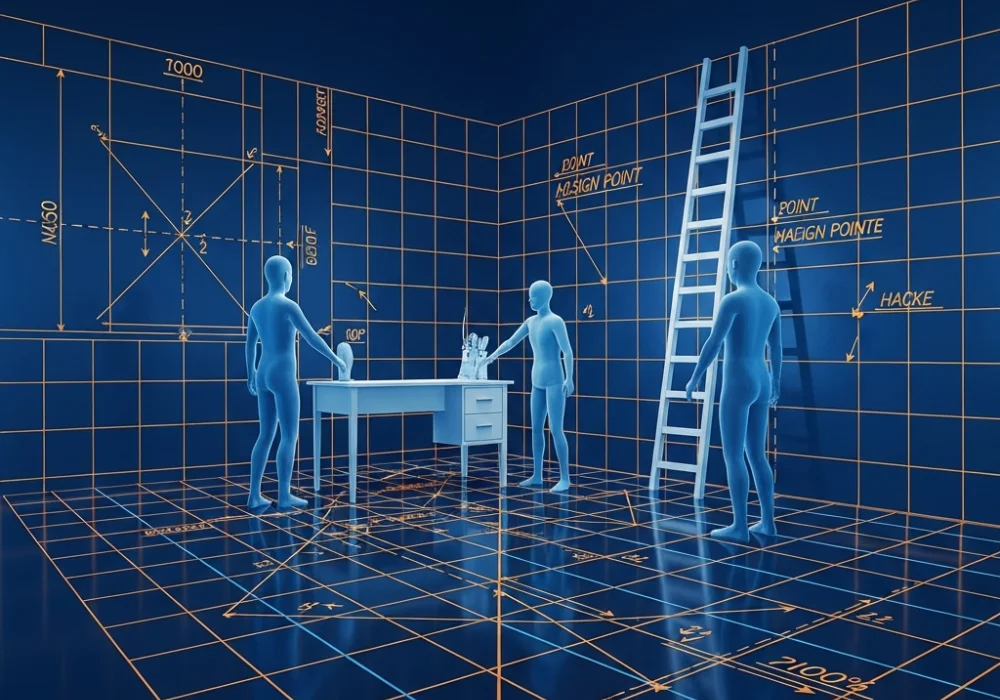
Unlocking the NID DAT: The Ultimate Anthropometry and Perspective Masterclass
For any aspirant aiming to crack the National Institute of Design (NID) Design Aptitude Test (DAT), the ability to visualize human interaction with the environment is the holy grail of drawing skills. One of the most recurring and challenging themes found in Previous Year Questions involves the complex intersection of anthropometry (the study of human body measurements) and three-point perspective. This requires not just artistic flair, but a mathematical understanding of space and a deep awareness of ergonomic standards. In this guide, we will decode the complexities of drawing human figures interacting with complex furniture from extreme angles.
What is Anthropometry in Design?
Anthropometry is the study of human body proportions, measurements, and movements. In NID DAT, examiners are not looking for a beautiful face; they are looking for functional realism. They want to see if you understand that a standard chair height is roughly 450mm, or that an average adult reaching upward has a specific range of motion. When you combine this with three-point perspective—where vertical lines converge to a third vanishing point—the difficulty level spikes. You are no longer just drawing a person; you are drawing a person within a distorted, dynamic spatial grid.
The Science of Three-Point Perspective
Unlike one-point or two-point perspective, three-point perspective introduces a third vanishing point either high above the horizon (Worm’s Eye View) or deep below it (Bird’s Eye View). This perspective is essential for creating drama and scale. In Previous Year Questions, this technique is used to test your ability to maintain human proportions while the body is being ‘stretched’ or ‘compressed’ by the rules of perspective. To master this, you must learn to build your human figures inside ‘bounding boxes’ that follow the perspective grid lines.
Detailed Breakdown of 5 Simulated Previous Year Questions
Question 1: The High-Shelf Library Interaction
Scenario: Draw a scene from a low angle (Worm’s Eye View) where a librarian is standing on a tall, modular rolling ladder, reaching for a heavy book on the top shelf of a massive bookshelf that spans the height of the room.
Traditional Method: Most students start by drawing the ladder, then try to ‘stick’ a person on it. They draw the bookshelf as a flat grid and then add perspective lines. This often leads to the person looking like they are floating or the ladder looking structurally unstable. The proportion of the librarian’s legs often looks too short compared to the reaching arms because the vertical convergence is ignored.
30-Second Ninja Shortcut: The ‘Vertical V-Grid’ Hack. Instead of drawing the ladder first, draw three vertical lines that converge at a point 30cm above your paper. These are your ‘gravity lines.’ Sketch the Librarian as a series of three boxes: the pelvis, the ribcage, and the head. Align the center of these boxes along one of the ‘gravity lines.’ This ensures the figure is balanced. For the ladder, draw two converging lines for the side rails first, and use the Librarian’s height as a ruler: the ladder steps should be roughly at the Librarian’s knee, hip, and shoulder levels. This ‘human-first’ approach ensures the furniture fits the person, not the other way around.
Question 2: The Under-Desk Repairman
Scenario: From a high-angle (Bird’s Eye View), draw a technician lying on a creeper (a flat wheeled board) sliding under a complex industrial workstation filled with monitors and hanging wires.
Traditional Method: Students usually draw the table top first and then struggle to fit the body underneath. The legs often end up poking out at weird angles that don’t match the floor plane. The foreshortening of the person’s body as it recedes into the distance is usually missed, making the person look too long.
30-Second Ninja Shortcut: The ‘Ground-Plane Box’ Strategy. Draw a large rectangle on the floor in three-point perspective where the technician will lie. Divide this rectangle into 8 equal parts (representing the 8-head height of a human). Place the head in the first section and the feet in the eighth. Now, build the ‘legs’ of the workstation around this rectangle. By defining the ‘floor space’ of the human body first, you guarantee that the technician actually fits under the furniture. The monitors above should follow the same vanishing points, creating a cohesive, compressed space.
Question 3: The Futuristic Sofa Huddle
Scenario: Draw three children of different ages playing on a complex, multi-level modular sofa system. Use a dynamic three-point perspective that emphasizes the height of the sofa modules.
Traditional Method: Drawing three different people is hard enough, but placing them on different levels of furniture often leads to scale errors. Often, the child on the higher module looks larger than the child on the lower module, which contradicts the rules of perspective.
30-Second Ninja Shortcut: The ‘Reference Pillar’ Technique. Draw a single vertical pillar at the front of your scene and mark the heights of a toddler (approx 90cm), a young child (120cm), and an adult (170cm) on it according to your perspective grid. Use these marks as a ‘scale key.’ Slide these measurements across your perspective lines to wherever you place a child. This ensures that even if one child is sitting and another is standing, their relative volumes are anthropometrically correct. For the sofa, think of it as ‘Lego blocks’ stacked according to these same height markers.
Question 4: The Hospital Bed Emergency
Scenario: A doctor is leaning over a patient in a complex, tilted hospital bed with various medical monitors and arm-rests. View this from a sharp corner angle (Three-point perspective looking down).
Traditional Method: Students get lost in the details of the medical equipment. They draw the bed as a simple box, failing to realize that a hospital bed has articulated joints. The doctor’s leaning posture usually looks stiff and the interaction with the patient lacks the ‘weight’ of the lean.
30-Second Ninja Shortcut: The ‘Action Line & Pivot’ Method. Draw the main ‘spine’ of the bed as a bent line following the three-point grid. Before drawing the doctor, draw a ‘weight vector’ line from the doctor’s shoulder to the bed surface. This represents the force of the lean. Build the doctor’s torso around this diagonal line. For the monitors, use the ‘Overlap Hack’: place the monitors slightly in front of or behind the doctor to create depth. Remember, the bed’s width should be roughly 900mm—use the doctor’s shoulder width (approx 450mm) as a 2:1 ratio guide.
Question 5: The Chef and the Rolling Oven
Scenario: A chef is pulling a heavy tray out of a tall industrial oven while stepping back. A rolling prep table is positioned nearby. Use a low-angle perspective to make the oven look imposing.
Traditional Method: The ‘stepping back’ motion is the hardest part. Usually, the feet look like they are on different planes, and the tray doesn’t look like it’s coming out of the oven. The oven often looks like a flat wardrobe rather than a deep, functional machine.
30-Second Ninja Shortcut: The ‘Footprint and Projection’ Hack. Mark two ‘X’ spots on the floor for the chef’s feet in perspective. Draw the chef’s body as a ‘C’ curve to show the tension of pulling the weight. To draw the tray, project two lines directly from the oven’s internal tracks toward the chef’s hands. This ‘projection’ ensures the tray is perfectly aligned with the furniture. Use the ‘3-point tilt’ to make the top of the oven narrower than the base, which adds to the sense of height and drama.
Cheat Sheet & Quick Revision Formulas
| Feature | Standard Anthropometric Measurement | 3-Point Perspective Rule |
|---|---|---|
| Standard Chair Height | 450mm (Approx. 1/4th of adult height) | Must converge to the side vanishing points. |
| Average Adult Height | 1700mm – 1800mm (7.5 to 8 heads) | Subject to vertical foreshortening (converging to V3). |
| Desk/Table Height | 750mm (Mid-thigh to waist level) | Always relative to the seated figure’s pelvis. |
| Arm Span | Equal to height | Decreases as it recedes towards any vanishing point. |
| Eye Level | Standing: 1600mm | Sitting: 1200mm | Determines if you see the top or bottom of furniture. |
Quick Tips for Success:
- The 8-Head Rule: Always divide your human figure into 8 equal parts to maintain proportion, even when the perspective makes the ‘head’ units smaller as they move away.
- The Center of Gravity: In any interaction (sitting, leaning, reaching), draw a vertical line from the pit of the neck to the floor. If this line falls outside the ‘base of support’ (the furniture or feet), the figure will look like it is falling.
- Vanishing Points (VP): In 3-point perspective, keep your third VP far away from the center of the page to avoid ‘extreme fish-eye’ distortion which can look amateurish.
- Shadows: Use the perspective grid to cast shadows. A human figure interacting with furniture must cast a shadow *onto* that furniture to look grounded.
Mastering these Previous Year Questions requires practice and a systematic approach. Don’t just draw; analyze the geometry of the human body and the furniture. By using the ‘Ninja Shortcuts’ provided above, you can save precious minutes during the NID DAT and produce a sketch that is both technically superior and visually compelling.
🚀 Ready to Ace your NID DAT?
Struggling with perspective or need personalized feedback on your sketches? Our design experts are here to help you navigate your preparation with free guidance, mock tests, and detailed critiques!
💬 Chat with our Experts on WhatsApp (+91 9526806124)




