
NID DAT Previous Year Questions: Mastering User-Centric Redesign Tricks
Welcome, future designers! If you are aiming for a seat at the National Institute of Design, you must master the intersection of form, function, and empathy. One of the most recurring themes in the Design Aptitude Test involves the redesign of tools for specific user groups, particularly rural artisans. These questions test your ability to observe a problem, understand ergonomic constraints, and propose a solution that is both culturally relevant and economically viable.
In this guide, we will decode five simulated yet highly realistic questions modeled after Previous Year Questions. We will move beyond basic sketching and dive into the ‘Ninja’ strategies that separate the average candidate from the top ranker. Remember, NID doesn’t just look for a pretty drawing; they look for a solution that works.
The Core Pillars of Rural Tool Redesign
Before we jump into the questions, you must understand the three pillars often evaluated in Previous Year Questions:
- Ergonomics & Anthropometry: How does the tool fit the human hand? Is it causing musculoskeletal strain?
- Materiality: Can this be made from bamboo, reclaimed wood, or recycled metal? Rural contexts demand low-cost, locally available resources.
- Visual Language (Form): Does the tool look like it belongs in a village workshop, or does it look like a high-tech kitchen gadget? The ‘form’ must communicate its purpose clearly.
💡 Click to Reveal the Secret Design Vocabulary
When writing your design justification, use terms like ‘Neutral Wrist Posture’, ‘Friction Grip’, ‘Mechanical Advantage’, and ‘Contextual Affordance’. Evaluators love these professional keywords!
Question 1: The Ergonomic Sickle Redesign
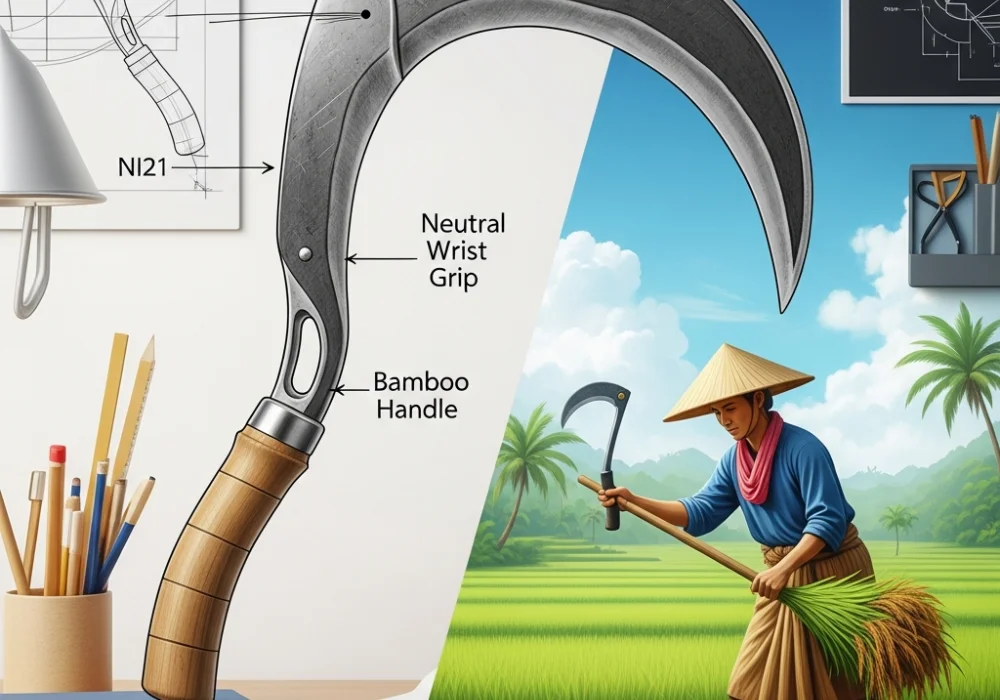
The Task: Redesign a traditional sickle used by rural women for harvesting paddy. The current tool causes repetitive strain injury in the wrist and lower back. Your design must be low-cost and ergonomic.
The Traditional Method (The Average Response)
Most students will draw a standard sickle with a slightly thicker handle and perhaps a colorful grip. They might mention using ‘better metal’. This approach fails because it doesn’t solve the posture problem—the user still has to bend at an awkward angle.
The 30-Second Ninja Shortcut: The “Angle of Attack” Rule
Instead of just changing the handle, change the axis of the blade. By tilting the blade at a 15-degree offset to the handle, you allow the wrist to remain in a ‘neutral’ position (like shaking hands) rather than bending it sideways. Add a ‘thumb-rest’ on the handle for better leverage.
Deep Concept: Neutral Posture. Any tool that requires a ‘deviated’ wrist will cause long-term pain. Your redesign should bring the tool to the hand, not force the hand to adapt to the tool.
💡 Pro-Tip for Sketching
Always draw a ‘Ghost Hand’ around your tool to show exactly how it is held. This proves to the examiner that you understand scale and grip.
Question 2: The Potter’s Manual Kick-Wheel
The Task: Rural potters often suffer from chronic back pain due to the lack of lumbar support and the constant repetitive kicking motion. Redesign the interface of a manual potter’s wheel for better efficiency and comfort.
The Traditional Method (The Average Response)
Adding a cushioned stool or a motor. While a motor is efficient, it might not be ‘low-cost’ or feasible in areas with poor electricity. Adding a cushion is a superficial fix.
The 30-Second Ninja Shortcut: The “Leverage & Lumbar” Combo
Redesign the stool as an integrated unit with the wheel. Create a ‘saddle’ seat that tilts the pelvis forward, naturally maintaining the curve of the spine. For the kick-wheel, replace the flat disk with a ‘treadle’ pedal (like a sewing machine). This converts a large, swinging leg motion into a controlled, vertical ankle motion, reducing fatigue.
Deep Concept: Static vs. Dynamic Loading. Sitting still (static) is more tiring than moving slightly (dynamic). A saddle seat promotes active sitting, which keeps the core engaged and the back safe.
Question 3: Bamboo Splitting Guide
The Task: Bamboo artisans use a heavy ‘Dao’ (knife) to split bamboo poles. This is dangerous and inconsistent in thickness. Design a low-cost tool or jig to assist them.
The Traditional Method (The Average Response)
Designing a sharper knife or a protective glove. This doesn’t address the ‘function’ of splitting the bamboo evenly.
The 30-Second Ninja Shortcut: The “Radial Divider” Logic
Think of an apple slicer. Design a circular metal frame with multiple ‘spokes’ or blades radiating from the center. The artisan simply places the bamboo pole on top and strikes it once. The bamboo splits into 4, 6, or 8 equal strips instantly.
Deep Concept: Mechanical Advantage and Safety. By moving the blade into a fixed ‘jig’ or guide, you remove the hazard of a swinging blade and ensure 100% consistency in the output.
💡 Why this wins?
This solution is ‘Low-Cost’ because it can be forged by a local blacksmith and it massively increases ‘Function’ by improving productivity.
Question 4: Hand-loom Shuttle Redesign
The Task: Weavers spend 8-10 hours a day throwing a wooden shuttle back and forth. This causes shoulder strain and calluses on the fingers. Redesign the shuttle for better ergonomics.
The Traditional Method (The Average Response)
Making the shuttle out of plastic to make it lighter. This often ruins the ‘tension’ required for quality weaving.
The 30-Second Ninja Shortcut: The “Contoured Indentation” Technique
Keep the weight (it’s needed for momentum) but redesign the topography of the shuttle. Carve deep ‘finger grooves’ that match the natural grip of the weaver. Add a low-friction ceramic eyelet for the thread to prevent snagging. Use a ‘bi-material’ approach: hardwood for the body and a soft, replaceable cork or rubber grip for the contact points.
Deep Concept: Tactile Feedback. Artisans rely on the ‘feel’ of the tool. Using materials like cork provides a high-friction grip without requiring the weaver to squeeze too hard, preventing ‘Grip Fatigue’.
Question 5: Jewelry Artisan’s Micro-Workstation
The Task: Small-scale jewelry makers in rural clusters work on the floor with poor lighting and tiny tools. Design a portable, low-cost workstation that improves their posture and organization.
The Traditional Method (The Average Response)
Drawing a small table with a drawer. This is just furniture, not a ‘user-centric redesign’.
The 30-Second Ninja Shortcut: The “Suitcase Studio” Concept
Design a box that unfolds into a 2-tier workstation. The ‘lid’ becomes a vertical tool rack (using magnets or elastic loops), and the ‘base’ becomes a felt-lined tray to prevent beads/stones from rolling away. Integrate a simple ‘magnifying lens’ on a flexible bamboo arm. The base should have an adjustable height to allow for both floor-sitting and stool-sitting.
Deep Concept: Portability and Multi-functionality. In rural homes, space is often shared. A tool that can be ‘closed and put away’ protects the artisan’s livelihood and respects their living environment.
Cheat Sheet: Quick Revision Formulas
| Problem Type | The “Ninja” Fix | Material Suggestion |
|---|---|---|
| Repetitive Strain | Neutral Wrist Angle (15°) | Rubber/Cork Wraps |
| Back Pain | Saddle Seating / Lumbar Arc | Steam-bent Bamboo |
| Visual Fatigue | Contrast Colors & Magnification | Recycled Acrylic/Glass |
| Tool Loss/Mess | Modular Storage/Magnetic strips | Pine wood / Metal scrap |
- Rule of Thumb: If the user is rural, avoid complex electronics. Focus on ‘Appropriate Technology’.
- Form Follows Function: Every curve in your design must have a reason (e.g., “This curve fits the palm’s thenar eminence”).
- Sustainability: Always mention how your design uses less energy or local waste materials.
Ready to Crack the NID DAT?
Understanding Previous Year Questions is just the beginning. To truly stand out, you need personalized feedback on your sketches and design thinking. Our experts are here to help you transform your creative potential into a top-tier rank!
💬 Chat with our Experts on WhatsApp (+91 9526806124)




