
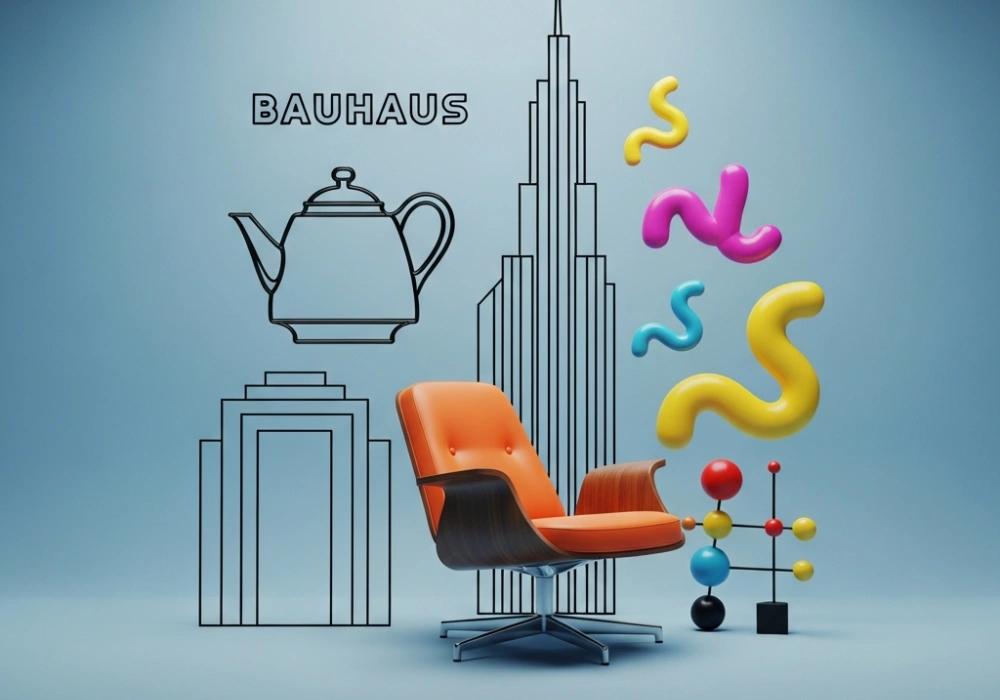
Cracking the NID DAT History Code
Welcome, future designers! If you are aiming for the National Institute of Design (NID), you already know that the Design Aptitude Test (DAT) isn’t just about drawing pretty pictures; it is about your ability to read the visual language of the world around you. One of the most recurring and high-scoring themes in Previous Year Questions involves understanding Historical Design Movements and how they shape the products we use today, from your iPhone to your office chair. In this masterclass, we will decode the core concepts, analyze five simulated Previous Year Questions, and provide you with Ninja Shortcuts to solve complex visual problems in seconds.
Question 1: The Bauhaus Legacy
Question: Analyze the design of a modern smartphone. Which of the following design philosophies from the Bauhaus movement is most evident in its industrial design? (A) Ornamental Expressionism (B) Form Follows Function (C) Asymmetrical Chaos (D) Naturalism.
The Traditional Method
The standard way to approach this is to recall your history textbooks. You would remember that Walter Gropius founded the Bauhaus in 1919 in Germany. You would think about the transition from the ornate Victorian era to the industrial age, where designers started using steel, glass, and concrete. You would analyze how a smartphone has no unnecessary buttons, focusing entirely on the screen and its utility. This process takes about 2-3 minutes of deep thinking.
The 30-Second Ninja Shortcut
Look for keywords! If the product is Minimalist, Geometric, and Efficient, the answer is almost always Bauhaus or its mantra: Form Follows Function. If you see a grid-based layout or a lack of decorative carvings, do not second-guess. Bauhaus is the parent of modern industrial minimalism. Bauhaus focused on mass production. This means designs had to be simple enough for machines to make. Today, this translates to the clean lines of Apple or Tesla products.💡 Click to Reveal Core Concept
Question 2: Art Deco and Luxury Branding
Question: A high-end luxury perfume bottle features bold geometric shapes, sunburst patterns, and gold-metallic finishes. Which historical movement does this product draw inspiration from? (A) Art Nouveau (B) De Stijl (C) Art Deco (D) Brutalism.
The Traditional Method
Students usually try to visualize the 1920s and 1930s. They remember the Great Gatsby era and the Chrysler Building in New York. They compare the perfume bottle to the architecture of that time, noting the symmetrical ‘zig-zag’ patterns and the sense of opulence and glamor that followed the first World War.
The 30-Second Ninja Shortcut
Use the ‘Glitz & Geometry’ rule. If the design feels Expensive, Symmetrical, and uses Metallic/Bold colors with sunbursts or tiered shapes, it is Art Deco. Unlike Bauhaus (which is plain), Art Deco is Fancy Geometry. Art Deco is about ‘Streamlining’. Think of old trains or vintage cars with sleek, aerodynamic lines. If a product looks like it belongs in a jazz club, it is Art Deco!💡 Click to Reveal Pro-Tip
Question 3: Mid-Century Modernism and Ergonomics
Question: The use of molded plywood and tapered legs in contemporary furniture design is a direct evolution from which period? (A) Renaissance (B) Mid-Century Modern (C) Gothic (D) Pop Art.
The Traditional Method
You would study designers like Charles and Ray Eames or Eero Saarinen. You would look at the post-WWII housing boom where furniture needed to be light, portable, and organic. You would analyze the ‘Lounge Chair’ and how it used wood in a way that mimicked the curves of the human body.
The 30-Second Ninja Shortcut
The ‘Eames Rule’: If you see Thin Wooden Legs (Tapered), Organic Curves (Kidney shapes), or Molded Plastic/Plywood, it is Mid-Century Modern. This movement brought ‘Nature’ into ‘Industrialism’. Previous Year Questions often focus on the Eames Lounge Chair. Remember: Mid-Century Modern = Comfort + Wood + Minimalism.💡 Click to Reveal Exam Insight
Question 4: Memphis Group and Post-Modernism
Question: A contemporary digital interface uses vibrant neon colors, clashing patterns, and squiggly lines that defy standard grid layouts. This is an example of: (A) Bauhaus (B) Swiss Design (C) Memphis Group (D) Minimalism.
The Traditional Method
You would research Ettore Sottsass and the 1980s reaction against the ‘seriousness’ of modernism. You would understand how designers wanted to bring back humor, kitsch, and irony into design. You would see how this ‘chaos’ is now popular in web design (often called Neo-Memphis).
The 30-Second Ninja Shortcut
The ’80s Party’ Rule: If the design looks Chaotic, Neon, Patterned, and Fun (Less is a Bore), it is Memphis Group. It is the exact opposite of Bauhaus. If it makes you dizzy but happy, it is Memphis! Memphis design is making a massive comeback in App UI/UX. Look for thick black outlines and pastel geometric shapes.💡 Click to Reveal Design Secret
Question 5: Arts and Crafts and Sustainability
Question: A brand promoting ‘Hand-crafted’ leather bags with visible stitching and natural dyes is utilizing the principles of which movement? (A) Industrial Revolution (B) Arts and Crafts (C) Futurism (D) Constructivism.
The Traditional Method
You would look back at William Morris and the 19th-century backlash against machine-made products. You would analyze how the Arts and Crafts movement valued the ‘Honesty of Materials’ and the ‘Joy of Labor’, emphasizing floral patterns and artisanal skills over factory efficiency.
The 30-Second Ninja Shortcut
The ‘Artisan’ Rule: If the product highlights Natural Materials, Handmade textures, and Traditional motifs (leaves/flowers), it is Arts and Crafts. In modern context, this is the ‘Sustainable’ or ‘Slow Fashion’ movement. Honesty of materials means a wooden chair should look like wood, not be painted to look like plastic. This is a key Arts and Crafts tenet found in Previous Year Questions.💡 Click to Reveal Core Philosophy
Cheat Sheet: Quick Revision Table
| Movement | Key Visual Elements | Modern Example |
|---|---|---|
| Bauhaus | Grids, Primary Colors, Steel, Minimalist | Apple Watch, IKEA Kallax |
| Art Deco | Symmetry, Zig-zags, Luxury, Metallics | Luxury Watch Dials, High-end Hotels |
| Mid-Century | Tapered legs, Organic curves, Plywood | Modern Cafe Chairs, Retro Lamps |
| Memphis | Clashing patterns, Neon, Playful, Chaotic | Instagram Filter Graphics, Pop-up Shops |
| Arts & Crafts | Nature motifs, Hand-crafted, Earthy | Sustainable Packaging, Artisanal Pottery |
Ready to Ace your NID DAT?
The History of Design is a visual journey. Don’t just memorize dates; look at the objects around you and ask: ‘Which movement does this belong to?’ If you need more simulated Previous Year Questions or expert feedback on your portfolio…
💬 Chat with our Experts on WhatsApp (+91 9526806124)




