
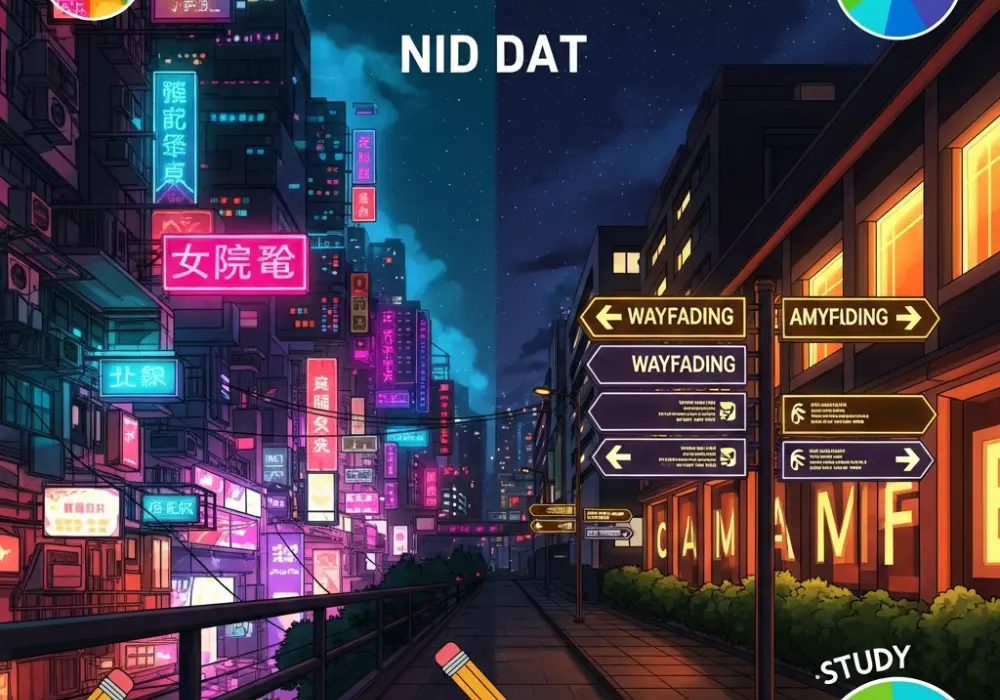
NID DAT Previous Year Questions Decoder: Mastering Urban Wayfinding and Light Pollution
Welcome, design aspirants! As you prepare for the National Institute of Design (NID) Design Aptitude Test (DAT), you will realize that the examiners are no longer looking for just ‘pretty’ drawings. They are looking for systemic thinkers who can solve complex urban problems. One of the most sophisticated topics appearing in recent trends is the synthesis of color theory and environmental context to create wayfinding systems that are both effective and ecologically responsible—specifically regarding the reduction of light pollution.
In this deep-dive guide, we will decode the logic behind these complex questions and provide you with the ‘Ninja’ shortcuts to solve them under the high-pressure environment of the NID studio test and mains. By understanding how light interacts with the atmosphere and how the human eye perceives color at night, you can score significantly higher than the average candidate.
Understanding the Core Challenge
Light pollution (skyglow, glare, and light trespass) disrupts ecosystems and human circadian rhythms. However, in an urban environment, we need light for safety and navigation. The NID examiner wants to see if you can design a wayfinding system (signs, maps, markers) that uses minimal active light and maximum color intelligence to guide users.
Question 1: The Nocturnal Nature Trail
The Challenge: Design a wayfinding signage system for a protected forest reserve that borders a city. The signs must guide night hikers without disturbing the local owl population, which is sensitive to blue-spectrum light.
The Traditional Method
A student might draw a standard rectangular sign with a bright white LED backlight and black text. They might add a small illustration of an owl. This fails the ‘environmental context’ test because white light contains high amounts of blue light, which scatters easily in the atmosphere and blinds nocturnal animals.
The 30-Second Ninja Shortcut
The ‘Amber-Glow’ Strategy: Use a monochromatic palette focused on 590nm (Amber) wavelengths. Specify ‘Downward-Shielded’ lighting. Use high-contrast reflective orange text on a dark matte wood background. Why? Amber light doesn’t suppress melatonin or scatter as much as white/blue light, and the matte background prevents glare.
Question 2: The Historic District Transition
The Challenge: A modern metro station opens in a historic heritage zone. Design a directional totem that points toward the station while ensuring the ‘light spill’ does not illuminate the facades of the surrounding 18th-century buildings.
The Traditional Method
Designing a glowing neon ‘M’ sign or a large backlit glass box. This causes ‘light trespass,’ where light goes where it is not wanted, ruining the aesthetic of the heritage buildings and annoying residents.
The 30-Second Ninja Shortcut
The ‘Perforated Negative Space’ Technique: Instead of a light box, use a solid metal sheet with laser-cut typography. Place a low-intensity warm light source *inside* the totem, directed only through the cut-outs. Use a 70:30 contrast ratio between the dark metal and the internal warm glow. This ensures the light is strictly directional and does not ‘spill’ into the environment.
Question 3: The Coastal Wayfinder
The Challenge: Design a series of beach-front markers for a coastal town that experiences heavy fog. The design must minimize skyglow to allow for stargazing and turtle nesting, yet remain visible to tourists.
The Traditional Method
Installing tall street lamps with bright colored bulbs. This creates massive skyglow and confuses sea turtle hatchlings who follow the light of the moon.
The 30-Second Ninja Shortcut
The ‘Photoluminescent Ground-Plane’ Approach: Do not use electricity. Use high-grade phosphorescent (glow-in-the-dark) pigments embedded in the ground. Use a ‘Cool Green’ glow for the path—green is the color the human eye is most sensitive to in low-light (scotopic) conditions. This requires zero power and creates zero upward light pollution.
Question 4: The High-Traffic Urban Intersection
The Challenge: Design a wayfinding map for a busy city square that uses ‘Color Coding’ to differentiate between bus, train, and taxi zones, while reducing the overall ‘Glitter’ effect of the city at night.
The Traditional Method
Creating a giant glowing digital screen with multiple bright colors. This contributes to ‘Glare,’ making it harder for drivers to see and increasing visual noise.
The 30-Second Ninja Shortcut
The ‘Reflective Hierarchy’ Method: Use passive retroreflective vinyl (like road signs). Instead of the sign emitting light, it uses the existing ambient light from cars and streetlamps to reflect back to the viewer. Assign ‘High-Visibility Yellow’ for the most urgent info (Taxis) and ‘Deep Blue’ for less urgent (Buses). Deep blue has low atmospheric scatter, making the city feel calmer.
Question 5: Typography and Legibility in the Dark
The Challenge: A neighborhood for the elderly requires new street name signs. The goal is to maximize legibility for aging eyes while keeping the street lighting at the lowest possible intensity to prevent sleep disruption.
The Traditional Method
Using small, thin fonts on a white background with a bright overhead lamp. For elderly eyes, this causes ‘Halation’—where the white light blurs the letters together.
The 30-Second Ninja Shortcut
The ‘Positive-on-Dark’ Sans Serif: Use a heavy-weight Sans Serif font (like Frutiger or Highway Gothic) in a ‘Warm White’ color on a ‘Dark Charcoal’ non-reflective background. Direct a single, shielded ‘Nadir-oriented’ (pointing straight down) LED onto the sign. This creates maximum contrast without the blinding effect of a backlit white surface.
Deep Dive: Synthesis of Color and Light Science
When solving Previous Year Questions from the NID entrance exams, you must mention these technical terms to show the examiners you are a pro:
- Scotopic Vision: Human vision under low-light conditions, which is most sensitive to the green-blue spectrum.
- CCT (Correlated Color Temperature): Always recommend lights under 2700K (Warm) for urban wayfinding to reduce environmental impact.
- Spectral Power Distribution: Explain that your design avoids the 450nm ‘blue peak’ to protect local biodiversity.
- Contrast Ratios: Aim for a 7:1 ratio for accessibility, even in low-light designs.
Cheat Sheet: Wayfinding & Light Pollution Quick Revision
| Design Factor | Traditional Approach (Avoid) | Master Designer Approach (Use) |
|---|---|---|
| Light Source | Global/Omnidirectional | Full Cut-off / Shielded |
| Color Temperature | Cool White (5000K+) | Extra Warm Amber (<2200K) |
| Material | Glossy/Reflective Metal | Matte / Perforated / Textured |
| Technology | Neon / High-Wattage LED | Retroreflective / Photoluminescent |
| Color Theory | Random bright colors | Functional Chromatic Hierarchy |
Summary for NID Aspirants
To ace the questions related to urban wayfinding and light pollution, remember the ‘Designers Creed’: Light only where it is needed, only when it is needed, and in the warmest color possible. Combine this with sharp typographic choices and high-contrast color palettes, and your solution will stand out as ecologically conscious and highly functional.
Practice sketching these ‘Ninja’ solutions. Instead of drawing a whole street, draw a ‘Section View’ showing how the light hits the sign and stays away from the sky. This technical clarity is what wins gold at NID!
Ready to Crack the NID DAT?
Our experts are here to help you decode every complex design problem with ease. Don’t let tough questions hold you back!
💬 Chat with our Experts on WhatsApp (+91 9526806124)Get free guidance, mock tests, and personalized feedback today!





