
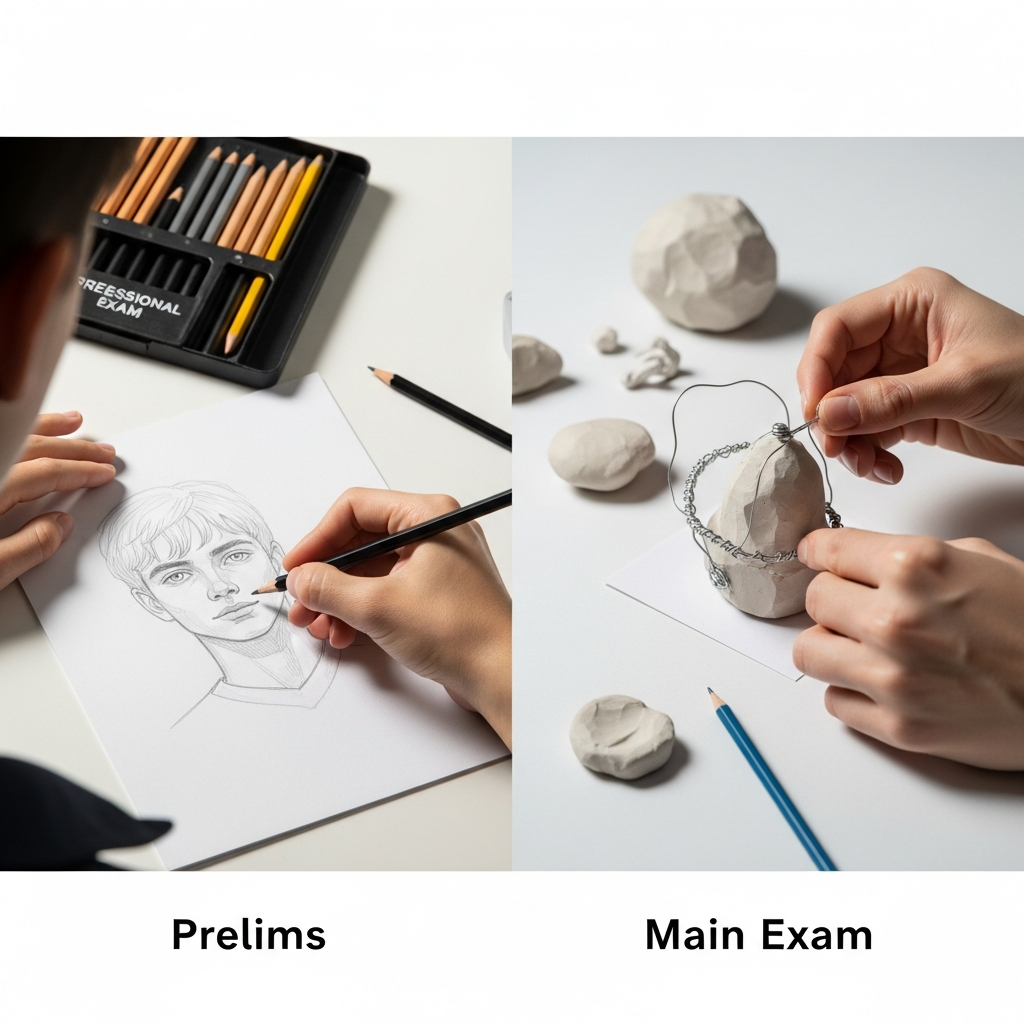
Understanding the Two-Stage Challenge: NID DAT Prelims vs Mains
The National Institute of Design (NID) is the premier destination for design education in India. To secure a seat in this prestigious institution, aspirants must clear the Design Aptitude Test (DAT), which is split into two distinct stages: Prelims and Mains. While many students approach these as separate hurdles, the most successful candidates understand that they are two sides of the same creative coin. A unified strategy that addresses both the theoretical and practical aspects of design is essential for success under the latest pattern.
What is NID DAT Prelims?
The Prelims stage is the primary screening round designed to test your mental agility, observation skills, and creative expression on paper. It generally consists of two parts: the General Design Aptitude Test (GDAT) and the Creative Design Aptitude Test (CDAT). The GDAT focuses on logical reasoning, abstract visualization, and general awareness, while the CDAT evaluates your sketching ability, composition skills, and storytelling through visuals. This stage is crucial because it determines whether you even get to showcase your hands-on skills in the next round.
What is NID DAT Mains?
Shortlisted candidates move to the Mains stage, which is far more interactive and practical. Primarily known as the Studio Test, it challenges your ability to translate 2D ideas into 3D forms. Depending on the current syllabus, this stage may also involve audio-visual tests, sensory observation tasks, and a personal interview with a portfolio review for certain disciplines. The Mains are not just about what you know; they are about how you think, adapt, and manipulate physical materials.
NID DAT Prelims vs Mains: A Quick Comparison
To help you structure your study schedule, it is vital to recognize the differences in the evaluation criteria of the two stages. Below is a detailed comparison based on the latest pattern:
| Feature | NID DAT Prelims | NID DAT Mains |
|---|---|---|
| Exam Format | Pen-and-paper based (Objective and Subjective) | Physical Studio Test (Hands-on) |
| Primary Skills Tested | Visualization, Sketching, Logical Reasoning | Material Handling, 3D Modeling, Dexterity |
| Duration | Approximately 3 hours | Full-day or multi-day assessment |
| Evaluation Focus | Ideation and 2D representation | Execution, Innovation, and Problem Solving |
| Preparation Tool | Mock tests and sketching practice | Material kits and workshop practice |
Strategy for NID DAT Prelims
Preparation for the Prelims requires a blend of speed and precision. Since you are competing against thousands of applicants, your work needs to stand out. Practicing with regular mock tests from myentrance.in is the best way to familiarize yourself with the latest pattern and ensure your time management is flawless.
- Focus on General Awareness: Stay updated with design-related current affairs, famous designers, and the history of art and craft in India.
- Master the Basics of Drawing: Perspective, human anatomy, light and shadow, and color theory are the pillars of the CDAT. Practice drawing everyday objects from unusual angles.
- Analytical Thinking: Solve puzzles and logical reasoning questions daily to keep your mind sharp for the objective section.
- Storytelling: Design is about communication. Practice creating comic strips or sequential drawings that tell a clear, concise story.
Strategy for NID DAT Mains
Transitioning from paper to physical models is often the hardest part for aspirants. The Studio Test requires you to work with materials you may have never used before, such as wire, clay, foam, and sunboard. You must show that you are not afraid to experiment.
- Material Sensitivity: Spend at least an hour daily working with different textures. Understand how paper behaves when folded versus how wire behaves when twisted.
- Observation under Pressure: In the audio-visual round, you might be shown a clip and asked to recall minute details or sounds. Practice this by watching short videos and writing down everything you saw and heard.
- Problem-Solving Models: Don’t just make a pretty model; make a functional one. If the prompt asks for a solution to a problem, ensure your 3D structure demonstrates that solution clearly.
- Portfolio Curation: If your discipline requires an interview, start organizing your best work now. Quality is always better than quantity. Show your process sketches as much as your finished pieces.
The Role of Mock Tests in Your Strategy
One of the biggest mistakes aspirants make is ignoring the time constraint of the actual exam. Whether it is finishing a complex sketch in 20 minutes or building a model in 45 minutes, speed is essential. By utilizing the comprehensive mock tests available on myentrance.in, you can simulate the exam environment for Prelims, ensuring that you enter the hall with confidence. Our tests are updated according to the latest pattern and provide instant feedback on your performance, helping you identify and bridge your knowledge gaps.
Top 5 Tips to Balance Your Preparation
1. Integration is Key: Don’t wait for Prelims results to start Mains prep. Dedicate 80% of your time to Prelims and 20% to material handling until the first exam is over. 2. Seek Expert Feedback: Design is subjective. Get your sketches and models reviewed by mentors or peers to understand different perspectives. 3. Maintain a Visual Diary: Carry a small sketchbook everywhere. Doodle your observations, ideas, and small material experiments. 4. Time Your Practice: Always use a stopwatch when practicing previous papers. 5. Stay Curious: Design is all around you. Analyze why a chair is comfortable or why a specific logo is memorable.
NID DAT Preparation: Frequently Asked Questions (FAQ)
What is the most important skill for NID Prelims?
While sketching is vital, ideation is the most important skill. NID examiners look for unique, creative solutions and perspectives rather than just technically perfect drawings.
How can I prepare for the Studio Test at home?
Collect everyday materials like newspapers, straws, clay, and tape. Practice making 3D models of animals, furniture, or abstract concepts like ‘tension’ or ‘stability’ using these materials.
Does NID DAT have negative marking?
According to the latest pattern for the Prelims, there is typically no negative marking, but it is always wise to read the instructions on your specific question paper carefully on the exam day.
Is a portfolio required for all NID courses?
Portfolios are generally required during the Mains stage for B.Des and M.Des programs, particularly during the interview round, to showcase your journey and skills to the jury.
Where can I find the latest pattern mock tests?
You can find updated mock tests and comprehensive study materials designed for the upcoming exams at myentrance.in, tailored specifically for NID and other design entrance tests.





