
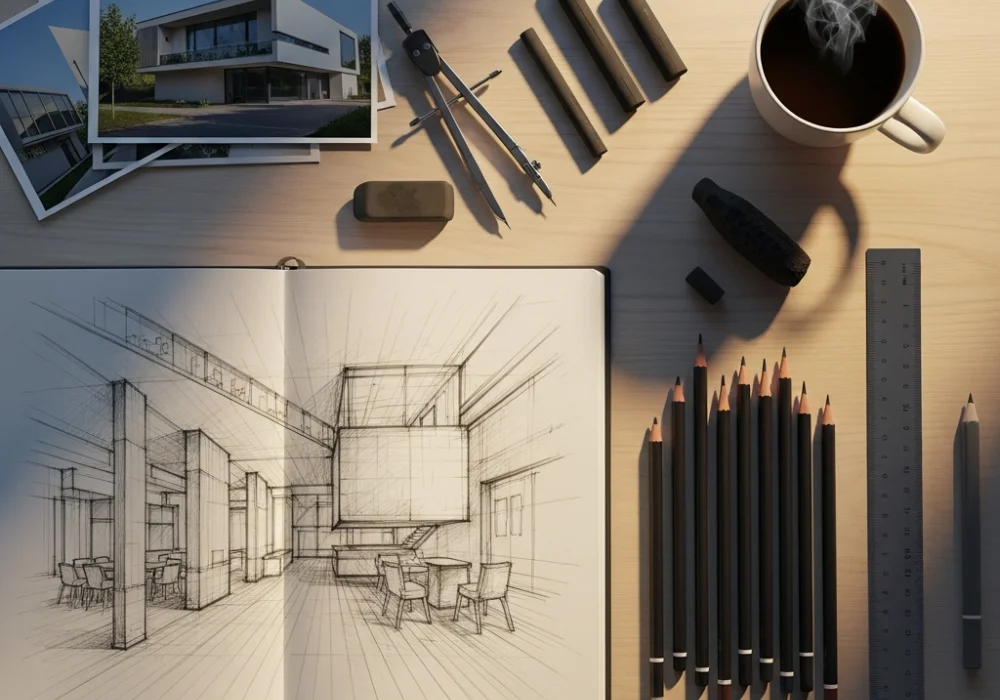
Mastering NID DAT Mains: The Power of Visualization and Sketching
Passing the NID DAT Prelims is a significant achievement, but the real test of a designer’s mettle lies in the NID DAT Mains. Unlike the preliminary stage, the Mains focus heavily on your ability to translate abstract ideas into tangible visuals. To succeed, candidates must master specific sketching skills tailored for visualization and spatial ability challenges. At myentrance.in, we provide comprehensive mock tests designed to simulate the latest pattern of these rigorous studio tests.
The Core of NID DAT Mains: Visualization Skills
Visualization is the ability to create mental images of objects, scenarios, or concepts and then project them onto a 2D surface. In the NID DAT Mains, you are often asked to imagine a scene from an unusual perspective or predict how an object looks when rotated. This requires a deep understanding of light, shadow, and form.
Essential Sketching Techniques for Design Aspirants
- Line Quality: Your lines should be confident and varied. Use lighter lines for construction and darker, bolder lines for final outlines.
- Perspective Drawing: Mastery over one-point, two-point, and three-point perspective is non-negotiable. It is the foundation of spatial representation.
- Proportions and Scale: Whether sketching a handheld product or a large public space, maintaining accurate proportions is crucial for realism.
- Human Anatomy: Many visualization tasks involve human interaction. Practice drawing gestures and silhouettes to add life to your sketches.
Comparing Visualization vs. Spatial Ability in NID Mains
While often used interchangeably, visualization and spatial ability focus on different cognitive design skills. The following table highlights the key differences as per the latest pattern:
| Feature | Visualization Skills | Spatial Ability |
|---|---|---|
| Primary Focus | Mental imagery and creative conceptualization | Understanding 3D space and object orientation |
| Task Example | Sketching a futuristic kitchen based on a theme | Drawing an object from a bird’s eye view |
| Key Skills | Creativity, storytelling, and detailing | Perspective, rotation, and volume analysis |
| Evaluation Criteria | Originality and aesthetic appeal | Structural accuracy and technical precision |
Developing Spatial Intelligence
Spatial ability challenges often involve mental rotation tasks. Candidates might be shown an unfolded box and asked to sketch what it looks like when assembled. To improve this, practice drawing everyday objects from multiple angles. Our mock tests at myentrance.in include specialized exercises that challenge your spatial reasoning, helping you prepare for the unconventional questions typical of the NID studio test.
Tips for the Studio Test Environment
The NID DAT Mains isn’t just about the final sketch; it’s about the process. Ensure you manage your time effectively between ideation and execution. Always carry a basic toolkit including various pencil grades, charcoal, and fine-liners. Remember, the examiners look for your ability to solve problems visually rather than just artistic flair.
Frequently Asked Questions (FAQ)
Do I need to be a professional artist to clear NID DAT Mains?
No, you don’t need to be an artist, but you must be able to communicate your ideas clearly through sketches. The focus is on design thinking and clarity of thought.
How can I improve my spatial ability?
Regular practice of drawing objects from different angles and solving 3D puzzles or mental rotation exercises can significantly boost your spatial intelligence.
What is the importance of mock tests for NID Mains?
Mock tests, like those offered at myentrance.in, help you get accustomed to the time pressure and the unique nature of the tasks in the studio test, ensuring no surprises on the exam day.
Does the NID DAT Mains syllabus change every year?
While the core principles remain the same, the specific themes and types of hands-on tasks follow the latest pattern established by the institute to keep the challenges fresh.





