
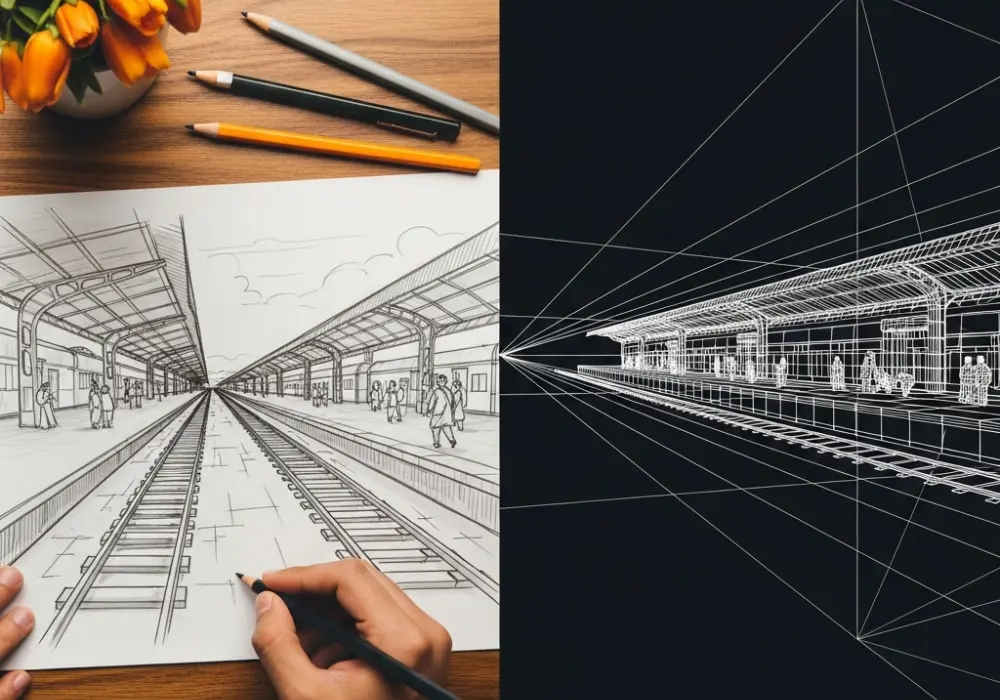
Understanding the Power of Memory Drawing in NID
Memory drawing is not merely about reproducing an image from the past; it is the ultimate test of a designer’s visual sensitivity, spatial intelligence, and storytelling capabilities. For students appearing for the NID (National Institute of Design) entrance exams, this section is often the most critical differentiator. NID examiners are not looking for photorealistic renderings; they are searching for candidates who can manipulate 3D space on a 2D surface while maintaining accurate proportions, human-centric details, and evocative atmospheres. Whether you are asked to draw a bustling railway station from the perspective of a child or a chaotic kitchen during a festival, your ability to recall the ‘logic’ of a scene—the way light hits a surface, how bodies move, and how objects diminish toward the horizon—is what will earn you a seat at India’s premier design institute. This mock test is designed to challenge your theoretical knowledge of these principles, ensuring your foundation is rock-solid before you pick up the pencil.
Phase 1: Concepts & Technical Fundamentals
Test your knowledge on perspective, human proportions, and environmental rendering with these challenging multiple-choice questions.
- In a two-point perspective drawing of a street scene, where do all the horizontal lines of the buildings converge?
- A) At a single central vanishing point on the horizon.
- B) At two vanishing points located on the horizon line.
- C) At three different points forming a triangle.
- D) They do not converge; they remain parallel.
- According to the standard ‘ideal’ human proportions for an adult, the height of the body is approximately how many ‘heads’ tall?
- A) 5.5 to 6 heads
- B) 7.5 to 8 heads
- C) 9 to 10 heads
- D) 4.5 heads
- When drawing a person sitting on a chair from a ‘Worm’s Eye View,’ the horizon line is:
- A) Above the person’s head.
- B) At the level of the person’s chest.
- C) Below the level of the person’s feet.
- D) Exactly at the center of the paper regardless of height.
- Which phenomenon causes objects in the distance to appear lighter, bluer, and less detailed?
- A) Linear Perspective
- B) Foreshortening
- C) Atmospheric (Aerial) Perspective
- D) Chiaroscuro
- If you are drawing a person reaching out their hand toward the viewer, the hand appears much larger than the rest of the body. This technique is called:
- A) Overlapping
- B) Isometric Projection
- C) Foreshortening
- D) Diminution
- Where is the ‘Horizon Line’ always located in a realistic memory drawing?
- A) At the top third of the page.
- B) At the bottom third of the page.
- C) At the viewer’s eye level.
- D) At the ground level.
- In an interior scene, an ellipse is used to represent a circular object (like a clock or a bucket). As the object moves closer to the horizon line, the ellipse becomes:
- A) More circular.
- B) Flatter/Narrower.
- C) Larger in diameter.
- D) Perfectly square.
- To create a sense of ‘Visual Hierarchy’ in a crowded scene, a designer should:
- A) Draw every object with the same amount of detail.
- B) Use thicker lines and more detail on the primary subject.
- C) Place the most important object at the very edge of the paper.
- D) Use only light pencils for the entire drawing.
- When drawing a human face, the eyes are generally located:
- A) In the top third of the head.
- B) At the halfway point between the top of the head and the chin.
- C) Right below the hairline.
- D) Adjacent to the top of the ears.
- Which of the following is most important for depicting ‘Action’ in a memory drawing?
- A) Perfect shading of the muscles.
- B) The Line of Action (Gesture).
- C) Using a high-quality 6B pencil.
- D) Drawing the background first.
- In three-point perspective, the third vanishing point is used to show:
- A) The depth of a hallway.
- B) The height of a very tall skyscraper or a deep canyon.
- C) The movement of a car.
- D) The reflection in a mirror.
- When drawing a crowd in a market, how do you maintain correct scale for people at different distances?
- A) Make all people the same size.
- B) Use the horizon line to anchor their eye levels (if the viewer is standing).
- C) Draw distant people with more detail.
- D) Decrease the number of people as you go further back.
- What does the ‘Rule of Thirds’ primarily help with in a composition?
- A) Accurate color mixing.
- B) Determining the height of a person.
- C) Creating a balanced and engaging layout.
- D) Calculating the vanishing point.
- The shadow cast by an object on the ground is called:
- A) Form Shadow
- B) Core Shadow
- C) Cast Shadow
- D) Highlight
- If you are drawing a scene from a ‘Bird’s Eye View,’ the viewer is:
- A) Lying on the ground.
- B) At a high elevation looking down.
- C) Looking through a fish-eye lens.
- D) Standing directly in front of the subject.
💡 Pro-Tip for NID Aspirants
Always start your memory drawing with a very light ‘stick figure’ and ‘wireframe’ layout. Don’t commit to details like eyes or clothing until you are 100% sure the perspective and proportions of the environment are correct. This saves time and prevents ‘perspective drift’!
Answer Key & In-Depth Explanations
Deepen your understanding by reviewing the logic behind the correct answers. These explanations are designed to build your design vocabulary.
In two-point perspective, we assume the viewer is looking at a corner of an object. Therefore, there are two sets of parallel horizontal lines, each receding toward its own vanishing point on the horizon. This is the most common perspective used in NID for street views because it creates a more dynamic and realistic sense of depth than one-point perspective.
While real people vary, the ‘Standard Proportions’ taught in art and design for a realistic adult figure is between 7.5 and 8 heads tall. Using this ratio ensures your figures look believable. If you use a 5-head ratio, the person will look like a child or a stylized cartoon character, which might not be appropriate unless specifically asked for in the brief.
The horizon line is synonymous with the observer’s eye level. In a ‘Worm’s Eye View,’ the observer is positioned very low (like a worm on the ground), looking up. Therefore, the horizon line—and thus the eye level—must be placed at the bottom of the scene, below the subject’s feet, making the subject appear towering and monumental.
Atmospheric perspective is a vital tool for creating ‘depth’ in memory drawing. Because of particles in the air (moisture, dust), objects that are far away lose contrast, become lighter, and shift toward a cooler (bluer) hue. Mastering this allows you to create a sense of vast space in outdoor scenes without needing complex grid lines.
Foreshortening is the visual distortion that occurs when an object is oriented toward the viewer. Because the hand is closer to the viewer’s eye than the shoulder, it must be drawn significantly larger to create the illusion of three-dimensional depth. This is a common requirement in NID ‘action’ sketches.
This is a fundamental rule of geometry in art: the horizon line is always at your eye level. If you stand up, the horizon line rises with you. If you sit down, it lowers. Understanding this helps you keep all objects in the scene consistent with the viewer’s point of observation.
As a circular object approaches the eye level (horizon), we see less of its top or bottom surface. Exactly at the horizon line, a circle looks like a straight line. As it moves away from the horizon, the ellipse ‘opens up’ and becomes more circular. This is crucial for drawing plates on a table or wheels on a car correctly.
Visual Hierarchy tells the viewer what to look at first. By using ‘Line Weight’ (thicker, darker lines) and high detail on your main character or object, you pull the viewer’s eye toward it. Background elements should be drawn with lighter, thinner lines to push them back into the distance.
A common mistake is drawing the eyes too high up on the forehead. In reality, the eyes are situated almost exactly in the vertical center of the head. The space above the eyes is occupied by the cranium and hair, while the space below contains the nose, mouth, and chin.
The ‘Line of Action’ is an imaginary line that runs through the spine of a character. It captures the essence of the movement (like a curve for a person bending). In memory drawing, establishing this gesture first is more important than anatomical detail because it conveys the story and energy of the scene.
One and two-point perspectives handle width and depth. Three-point perspective adds a vertical vanishing point (either high in the sky or deep in the ground). This is used to simulate ‘extreme’ angles, such as looking up at a skyscraper from the sidewalk or looking down from a balcony.
In a scene where everyone is standing on level ground and the viewer is also standing, the eyes of all people (regardless of distance) will align near the horizon line. Their feet, however, will move higher up the page as they get further away. This is the ‘Eye-Level Rule’ for crowds.
The Rule of Thirds involves dividing your frame into a 3×3 grid. Placing your focal point at the intersections of these lines creates a more natural, aesthetically pleasing composition than placing the subject dead-center, which can often feel static and boring.
A ‘Cast Shadow’ is the shadow an object throws onto another surface (like the ground or a wall). It is essential for ‘grounding’ your objects so they don’t look like they are floating in space. The shape of the cast shadow depends on the angle of the light source.
A Bird’s Eye View is a high-angle shot where the viewer is positioned above the scene, looking down. This perspective is excellent for showing the layout of a space, such as a floor plan of a room or the arrangement of stalls in a marketplace.
Final Checklist for Memory Drawing Success
- Context: Did you add background details like weather, time of day, or specific cultural elements?
- Proportion: Are the human figures sized correctly relative to the furniture and architecture?
- Storytelling: Is there a clear ‘event’ happening in your drawing?
- Clarity: Is the focal point of your drawing obvious at first glance?
Remember, NID is not just a test of your drawing skills, but a test of your observation of the world around you. Start noticing how shadows fall on the pavement and how people lean when they are tired!
Need Personalized Feedback on your Sketches?
Our team of NID alumni and expert mentors are here to help you crack the design entrance exams with ease. Get free guidance, access more mock tests, and have your portfolio reviewed by professionals.
💬 Chat with our Experts on WhatsApp (+91 9526806124)




