
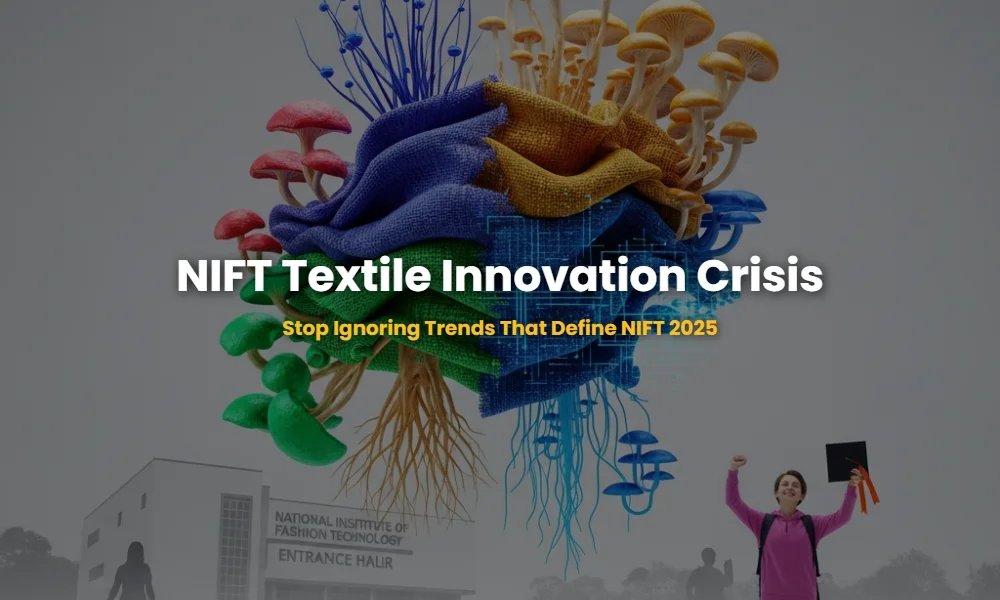
Hey there, NIFT Warrior. I know the feeling—the late-night caffeine, the overwhelming pile of sketchbooks, and that nagging voice asking if you’ve studied enough General Knowledge. You might think memorizing the ‘Father of Fashion’ is enough, but the industry has moved on to bio-fabricated leather and AI-driven forecasting. If your prep ignores these, you aren’t just missing facts; you’re missing the future of the NIFT entrance exam.
The Hidden Risk: Why Neglecting Textile Innovations Hurts Your NIFT Rank
Neglecting textile innovations in NIFT preparation causes a direct scoring loss in the General Ability Test (GAT), where 15-20% of GK questions now focus on sustainability. Furthermore, it weakens your performance in the Situation Test and Interview by limiting your design-thinking vocabulary.
The NIFT examiners aren’t just looking for artists; they are looking for future industry leaders who understand how Smart Textiles and Technical Textiles are reshaping India’s economy. When you ignore updates like the National Technical Textiles Mission (NTTM) or 3D body scanning (INDIAsize), you appear out of touch with the very curriculum you wish to join.
- GAT Impact: Direct loss of marks in current affairs and case study questions.
- Situation Test Impact: Inability to justify material choices using modern concepts like Circular Economy.
- Interview Impact: A lack of depth when discussing the “Future of Fashion,” making you look like a rote-learner rather than a visionary.
💡 Pro-Tip: The ‘Innovation Link’ Hack
Whenever you study a traditional craft (like Handloom), immediately search for its modern sustainable version. For example, connect Khadi to the Centre of Excellence for Khadi (CoEK) and its AI-driven quality checks. This dual-layered knowledge is what secures a Top 100 rank.
Decoding 2025’s Sustainable Fashion Trends: A Must-Know for NIFT
Sustainable fashion trends in 2025 focus on regenerative bio-materials, circularity, and ethical transparency. Key concepts for NIFT aspirants include Mycelium (mushroom) leather, closed-loop recycling, and the EU’s Digital Product Passport, which are frequently tested in GAT and Interview rounds.
The shift from Linear Fashion (Take-Make-Waste) to Circular Fashion is the single most important conceptual framework you need to master. Recent NIFT events like Samvaad 2025 and Bharat Tex have highlighted that sustainability is no longer a ‘choice’—it’s a regulatory requirement.
The Bio-Material Revolution
| Innovation | Source / Tech | Exam Relevance |
|---|---|---|
| Mycelium Leather | Mushroom Roots | Animal-free luxury (e.g., Stella McCartney) |
| Piñatex | Pineapple Leaves | Agricultural waste upcycling |
| Microbial Dyes | Colorifix / Bacteria | Zero-water pollution dyeing |
| Grape Leather | Wine Industry Waste | Bio-based synthetic alternatives |
Government Initiatives & Technical Textiles: The GK Powerhouse
Government schemes like PM MITRA, PLI for Textiles, and the GREAT scheme for start-ups are central to NIFT GK. These initiatives aim to modernize the Indian textile sector through mega-integrated parks and R&D in technical textiles.
As an aspirant, you must track the Ministry of Textiles updates religiously. For instance, the GREAT (Grant for Research and Entrepreneurship across Aspiring Innovators in Technical Textiles) scheme recently sanctioned 31 start-up projects involving Smart Textiles and Wearable Healthcare. Ignoring these means you’ll miss the 5-10 marks specifically reserved for Indian Economic Fashion GK.
- PM MITRA: Mega Integrated Textile Regions and Apparel parks aimed at world-class infrastructure.
- VisioNxt: India’s first AI-driven trend forecasting lab by NIFT.
- INDIAsize: The national sizing survey to create a standard body size chart for the Indian population.
- PLI Scheme: Incentives for manufacturing Man-Made Fibers (MMF) and technical textiles.
Actionable Hacks: Daily Routine for NIFT Innovation Prep
Integrating innovation updates requires a ‘Micro-Learning’ strategy. Follow a 15-minute daily routine: 5 minutes on the Ministry of Textiles PIB feed, 5 minutes on a global fashion tech blog (like WGSN or Business of Fashion), and 5 minutes sketching an application for a new textile.
Warrior, I know you’re tired. But these 15 minutes are the difference between a Common Merit Rank (CMR) of 500 and 5000. Don’t just read about 3D Knitting; imagine using it in your NIFT Situation Test model to explain zero-waste construction. This is how you win.
❓ Frequently Asked Questions
A: No! B.Des aspirants need this knowledge for the GAT and the Interview. NIFT values design-science synergy.
Q: Where can I find the most recent Indian textile news?
A: Follow the Press Information Bureau (PIB) under the ‘Ministry of Textiles’ section and the official NIFT website’s ‘Projects’ tab.
Q: How do I mention sustainability in my Situation Test?
A: When writing your 100-word write-up, use terms like “upcycled aesthetic,” “modular design for longevity,” or “mimicking bio-mimetic patterns.”





