
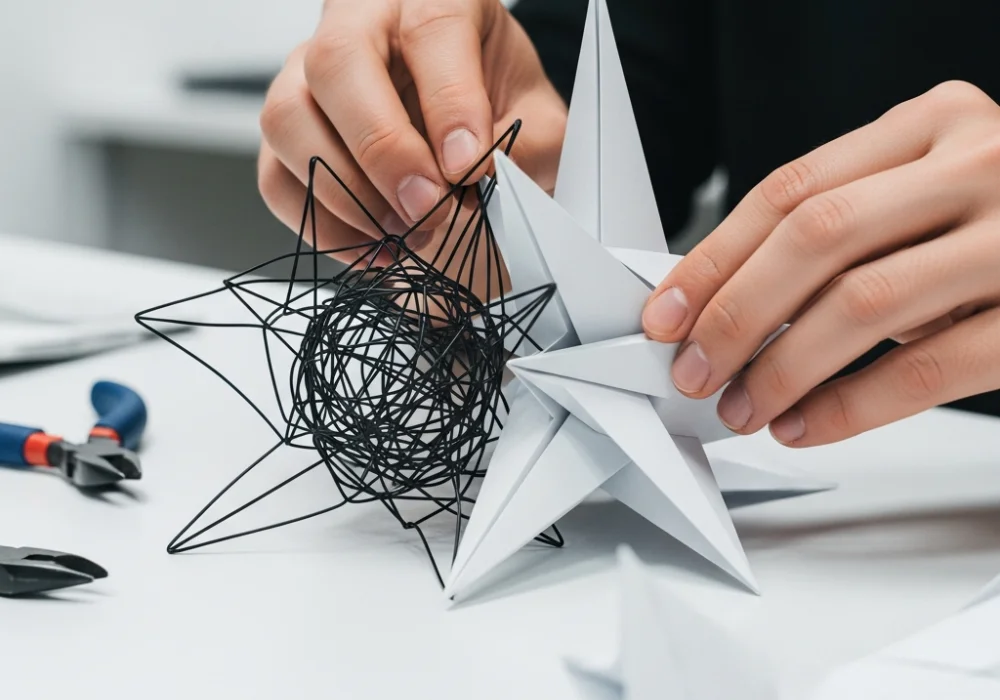
Introduction: The Battle of Form and Emotion
Welcome to the ultimate guide for the NIFT Situation Test, curated specifically for aspirants at myentrance.in. In the world of design, abstraction is the highest form of expression. Today, we tackle one of the most intellectually stimulating prompts: “Model the abstract concept of ‘Chaos versus Harmony’ by contrasting jagged wire-frame structures with smooth, symmetrical paper-folded geometries.”
This scenario is not just about making something that looks ‘nice.’ It is about your ability to translate a complex human experience—the tension between disorder and peace—into a tangible 3D model. As an elite admission panelist, I look beyond the glue and the paper; I look for the narrative within your structure. This guide will walk you through the psychological, technical, and creative aspects of mastering this challenge.
What the Panelists Are Secretly Looking For
Before you touch your materials, you must understand the scorecard. The NIFT Situation Test evaluates more than your craftsmanship. Here are the core pillars of evaluation:
- Conceptual Clarity: How well did you interpret ‘Chaos’ and ‘Harmony’? Is the contrast visible from a distance?
- Material Manipulation: Can you bend wire without leaving messy tool marks? Is your paper folding crisp or is it crumpled?
- Structural Integrity: Does the model stand on its own, or is it sagging? A designer must understand gravity.
- Innovation: Have you used the materials in a way that isn’t obvious? For example, using wire as a structural skeleton vs. using it as a decorative texture.
- Neatness: Excess glue is the enemy. Your model should look like a finished product, not a work-in-progress.
💡 Pro-Tip: The ‘360 Degree’ Rule
Examiners will walk around your table. Ensure your model looks aesthetically pleasing and conceptually sound from every single angle. Avoid having a ‘back side’ that is messy or unfinished.
Deep Dive into ‘Chaos’ (The Wire Component)
The Psychology of Chaos
Chaos is unpredictable, sharp, and multi-directional. In this model, the wire represents this erratic energy. To represent chaos effectively, you must avoid repeating patterns. Use the wire to create jagged wire-frame structures that move in conflicting directions.
Technical Wire Handling Tips
- Crimping and Kinking: Instead of smooth curves, create sharp angles by using pliers or your fingernails to ‘kink’ the wire. This creates visual tension.
- Webbing: Interweave the wire sporadically. Think of a shattered glass pattern or a tangled thicket.
- Negative Space: Chaos doesn’t have to be dense. A few sharp, long strands stretching into the air can create a sense of ‘explosion’ or ‘unrest’.
💡 Hidden Technique: The Wire ‘Nest’
To show total chaos, wrap the wire around a pencil to create a coil, then pull it apart unevenly. This ‘spring-gone-wrong’ look perfectly captures the lack of order.
Deep Dive into ‘Harmony’ (The Paper Component)
The Geometry of Peace
Harmony is about balance, symmetry, and rhythm. While the wire is aggressive, the paper should be soothing. Use smooth, symmetrical paper-folded geometries to represent a sense of calm and order.
Paper Manipulation Techniques
- Pleating: Accordion folds represent rhythm. Ensure each fold is exactly the same width.
- Origami Cubes or Pyramids: These geometric solids represent the building blocks of order.
- Scoring for Precision: Use a dry refill or the back of a cutter to lightly ‘score’ the paper before folding. This ensures the edge is razor-sharp.
- Curving: Sometimes harmony is represented by a perfect circle or a cylinder. Use a pen to roll the paper into a perfectly smooth tube.
💡 Design Secret: Radial Symmetry
Arrange your paper elements around a central axis. This ‘mandala’ effect instantly communicates harmony to the human brain.
Step-by-Step Construction Strategy
You have exactly two hours. Here is how you should divide your time:
Phase 1: Ideation & Sketching (15 Minutes)
Don’t jump straight to the materials. Draw a small thumbnail of your model. Decide how the chaos and harmony will interact. Will the chaos be ‘attacking’ the harmony, or will the harmony be ’emerging’ from the chaos?
Phase 2: The Core Structure (45 Minutes)
Build the largest parts first. If your harmony is a central pillar of folded paper, build that first. It provides a stable base. If your chaos is a wire cage surrounding the paper, build the outer frame early to ensure it fits.
Phase 3: Detailing & Contrast (40 Minutes)
This is where you refine the textures. Add the sharpest wire points. Ensure the paper folds are pristine. This is the stage where the ‘contrast’ becomes obvious. Use the wire to pierce through the paper or wrap tightly around it to show the conflict.
Phase 4: Finishing Touches & Write-up (20 Minutes)
Clean up the glue strands. Check the stability. Spend the last 10 minutes writing your concept note. Your note should explain why you chose these shapes.
“Chaos is the raw energy of creation, represented by the unbridled wire. Harmony is the refined order of design, represented by the mathematical precision of the paper folds.”
The Concept Note: Your Silent Interview
In the NIFT Situation Test, you are required to write a short paragraph explaining your model. This is often where students lose marks. Do not just describe what you made (e.g., ‘I made a wire ball and a paper box’). Describe the intent.
Sample Write-up:
“My model, ‘The Synthesis of Being,’ explores the dual nature of existence. The jagged, non-linear wire-frame represents the external chaos of the world—unpredictable and sharp. Within this shell, I have placed a series of interlocking, symmetrical tetrahedrons made of smooth ivory paper. These represent the internal harmony and disciplined mind of an artist. The contrast between the metallic rigidity of the wire and the soft, geometric precision of the paper highlights that order can exist even in the midst of disorder.”
💡 Quiz: Which is a better description of Harmony?
A: Using paper to make a bird.
B: Using repeating, equal-sized paper pleats to create a sense of rhythm.
Answer: B. Design entrance exams value abstraction and design principles over literal representations.
Final Tips for Success
- Keep your hands clean: Especially when working with white paper. Oils and graphite from your hands can leave smudges.
- Manage your scraps: Keep your workspace tidy. It reflects your organizational skills as a designer.
- Use the ‘Invisible’ Glue Rule: Use a toothpick to apply small dots of glue. Do not pour glue directly from the bottle onto the model.
- Stay Calm: If a part of your model collapses, don’t panic. Incorporate the collapse into your design as ‘Chaos’ and move forward.
Remember, the NIFT Situation Test is a test of your temperament as much as your talent. Be bold, be conceptual, and be neat. You are a designer in the making!
Need help with your NIFT Preparation?
Our experts are ready to guide you through mock tests, portfolio reviews, and more.
💬 Chat with our Experts on WhatsApp (+91 9526806124)




