
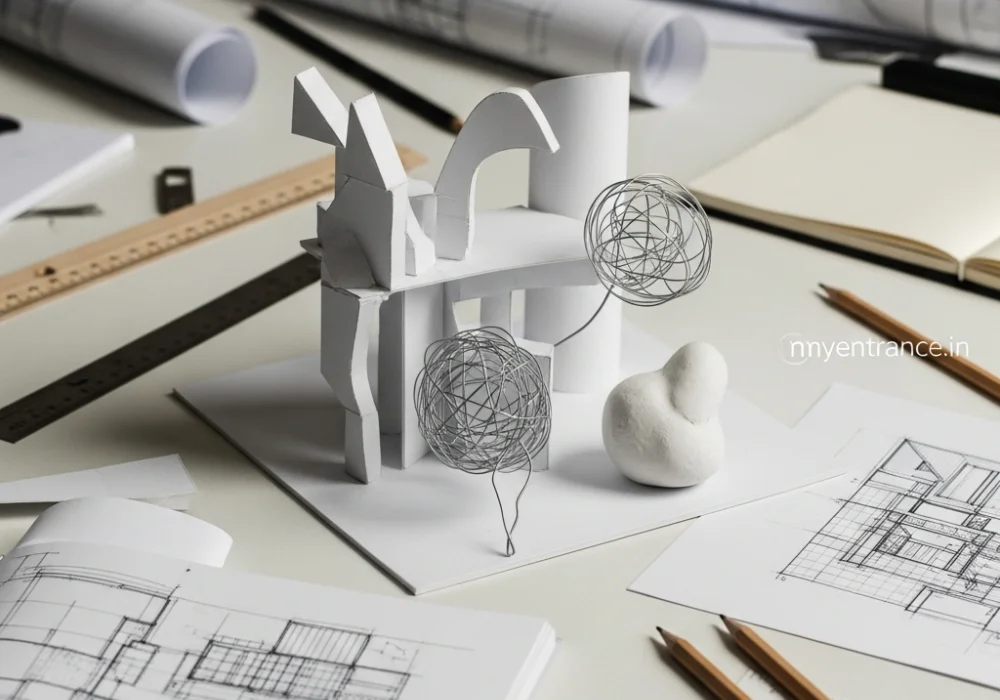
Introduction to the NIFT Situation Test
The NIFT Situation Test is the final hurdle for Bachelor of Design (B.Des) aspirants who have cleared the General Ability Test (GAT) and Creative Ability Test (CAT). This practical examination evaluates a candidate’s creative ability to manipulate materials and create a three-dimensional model based on a given prompt. However, it is not just about craft skills; it is about innovation, space visualization, and the ability to narrate a story through your design. To excel in the upcoming exams, students must blend advanced sketching techniques with efficient material management.
The Importance of Advanced Sketching in Situation Tests
While the Situation Test is primarily a model-making exam, sketching plays a pivotal role in the initial planning phase. Before touching the materials provided in the kit, an aspirant must visualize the final product. Advanced sketching techniques allow you to create a blueprint of your model, ensuring that you do not waste precious materials or time. At myentrance.in, our mock tests emphasize the development of these conceptual sketches.
1. Thumbnail Sketching
Begin with quick thumbnail sketches. These are small, rough drawings used to explore multiple ideas in a short time. Instead of sticking to your first thought, try at least three different perspectives. This helps in identifying structural flaws before they manifest in the 3D model.
2. Perspective and Orthographic Views
Understanding 1-point, 2-point, and 3-point perspectives is essential for the NIFT Situation Test. Once you have a concept, draw it from different angles—top view, side view, and front view. This orthographic projection ensures that you understand the proportions of your model, which is a key criterion for the latest pattern of evaluation.
Critical Material Handling Techniques
The material kit provided at the NIFT center usually contains items like cardboard, ivory sheets, copper wire, clay, thread, and fabric. Mastering the transformation of these basic items into complex structures is the hallmark of a successful candidate. Here is a breakdown of how to handle different materials:
- Cardboard and Ivory Sheets: Use techniques like scoring (making a shallow cut to fold easily), curling (using a pencil to create curves), and interlocking to avoid excessive use of adhesive.
- Wire Manipulation: Copper or aluminum wire is best used for creating skeletons or adding linear elements. Use pliers or even your hands to create spirals, zig-zags, or structural supports.
- Clay Modeling: Clay is ideal for organic shapes. Remember to smooth out the surfaces to give a professional finish.
- Fabric and Thread: These can be used for texture or to simulate motion and fluidity in your model.
Comparing Material Use for Better Design Outcomes
Understanding which material to use for a specific purpose can save you time and improve the aesthetics of your model. The following table provides a guide based on the current syllabus requirements:
| Material | Best Use Case | Primary Technique | Difficulty Level |
|---|---|---|---|
| Corrugated Cardboard | Main structure, heavy bases | Scoring and Folding | Medium |
| Ivory Sheet | Flexible surfaces, origami | Curling and Pleating | Easy |
| Copper Wire | Outlines, human figures | Twisting and Bending | Hard |
| Clay | Organic forms, detailing | Molding and Texturing | Medium |
| Straws/Sticks | Beams, trusses, elevation | Interlocking and Gluing | Easy |
High-Probability Mock Scenarios for Practice
To succeed, you must practice with diverse prompts. The following mock scenarios are designed to challenge your creativity and are similar to those found in the comprehensive mock test series at myentrance.in.
Scenario 1: The Future of Urban Commute
Design a model representing a sustainable public transport terminal for a futuristic city. Focus on ergonomics, passenger flow, and environmental friendliness. Consider how people will interact with the space.
Scenario 2: A Child’s Dream Playground
Create a 3D model of a playground designed specifically for children with visual impairments. Use textures and sensory elements to make the space inclusive and engaging.
Scenario 3: Work-from-Home Ecosystem
Design a compact, multifunctional workspace for a professional illustrator who works in a studio apartment. The model should reflect efficiency and aesthetic appeal.
Writing the Design Narrative
After completing your model, NIFT requires you to write a brief explanation (usually 60–100 words). This write-up is as important as the model itself. It should explain:
- The concept behind your design.
- The materials you chose and why you chose them.
- How your design solves the problem presented in the prompt.
- The unique selling point (USP) of your model.
Use professional design terminology such as “ergonomics,” “sustainability,” “fluidity,” and “minimalism” to impress the evaluators.
Why Practice with Myentrance.in?
The difference between a good rank and a great rank often lies in the quality of your preparation. myentrance.in offers a dedicated platform for NIFT aspirants, providing real-time feedback on mock scenarios and detailed guides on material manipulation. Our mock tests are curated by industry experts who stay updated with the latest exam trends, ensuring that you are never caught off guard on the day of the exam.
Conclusion
The NIFT Situation Test is an opportunity to showcase your unique voice as a designer. By mastering advanced sketching to plan your work, honing your material handling skills, and practicing with diverse mock scenarios, you can approach the test with confidence. Remember, the goal is not just to build a model, but to build a solution that is both functional and beautiful. Visit myentrance.in today to explore our full range of study materials and mock tests to kickstart your journey toward a premier design career.
Frequently Asked Questions (FAQ)
What materials are provided in the NIFT Situation Test?
Typically, NIFT provides a kit containing items such as cardboard, colored paper, ivory sheets, wire, clay, fabric, pins, and adhesives. The exact contents can vary based on the prompt.
Can I bring my own materials to the exam hall?
No, candidates are strictly prohibited from bringing any external materials. You must use only the items provided in the kit to create your model.
How long is the NIFT Situation Test?
The test usually lasts for two hours, which includes the time for model making and writing the design description.
How is the model evaluated by NIFT?
Models are evaluated based on creativity, innovation, material manipulation, structural stability, aesthetic appeal, and the clarity of the written narrative.
Does sketching really matter if it is a 3D test?
Yes, sketching is crucial for the conceptualization phase. It helps you organize your thoughts and ensures that your final model is well-proportioned and structurally sound.





