
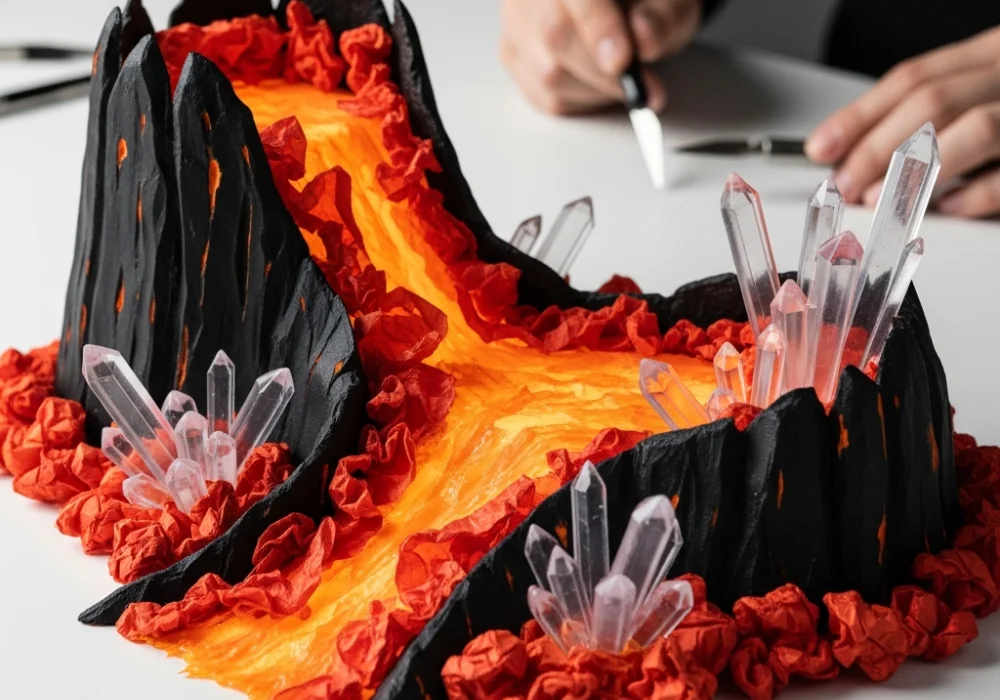
Introduction: The Crucible of Creativity
Welcome, future designers, to the definitive guide for the current NIFT Situation Test. As an elite admission panelist, I have witnessed thousands of models, but only a handful truly capture the essence of a theme while demonstrating technical mastery. The ‘Subterranean Glow’ theme is not just about making a ‘pretty’ ramp; it is a test of your ability to translate abstract geological phenomena—like the visceral heat of volcanic lava and the sharp, glassy stillness of obsidian—into a three-dimensional physical structure using nothing but a limited kit of materials.
This masterclass is designed for students at myentrance.in to move beyond basic crafting and into the realm of conceptual design. We will explore how to simulate molten fluidity and crystalline rigidity under the high-pressure environment of the NIFT studio test. Remember, the jury is not looking for a dollhouse; they are looking for a designer’s mind expressed through their hands.
What the Jury Secretly Evaluates: The Scorecard
Before you touch your scissors, you must understand how you are being graded. In the upcoming Situation Test, the evaluation is divided into several invisible layers. Many students fail because they focus on ‘making’ rather than ‘solving’. Here is the breakdown of what we look for:
- Conceptual Translation: How well did you interpret ‘Subterranean’? Did you just place a ramp on the floor, or did you create a sense of being underground?
- Material Innovation: If we give you a straw, do you use it as a pipe, or do you shred it to create a crystalline texture? We look for ‘unconventional’ use of ‘conventional’ materials.
- Structural Integrity: Does your ramp stand firm? If a model is collapsing under its own weight, it indicates a lack of understanding of load-bearing and construction.
- Aesthetic Harmony: The contrast between the ‘heat’ of the lava and the ‘cold’ of the obsidian must be visually balanced. Color theory and texture contrast are key here.
- The Write-Up: This is 10% of your score but often the tie-breaker. It must justify your design choices using professional design vocabulary.
💡 Click to Reveal: The ‘Wow’ Factor Tip
Jury members love ‘Negative Space’. Instead of building a solid block, create voids that imply caverns. If you can make the viewer feel like they are looking into the earth, you have already secured a top-tier score.
Decoding the Theme: Subterranean Glow
1. Volcanic Lava Flows (The Fluidity)
Lava is organic, viscous, and luminous. To represent this, you need to avoid straight lines. Use materials that can be curved or layered to suggest movement. Think of ‘flow’ and ‘temperature’. Your design should feel like it is pulsing with heat.
2. Obsidian Rocks (The Geometry)
Obsidian is volcanic glass. It is characterized by sharp edges, conchoidal fractures, and a deep, glossy black finish. This provides the perfect architectural counterpoint to the fluid lava. Use geometric forms, triangles, and jagged edges to represent these rocks.
3. The Ramp (The Function)
Never forget that this is a ramp. It must have a clear start and end point. It needs to be walkable (in a conceptual sense). Integrating the path of the model within the ‘lava’ and ‘rock’ without making it look like a messy pile is the ultimate challenge.
Material Handling Strategies
In your kit, you might find cardstock, mount board, cellophane, sandpaper, wire, and fabric. Here is how to manipulate them for this specific theme:
- Creating Obsidian: Use black tinted paper or cardstock. Instead of folding it normally, ‘score’ it and create ‘low-poly’ 3D shapes. If you have sandpaper, use the abrasive side to contrast against the smooth paper to show different rock ages.
- Simulating Lava: Take orange or red cellophane/glaze paper. Don’t just glue it flat. Crumple it, then partially smooth it out to create a ‘crackled’ texture that mimics cooling magma. Layer yellow underneath to create a ‘glow’ effect.
- Mineral Formations: Use transparent straws or plastic sheets. Cut them into tiny shards and cluster them together to simulate crystalline minerals found in subterranean caves.
- The Heat Effect: Use a white gel pen or a thin strip of white paper on the edges of your ‘lava’ to simulate the hottest part of the flow where it meets the rock.
💡 Click to Reveal: Glue Management Secret
Avoid ‘glue stains’ at all costs. For cellophane or thin papers, use a toothpick to apply tiny dots of Fevicol. Excess glue ruins the ‘glow’ and makes the model look messy, which leads to marks being deducted for ‘neatness’.
Step-by-Step Model Making Strategy
Phase 1: Sketching and Prototyping (15 Minutes)
Do not skip this. Spend 15 minutes drawing three quick thumbnails. Choose the one where the ramp spirals or cuts through the rock. Ensure the ramp itself is the focal point. Decide where the ‘light source’ (the lava) is coming from.
Phase 2: The Foundation (30 Minutes)
Use your corrugated sheet as the base. Build the ‘subterranean cave’ walls using mount board. Create a sense of depth by making the back walls higher than the front. This ‘theatre box’ approach helps the jury focus on your composition.
Phase 3: The Ramp Structure (45 Minutes)
Construct the ramp using a sturdy material like mount board. For the ‘Subterranean Glow’ theme, consider a ramp that looks like it is floating over a river of lava. Use wire or thin strips of cardstock to create ‘supports’ that look like rock pillars.
Phase 4: Adding the Narrative Textures (60 Minutes)
This is where the magic happens. Apply your ‘obsidian’ rocks around the ramp. Infuse the ‘lava’ flows underneath the ramp. Add your ‘crystalline’ formations in the corners. Ensure there is a sense of rhythm; for every sharp rock, add a soft flow of lava.
Phase 5: Refinement and Cleaning (30 Minutes)
Cut off any hanging threads of glue. Ensure the model is stable. If something is wobbling, reinforce it from the back where it isn’t visible. Use any leftover scraps to add ‘debris’ on the ramp to make it look realistic.
Mastering the Write-Up
Your write-up should be concise and professional. Avoid saying “I made a ramp with lava.” Instead, use design terminology. Here is a template of how to frame your thoughts:
“The design, titled ‘Magmatic Veins’, explores the juxtaposition between the volatile energy of subterranean lava and the static elegance of obsidian formations. The ramp serves as a bridge through this dualistic environment. I utilized scoring techniques on black cardstock to mimic the conchoidal fracture of volcanic glass, while the layered, crumpled cellophane represents the kinetic viscosity of molten rock. The inclusion of translucent shards simulates mineral crystallization, providing a sense of scale and realism to the subterranean landscape.”
💡 Click to Reveal: Key Vocabulary Words to Use
Use words like: Juxtaposition, Viscosity, Tectonic, Crystalline, Organic vs. Geometric, Fluidity, Structural Integrity, and Gradient.
Final Checklist Before You Finish
- Is my ramp identifiable as a ramp?
- Did I use at least 75% of the provided materials creatively?
- Is my model stable enough to be carried to the jury table?
- Does the ‘glow’ feel central to the theme?
- Is my write-up legible and placed next to the model?
Remember, the Situation Test is a marathon of the mind. Stay calm, keep your workspace clean, and let your creative instincts guide your hands. We look forward to seeing your brilliance in the upcoming entrance rounds.
Need Personalized Feedback on Your Models?
Don’t leave your NIFT dream to chance. Get expert guidance and mock tests today!
💬 Chat with our Experts on WhatsApp (+91 9526806124)




