
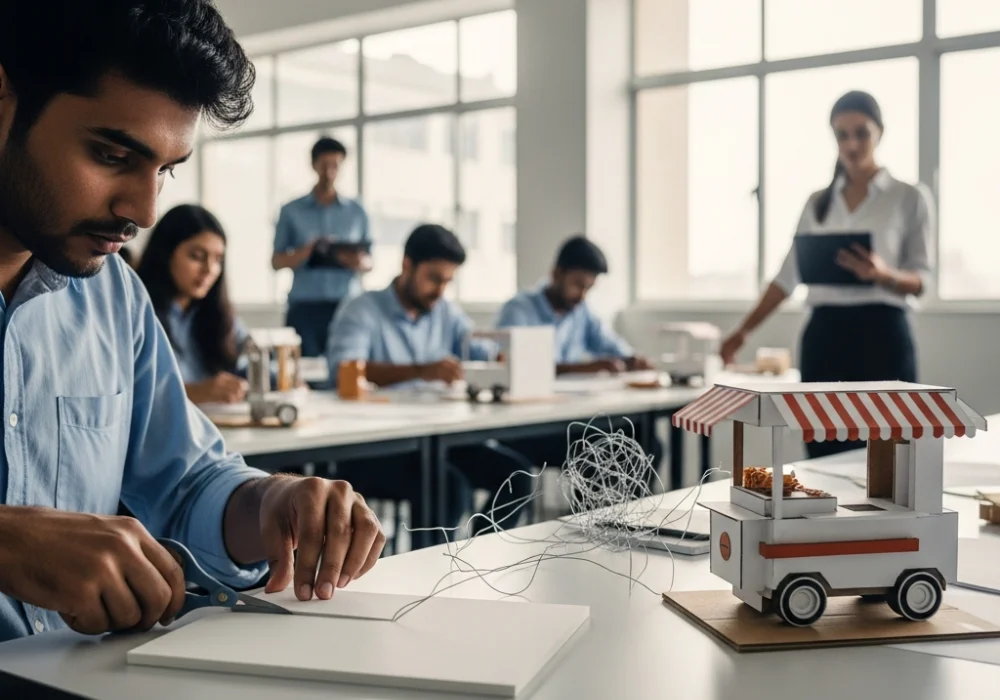
Introduction: The Evolution of Street Food
The NIFT Situation Test is not merely a test of your handicraft skills; it is a rigorous assessment of your design thinking, spatial awareness, and ability to innovate under pressure. In the upcoming entrance cycle, the panel is looking for students who can look beyond the obvious. When presented with a scenario like ‘Designing a compact, foldable unit for a futuristic street food vendor’, you are being asked to solve a multifaceted problem involving urban space management, environmental sustainability, and public health.
As we move toward a more tech-integrated future, the street food vendor—a staple of global culture—must adapt. This guide will walk you through the nuances of creating a 3D model that balances aesthetics with extreme functionality, ensuring you stand out as a top-tier candidate on www.myentrance.in.
What Examiners Are Secretly Looking For (Evaluation Criteria)
To score high in the Situation Test, you must understand the ‘Secret Rubric’ used by NIFT panelists. It is not just about the neatness of your glue work; it is about the depth of your concept.
- Innovation & Conceptualization: How unique is your approach? Did you just make a box on wheels, or did you rethink the architecture of a mobile kitchen?
- Material Handling: Can you manipulate mundane materials like cardboard, wire, and plastic sheets into textures that represent metal, glass, or fabric?
- Functional Utility: Does the model actually fold? Is there a designated space for the vendor to stand? Are the solar panels placed logically?
- Cleanliness & Aesthetics: A futuristic design demands sharp edges, clean joins, and a sophisticated color palette. Messy glue marks are a significant deterrent.
- The Design Write-up: Your ability to articulate your design choices in English is 50% of the battle. You must explain why you chose specific forms and how they solve the user’s problems.
💡 Click to Reveal: The Panelist’s Pro-Tip
Don’t just build a model; tell a story. Name your brand. For example, ‘The Sol-Snack 2027’. This shows the examiner you have thought about branding and market placement, which are core components of fashion and product design.
Decoding the Scenario: Breaking Down the Brief
The prompt contains four critical keywords that must be represented in your model:
1. Compact & Foldable
In a futuristic urban setting, space is a luxury. Your design should utilize Telescopic Mechanisms or Origami-inspired folds. Think of how a laptop closes or how a professional photography reflector folds into a small circle. Your model should have visible ‘hinges’ (made from scored cardboard or wire loops) that suggest it can shrink for transport.
2. Hygiene & Contactless Service
Post-pandemic design focuses on ‘Low-Touch’ environments. Incorporate a transparent shield (using OHP sheets) between the vendor and the customer. Design a modular ‘dispensing slot’ rather than an open counter to minimize exposure to pollutants.
3. Waste Management
Futuristic street food units cannot have open dustbins. Design an Integrated Dual-Bin System within the unit. Use color-coded slots (Green for organic, Blue for recyclables) built into the side of the unit. This shows you have prioritized the environment.
4. Solar-Powered Heating
Instead of bulky LPG cylinders, the 2027 vendor uses ‘Photovoltaic Umbrellas’. Design a canopy that doubles as a solar collector. Use silver foil or glitter to represent the solar cells. This canopy should be adjustable to track the sun throughout the day.
Material Handling Strategies for the 3D Model
Success in the Situation Test is 70% about how you use your material kit. Here is how to handle common materials for this specific futuristic theme:
- Cardboard (The Skeleton): Never use the thickness of the cardboard as is. ‘Peel’ the top layer to reveal the corrugated texture for ‘radiators’ or solar panel structures. Score it (cut halfway) to create perfect 90-degree bends.
- Wire (The Framework): Use wire to create the ‘foldable’ joints. Twist two wires together to represent electrical conduits or structural supports for the solar canopy.
- Plastic/OHP Sheets: Use these for the ‘Smart Glass’ partitions. Keep them clean! Fingerprints on plastic look unprofessional. Use double-sided tape sparingly on the edges.
- Cotton/Wool: Can be used to represent steam from the heating elements or insulation around the cooking zone.
- Sandpaper: Excellent for creating a ‘non-slip’ floor texture for the vendor’s standing area.
💡 Click to Reveal: The ‘Invisible’ Connection Hack
Avoid using too much liquid glue; it makes cardboard soggy. Use paper tabs (the ‘tab and slot’ method) to connect walls. It is much stronger and looks significantly cleaner to the examiners.
Step-by-Step Model Construction Strategy
You have exactly 2 hours (120 minutes). Manage your time like a professional designer.
Phase 1: Ideation & Sketching (15 Minutes)
Do not start cutting immediately. Sketch three quick thumbnails. Choose the one that is most ‘dynamic’. Draw a quick exploded view to understand how the parts will fit together. This is the stage where you decide where the solar panels go and how the waste bin slides out.
Phase 2: Base & Primary Structure (45 Minutes)
Build the main chassis. Ensure it is stable. If it’s a ‘foldable’ unit, build it in its ‘open’ or ‘operational’ state, but leave visible indicators (like creases and hinges) of how it closes. Use the thickest cardboard for the base to ensure the model doesn’t tip over.
Phase 3: Functional Elements (30 Minutes)
This is where you add the ‘Solar Panels’, ‘Waste Bins’, and ‘Heating Plates’. Use silver foil for the heating surface to represent induction technology. Create a small ‘control panel’ with buttons (using tiny bits of colorful paper or beads) to show it is a high-tech unit.
Phase 4: Detailing & Aesthetics (20 Minutes)
Add the ‘Human Factor’. Create a small abstract human figure out of wire or paper to show the scale of the unit. This helps the panelist understand the ergonomics. Clean up any glue strings and ensure all edges are sharp.
Phase 5: The Write-up (10 Minutes)
Write a concise, professional paragraph explaining your concept. Focus on the ‘Futuristic’ and ‘Sustainability’ aspects. Use terms like ‘Ergonomics’, ‘Modular Design’, and ‘Renewable Energy Integration’.
The Final Write-up Template
Your write-up should follow this structure for maximum impact:
Title: The ‘Aura-Cart’ – A Sustainable Street Food Ecosystem
Concept: My design focuses on the ‘Zero-Footprint’ philosophy. The unit utilizes a folding hexagonal geometry to maximize surface area for solar collection while remaining compact for mobility. The hygiene is maintained through a contactless induction heating system and a modular waste segregation unit that compresses trash automatically.
💡 Click to Reveal: Common Mistakes to Avoid
1. Making the model too big: You have limited materials. Focus on detail, not size. 2. Forgetting the vendor: Always leave space for a person to operate the unit. 3. Over-gluing: Use tiny drops; excess glue ruins the ‘futuristic’ clean look.
Ready to Ace the NIFT Situation Test?
Preparing for the latest NIFT entrance requires more than just creativity—it requires a strategic mindset. Join the community at www.myentrance.in for expert-led mock tests, personalized feedback on your models, and exclusive access to previous years’ solved scenarios.
💬 Chat with our Experts on WhatsApp (+91 9526806124)




