
Introduction: The Ultimate Challenge of the Situation Test
Welcome, future designers. As an elite panelist for the NIFT Entrance Exam, I have witnessed thousands of students struggle with the transition from a 2D sketch to a 3D reality. The Situation Test is not just a test of your handicraft skills; it is a test of your Design Thinking, your ability to empathize with a user, and your capacity to innovate under extreme time pressure. Today, we are diving deep into one of the most challenging prompts you might face: Designing a multi-functional, wearable accessory for elderly pedestrians that integrates navigation, health monitoring, and night-time visibility.
This scenario requires more than just making something look ‘pretty.’ You are designing for a specific demographic with unique needs—the elderly. In the upcoming years, the integration of technology into fashion will be seamless. Your task is to represent this ‘smart’ future using the humble materials provided in your NIFT kit: cardboard, wire, glaze paper, cloth, and pins.
Understanding the Brief: Breaking Down the Requirements
Before you touch the glue, you must dissect the prompt. A multi-functional wearable for 2027 must address three critical pillars:
- Navigation Aids: How does an elderly person find their way without staring at a tiny smartphone screen? Think haptic feedback (vibrations) or audio cues.
- Health Monitoring: Pulse sensors, fall detection, or hydration reminders. These need to be placed near ‘pulse points’ like the wrist or neck.
- Night-time Visibility: Essential for pedestrian safety. This involves reflective surfaces and active light-emitting elements (simulated with bright materials).
💡 Click to Reveal: The Panelist’s Secret Perspective
We don’t expect you to build a working circuit. We expect you to visualize where the technology sits. Use colored beads or small buttons to represent ‘sensors.’ Use silver paper to represent ‘reflective strips.’ The key is intentionality—every fold must have a reason.
Decoding the Evaluation Criteria: What We Secretly Look For
As examiners, we use a rubric that goes far beyond ‘neatness.’ Here is the breakdown of how your model is actually scored:
- Concept Innovation (25%): Did you just make a watch? Or did you design a ‘Smart Sash’ or a ‘Haptic Glove’ that feels futuristic yet functional?
- Empathy & Ergonomics (25%): Elderly users often have arthritic hands. Does your accessory have large, tactile buttons? Is it easy to wear (Velcro instead of tiny hooks)? If you show this level of thought, you are in the top 1%.
- Material Manipulation (25%): Can you make cardboard look like plastic? Can you make wire look like a sleek sensor? We look for techniques like quilling, weaving, and scoring.
- The Write-Up (25%): Your explanation must justify your design choices. It is the bridge between your model and our understanding.
“Design is not just what it looks like and feels like. Design is how it works.” — This quote should be your mantra during the Situation Test.
Step-by-Step Model Making Strategy
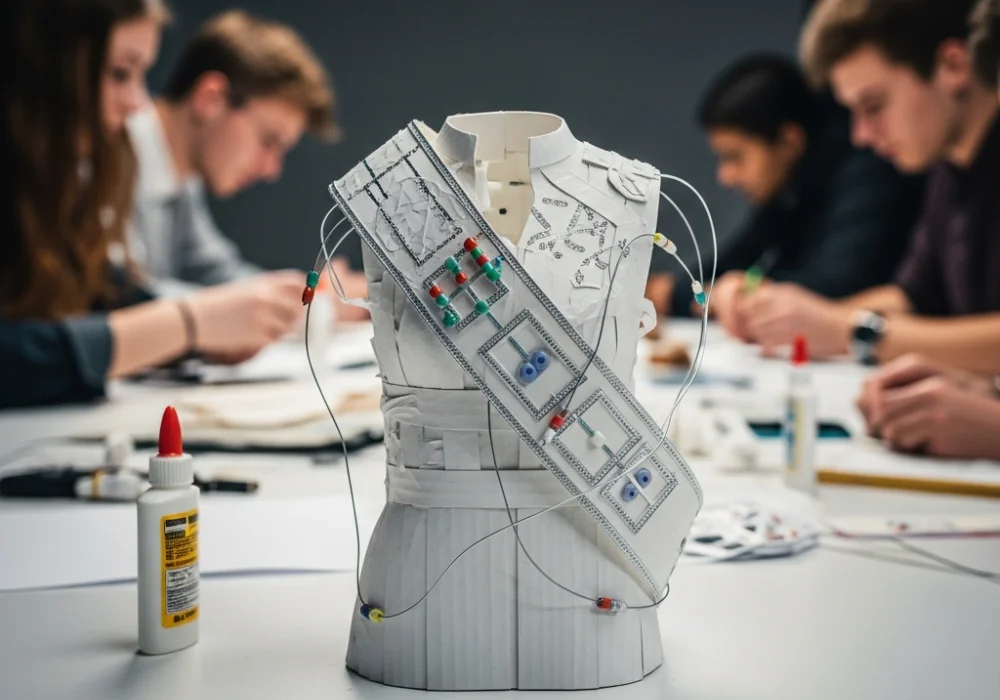
For this specific topic, I recommend designing a ‘Smart Navigator Sash’. It is larger than a wristband, allowing you to show more features, and it is highly visible.
Phase 1: The Skeletal Structure (0-30 Minutes)
Use card sheet to create a curved base that sits comfortably over the shoulder. Remember, the elderly need comfort. Score the cardboard (cutting halfway through) to create smooth curves. Use wire to reinforce the edges so the sash holds its shape when placed on the table.
Phase 2: Integrating Features (30-90 Minutes)
Visibility: Cut thin strips of silver glaze paper or aluminum foil. Apply them in a geometric pattern across the sash. This represents 360-degree reflective technology.
Navigation: Create a small ‘control hub’ on the chest area using a small box made of ivory sheet. Use colored pins or beads to represent buttons that can be felt through clothing.
Health Monitoring: Use a different texture of paper (perhaps crepe or handmade paper) on the underside to represent ‘bio-sensors’ that touch the skin.
Phase 3: Fine Finishing (90-110 Minutes)
Cleanliness is godliness in the Situation Test. Ensure there are no visible glue marks or ‘spider webs’ from the glue gun. Hide your joints. Use a paper cutter for sharp edges—never tear paper by hand.
💡 Pro-Tip: Adding ‘Interactive’ Details
Create a small ‘battery pack’ or ‘charging port’ using a small cylinder of rolled paper. This shows you have considered the power needs of your 2027 tech, making the model feel more realistic and grounded.
Material Handling Masterclass
The materials provided are often basic, but your execution must be premium. Here is how to handle the common items for this specific topic:
- Wire: Do not just use it as a string. Coil it to represent ‘antennae’ or use it as a structural rib to give your accessory 3D volume.
- Straws: These are excellent for representing ‘conduits’ for data or wires within your smart garment.
- Glaze Paper: Use the shiny side for ‘touch screens’ and the matte side for ‘solar panels’ (if you include them).
- Cotton/Fabric: Use this for padding. The elderly prioritize comfort; showing a padded shoulder strap demonstrates immense empathy.
Common Pitfalls to Avoid
Many students make the mistake of making a ‘static’ model. If your design has a screen, try to make it a ‘pop-up’ or a ‘sliding’ mechanism using a paper track. This interactivity delights the examiners.
Drafting the Perfect Write-Up
Your write-up should be structured and professional. Use the following headers:
- Inspiration & Concept: Explain why you chose the ‘Sash’ form (e.g., ergonomic distribution of weight).
- User Persona: Describe ‘Mr. Sharma,’ a 75-year-old who loves evening walks but struggles with low vision.
- Feature Breakdown: Explain what each color and material represents (e.g., “Blue beads represent haptic vibration sensors for left/right turns”).
- Material Choice: Justify your use of materials (e.g., “Wire was used to provide structural rigidity while maintaining a lightweight profile”).
Keep it concise. 100-150 words is usually enough, but ensure the English is impeccable and the handwriting is legible.
Final Checklist Before the Bell Rings
- Is the model stable? (Give it a gentle tap; it shouldn’t fall over).
- Is the workspace clean? (Always clean your desk before leaving).
- Is the write-up attached securely?
- Did you answer all parts of the prompt? (Navigation, Health, Visibility).
The NIFT Situation Test is a marathon of the mind. Stay calm, visualize the user, and build with purpose. You are not just making a model; you are proposing a solution for a better future.
Ready to Ace Your NIFT Journey?
Don’t leave your dreams to chance. Get expert feedback on your models and personalized coaching for the upcoming entrance exams.
💬 Chat with our Experts on WhatsApp (+91 9526806124)




