
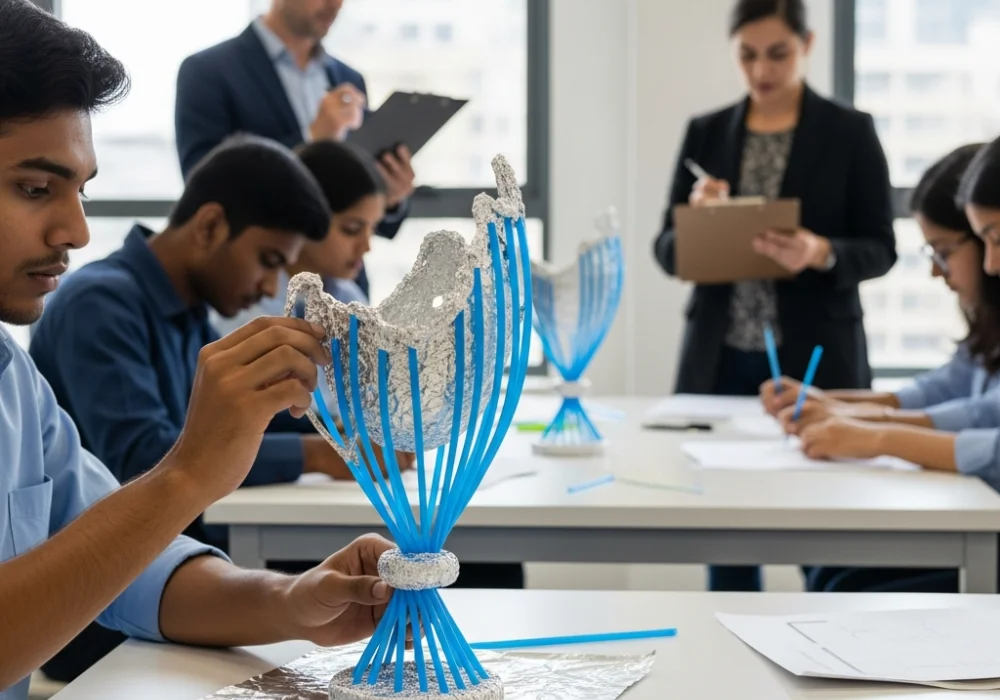
Introduction: The Intersection of Design and Activism
Welcome, future designers. As an elite panelist for the NIFT entrance exams, I have seen thousands of models. However, the current trend in design education focuses heavily on Sustainability and Social Impact. The ‘Save the Oceans’ marathon trophy challenge is not just a test of your hand-skills; it is a test of your empathy for the environment and your ability to abstract complex concepts using limited materials.
In the Situation Test, you are often given contrasting materials like Aluminum Foil (reflective, malleable, metallic) and Straws (linear, rigid, plastic). Your task is to marry these textures to create a contemporary trophy that feels prestigious yet poignant. This guide will walk you through every nuance of this specific scenario, from the first fold of the foil to the final sentence of your write-up.
💡 Pro-Tip: What is ‘Contemporary’ Design?
Contemporary design focuses on minimalism, fluid forms, and the use of materials in unconventional ways. Avoid making a literal ‘cup’ trophy. Think of dynamic sculptures that represent movement, waves, or the struggle of marine life.
The Panelists’ Secret Scorecard: Evaluation Criteria
When we walk around the examination hall, we aren’t just looking at the final model. We are looking for these specific markers of a high-ranking candidate:
- Material Transformation: Have you used the foil just as a wrapper, or have you textured it? Have you used straws as mere sticks, or have you explored their hollow nature or flexibility?
- Structural Integrity: Does the trophy stand firm? A trophy is meant to be held and displayed. If it wobbles, it fails the primary functional requirement.
- Narrative Symbolism: Does every fold of the foil mean something? Design is intentional. Randomness is the enemy of a NIFT aspirant.
- Neatness (The ‘Glue Gun’ Rule): Visible Fevicol blobs or glue gun strings are instant marks-reducers. Clean joinery is non-negotiable.
- Composition: Balance, rhythm, and proportion. A trophy should have a focal point that draws the eye upward, symbolizing the achievement of the marathon runner.
Deep Dive: Handling Aluminum Foil and Straws
Working with these two materials requires a high degree of tactile sensitivity. Let’s break down the techniques for the ‘Save the Oceans’ theme.
1. Aluminum Foil: The Water Element
Aluminum foil is your best friend for representing the ocean. Its reflective quality mimics the sun hitting the water’s surface.
- The ‘Crumple and Smooth’ Technique: Crumple a sheet of foil tightly and then gently open it. This creates a texture resembling ‘choppy waters’ or deep-sea ripples.
- The ‘Rolled Edge’: Roll the edges of the foil to create the ‘crest’ of a wave. This adds structural strength to an otherwise flimsy material.
- Reflective Play: Use the shiny side for clean water and the matte side for polluted or stagnant water to create a visual contrast in your narrative.
2. Straws: The Linear Narrative
Straws represent both the problem (plastic pollution) and the solution (the linear path of the marathon).
- Radial Slicing: Cut the ends of straws into fringes to represent sea anemones or coral.
- Bundling: Tie 5-7 straws together with a thin strip of foil to create ‘pillars’ for the trophy base.
- Heating (Caution): If permitted, slightly bending straws at the joint can create organic curves resembling sea kelp.
💡 Quiz: How to glue straws vertically?
Answer: Never just put glue on the tip. Create a ‘flange’ by cutting the bottom of the straw into 4 small tabs and folding them outward. Glue these tabs to the base for 10x more stability.
Step-by-Step Model Strategy: The ‘Oceans Path’ Trophy
Step 1: The Foundation (Minutes 0-15)
Construct a sturdy base using cardstock or thick mount board (if provided). Wrap the base neatly in smooth aluminum foil. A square or hexagonal base provides a contemporary feel. This base represents the earth upon which the marathon is run.
Step 2: The Core Structure (Minutes 15-45)
Use the straws to create an upward-spiraling vortex. This represents the ‘Current’ of the ocean and the ‘Energy’ of the marathon runners. Interweave the straws so they support each other. Avoid using too much glue; try to ‘lock’ them by making small slits in the straws and sliding them into one another.
Step 3: Integrating the ‘Water’ (Minutes 45-90)
Drape the textured aluminum foil through the straw structure. Let the foil cascade like a waterfall from the top of the trophy. This symbolizes the flow of clean water. Ensure some parts of the foil are taut (representing speed) and some are ruffled (representing the ocean breeze).
Step 4: The Finial (The Top) (Minutes 90-105)
The top of the trophy should be the most detailed. Create a small, abstract ‘droplet’ using a tightly packed foil ball finished with a smooth outer layer. This droplet is the ‘Goal’—the preservation of every single drop of the ocean.
Step 5: Final Refinement (Minutes 105-120)
Check for loose ends. Hide any visible tape or glue. Ensure the model can be rotated 360 degrees without any ‘bad angles’.
The Write-Up: Documenting Symbolism
Many students build a great model but fail because their write-up is weak. Your write-up should be professional and insightful. Use the ‘Concept-Material-Execution’ framework.
“My design, titled ‘The Resilient Ripple’, represents the fluid movement of a marathon runner and the undulating waves of the ocean. The base uses rigid straw bundles to signify the strength of collective human action. The aluminum foil is textured using a ‘micro-crumpling’ technique to mimic the shimmering surface of the Pacific, symbolizing the beauty we aim to protect. The upward spiral of straws signifies the progress of the ‘Save the Oceans’ movement, culminating in a single foil droplet that represents the purity of our goal.”
Key Keywords to include: Fluidity, Sustainability, Reflection, Synergy, Modernity, and Resilience.
Common Pitfalls to Avoid
- Literalism: Do not make a fish. Do not make a boat. These are amateurish. Make an abstract representation of the ocean.
- Over-crowding: Don’t use every single straw provided. Negative space (the empty areas in your model) is a design element. Let the model ‘breathe’.
- Weak Base: If your model falls over when the examiner walks by, your marks will plummet. Test the balance constantly.
💡 Secret Hack for Foil
If you want to make the foil look like high-end polished chrome, use the back of your fingernail or a plastic scale to burnish (rub) the foil against a hard surface. It will become incredibly smooth and shiny.
Ready to Ace the NIFT Situation Test?
Success in the Situation Test comes with practice and expert feedback. Don’t leave your dream to chance. Get your models reviewed by NIFT alumni and industry experts today!
💬 Chat with our Experts on WhatsApp (+91 9526806124)




