
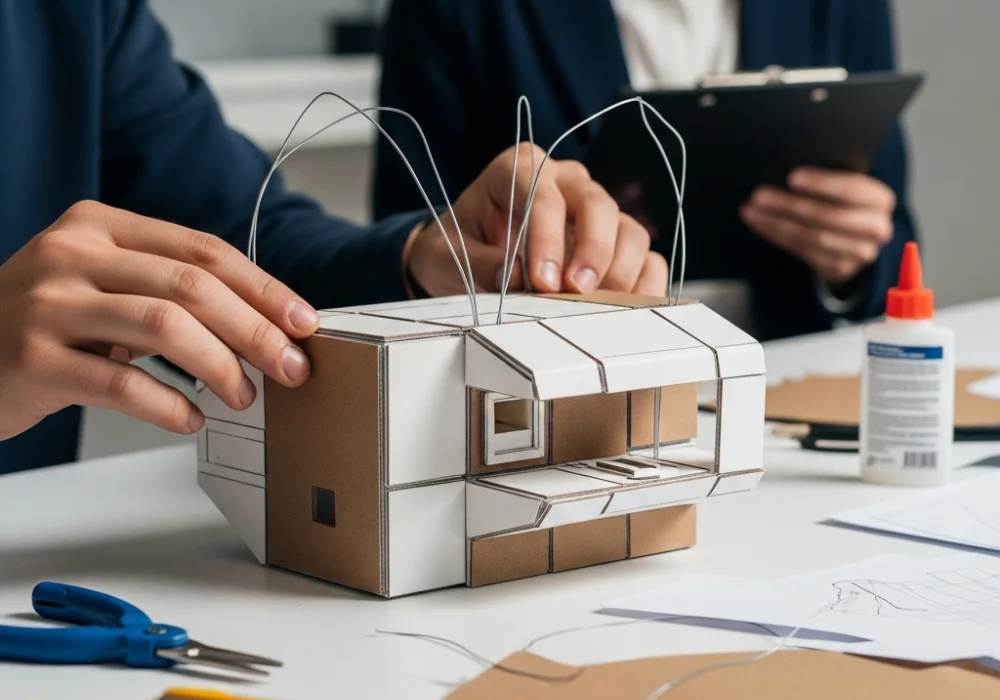
Introduction: The Future of Design in NIFT Situation Tests
As an elite panelist for the National Institute of Fashion Technology (NIFT), I have observed thousands of students attempt to translate their imagination into physical models. The Situation Test is not merely a test of your handicraft skills; it is a rigorous assessment of your design thinking, material intelligence, and ability to innovate within constraints. The upcoming entrance cycle will prioritize themes that intersect sustainability with technology. One such high-stakes scenario is the design of a sustainable modular kiosk for a hyper-local community seed bank.
In this guide, we will break down every element of this specific challenge. We are looking for a design that reflects the urgency of biodiversity conservation while maintaining a sleek, modern aesthetic suitable for a future urban landscape. Remember, a seed bank is not just a storage box; it is a monument to survival and local heritage.
The Examiner’s Secret Checklist: What Are We Evaluating?
When I walk around the examination hall, I am looking for more than just a neat model. Here is the internal rubric used by the jury:
- Concept Innovation (20%): How original is your interpretation of ‘modular’ and ‘hyper-local’? Does it look like a standard stall, or does it feel like a futuristic community hub?
- Material Manipulation (30%): This is the most critical area. We evaluate how you have changed the inherent property of the materials. Did you just use cardboard as a flat surface, or did you texture it, score it, or fold it into complex geometries?
- Thematic Execution (20%): Does the design scream ‘Seed Bank’? The use of organic shapes, protection mechanisms for the seeds, and the overall ‘sustainable’ vibe must be evident.
- Neatness and Structural Integrity (20%): Does the model stand firm? Are there visible glue marks? We look for professional finishing even in the limited 2-hour window.
- Write-up Quality (10%): Your ability to articulate your design choices in English is vital.
💡 Pro-Tip: The ‘X-Factor’ in Sustainability
To stand out, incorporate the concept of ‘Biomimicry’. Tell the jury your kiosk design was inspired by the structure of a honeycomb or the protective layers of a seed pod. This shows depth in research!
Step-by-Step Model Construction Strategy
To tackle the ‘Sustainable Modular Kiosk’ scenario, follow this structured workflow to ensure you finish 15 minutes early for final touch-ups.
Phase 1: The Modular Foundation (0-30 mins)
Modularity implies that the structure can be expanded or rearranged. Use your thick ivory board or cardboard to create ‘units’. Instead of one large block, create 3 to 4 interlocking hexagonal or cubic modules. This allows the community to add more seed storage as their collection grows.
Phase 2: Seed Protection & Storage (30-70 mins)
Seeds are fragile. They need protection from heat and moisture. Use your OHP sheets to create transparent ‘vials’ or windows within the modules. This adds a layer of aesthetic sophistication—allowing passersby to see the colorful seeds while keeping them protected behind a ‘climate-controlled’ barrier. Technique Tip: Roll the OHP sheet into cylinders and use thin wire to secure them into the cardboard frame.
Phase 3: Aesthetic Integration & Texture (70-100 mins)
Sustainability should be visible. Use jute string or brown paper to create ‘organic’ textures on the exterior. You can create a ‘living wall’ effect by shredding green tinted paper or using small clay accents to represent bio-bins. Ensure the entry and exit points are clearly defined to show functionality.
Phase 4: The Finishing Touches (100-120 mins)
Clean up any stray glue threads. Add a small ‘signage’ board using a toothpick and a scrap of paper. This signage should have a catchy name for the seed bank (e.g., ‘Eco-Vault’ or ‘The Green Legacy’).
Material Handling Masterclass
In the Situation Test, the materials provided are often basic, but your application should be extraordinary. Here is how to handle them for this specific scenario:
- Cardboard/Ivory Board: Never use them just as flat walls. Use ‘scoring’ (lightly cutting halfway through) to create curves and accordion folds. For a modular kiosk, curved walls suggest a more natural, seed-like form.
- Wire: Use wire to create ‘skeletons’ or ‘antennas’ for the kiosk. It represents the tech-integration of the 2027 era—perhaps for solar energy or community Wi-Fi within the kiosk.
- Clay: Do not use clay just for making balls. Use it as a weight at the base for stability, or flatten it out to create ‘stone paths’ leading into the kiosk.
- Aluminum Foil: Since the theme mentions protection, use foil to line the interior of the seed compartments to represent ‘thermal insulation’. This shows the jury you are thinking about the science of seed preservation.
💡 Interactive Quiz: Material Choice
Question: Which material is best suited to show a ‘transparent moisture-proof barrier’ in your seed bank model?
Answer: The OHP (Overhead Projector) sheet. It represents glass or high-grade recycled plastic in a futuristic model.
The Design Write-up: Articulating Your Vision
Your model speaks through its form, but your write-up speaks through your mind. You must explain the ‘Why’ behind the ‘What’. Use the following keywords in your 100-word explanation:
“My design for the Sustainable Modular Seed Bank Kiosk focuses on scalability and climate-resilience. Inspired by the geometric efficiency of a seed pod, the modular units allow for easy expansion within the local community. I have utilized upcycled textures to represent the hyper-local ethos, while the integrated OHP segments ensure visual transparency and protection for the indigenous seeds. The structure is designed to be a carbon-neutral community touchpoint.”
Avoid generic sentences like “It is very beautiful” or “I used cardboard and glue.” Focus on the design intent!
Frequently Asked Questions (FAQs)
Q: Is it okay if my model is small?
A: Quality over quantity. However, a model that is too tiny might lack detail. Aim for a size that fits comfortably on a 12×12 inch base, ensuring it has enough height to be visible.
Q: Can I use colors other than the materials provided?
A: No. You are strictly prohibited from using any outside material or colors. You must use the colors inherent in the materials provided. Use the contrast between white paper, brown cardboard, and silver foil to create visual interest.
Q: What if my model breaks during the final 5 minutes?
A: Don’t panic. Use a quick-fix with clay or a concealed tape joint. Design your model with a wide base to ensure stability from the start.
Struggling with your Situation Test Prep?
Our experts at MyEntrance are here to help you refine your model-making techniques and design thinking. Don’t leave your NIFT dream to chance!
💬 Chat with our Experts on WhatsApp (+91 9526806124)




