
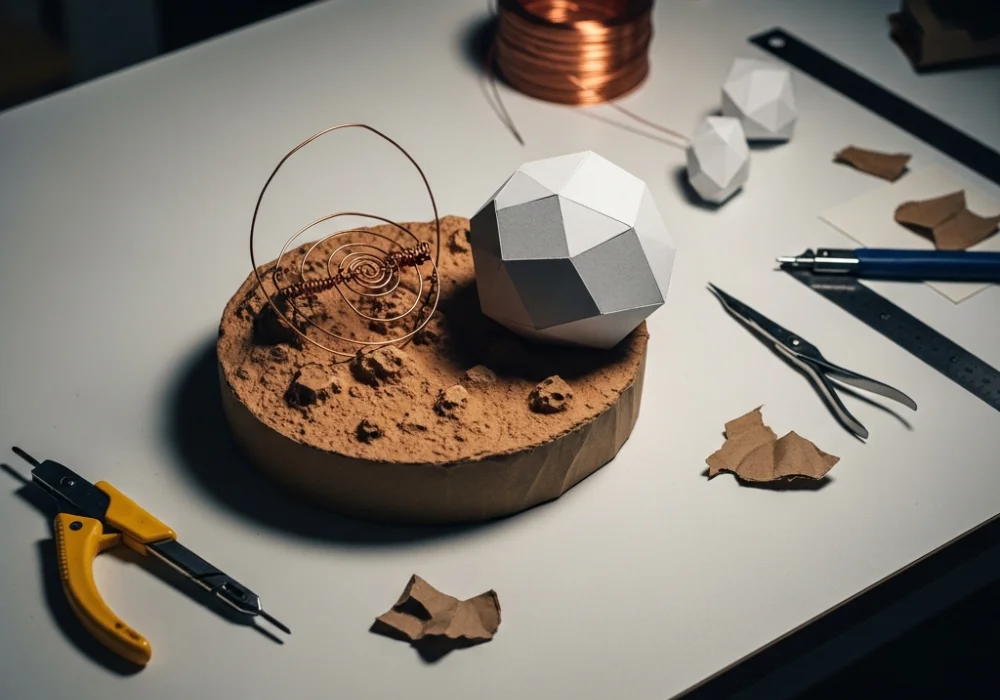
Introduction: The Red Planet Challenge
Welcome, aspiring designers. As an elite admission panelist, I have seen thousands of models, but the ones that truly stand out are those that transcend the physical constraints of the materials provided. The NIFT Situation Test is not just a test of your craft; it is a test of your imagination and empathy for a context. The challenge of creating a conceptual souvenir for a ‘Mars Tourism Agency’ is a sophisticated exercise in translating abstract environmental conditions—like low gravity, extreme dust storms, and jagged iron-rich landscapes—into a tangible object that a traveler would cherish.
In this guide, we will explore how to manipulate mundane materials like cardboard, wire, and crepe paper to mimic the otherworldly textures of Mars. We will move beyond the literal ‘planet on a stick’ and dive into conceptual form exploration that captures the essence of the Martian atmosphere.
What the Examiners are Secretly Looking For
Many students believe the Situation Test is about making a ‘beautiful’ object. While aesthetics matter, the jury uses a specific set of hidden metrics to grade your performance. Here is the breakdown of the evaluation criteria:
- Conceptual Innovation: Did you just make a rock? Or did you design a souvenir that symbolizes the ‘spirit’ of Martian exploration? We look for metaphors.
- Material Manipulation: How many different ways did you use the same material? If you only used paper as a flat surface, you lose marks. If you pleated, quilled, or crumpled it to represent the Valles Marineris canyon, you gain them.
- Structural Stability: Your model must not fall apart when the examiner moves it. This tests your understanding of joinery and balance.
- Thematic Relevance: Does the souvenir actually look like it belongs to a high-end space agency? The branding and finish must feel premium.
- Neatness: Visible glue marks (especially from a glue gun) or jagged, unrefined edges are the quickest way to lose points.
💡 Pro-Tip: The ‘White Space’ Secret
In design, what you leave out is as important as what you put in. Don’t clutter your souvenir. Use negative space to represent the vastness and emptiness of the Martian sky. A minimalist, sleek design often scores higher than a cluttered, messy one.
Material Alchemy: Mimicking Mars
1. Representing the Martian Soil (Regolith)
Mars is covered in fine, iron-oxide dust. To replicate this, use brown paper or sandpaper (if provided). Crumple the paper repeatedly into a ball and then flatten it out; this creates a network of ‘cracks’ and ‘ridges’ that look like a weathered landscape. You can also use the technique of ‘tearing’ rather than ‘cutting’ to create more natural, jagged rock formations.
2. Capturing the Atmosphere and Dust Storms
The Martian atmosphere is thin but dynamic. Transparent sheets or fine wire can be used to represent the ‘wind.’ By spiraling thin copper or GI wire around a pencil and then stretching it out, you can create a vortex-like structure that symbolizes a Martian dust devil. If you have butter paper, crumple it and use it as a translucent cloud to represent the hazy Martian horizon.
3. The ‘Agency’ Element
Remember, this is for a Tourism Agency. It needs to feel corporate and modern. Use ivory sheet or white mount board to create a stable, geometric base. A clean, sharp-edged base suggests a human-engineered structure (like a space base) amidst the chaotic Martian terrain.
Step-by-Step Model Making Strategy
Phase 1: Ideation & Sketching (15 Minutes)
Do not touch the materials yet! Spend the first 15 minutes sketching three rapid concepts. Choose the one that balances Form (the shape) and Function (a souvenir must be portable and evocative). For our Mars souvenir, let’s aim for a ‘Fragment of Mars’—a piece of the planet encapsulated in a futuristic frame.
Phase 2: The Foundation (30 Minutes)
Construct a sturdy base. A square or hexagonal base works best for souvenirs. Ensure your joints are clean. If using glue, apply it with a toothpick to avoid overflow. This base represents the ‘Agency’s’ containment of the wild planet.
Phase 3: Building the Landscape (45 Minutes)
Using the techniques mentioned earlier, build the core of your souvenir. Focus on the Contrast. Pair the rough, jagged texture of ‘rocks’ (made from corrugated cardboard) with the smooth, sweeping curves of ‘atmosphere’ (made from wire or ivory sheet). Ensure the model is visually balanced from all 360 degrees.
Phase 4: Finishing Touches (30 Minutes)
Refine your edges. If you have aluminum foil, use it sparingly to represent high-tech components or frozen carbon dioxide (dry ice) found at the Martian poles. Add a small ‘label’ or ‘logo’ area on the base to ground the object in its role as a tourism product.
💡 Check your ‘Gravity’
Since Mars has 38% of Earth’s gravity, try to make your model look ‘light.’ Use thin wire supports to make elements look like they are floating or defying gravity. This subtle touch shows the jury you have researched the topic.
The Write-Up: Your Design Manifesto
In the latest NIFT patterns, the 100-word write-up is the bridge between your model and the examiner’s mind. Do not just describe what you made; explain why you made it. Use the ‘AIDA’ format: Attention, Interest, Desire, Action.
“My souvenir, titled ‘The Pulse of Olympus,’ captures the raw duality of Mars. The jagged, hand-torn cardboard base represents the ancient, iron-rich regolith of the Tharsis region. In contrast, the sweeping wire arcs represent the thin, high-velocity winds that define the Martian climate. Designed for the latest generation of space travelers, the minimalist ivory frame signifies the agency’s commitment to safety and human ingenuity in an alien world.”
Notice the use of design terminology: ‘duality,’ ‘regolith,’ ‘minimalist,’ ‘contextual harmony.’ This language positions you as a professional student, not just a hobbyist.
Frequently Asked Questions
Can I use water to shape my paper?
Only if you have enough time for it to dry. Wet paper is fragile and can ruin your model if handled too early. Use it only for small, organic textures.
What if my model breaks in the last 10 minutes?
Don’t panic. Incorporate the break into the design if possible, or use a ‘concealer’ element like a wrap of wire or a paper fold. Design is about problem-solving!
Should I color my model?
Usually, you are only provided with colored paper, not paints. Use the intrinsic colors of the materials. Layering different shades of brown and orange paper is more effective than trying to ‘draw’ on the model.
Ready to Ace the NIFT Situation Test?
The journey from an aspirant to a NIFTian requires guidance, practice, and the right mindset. If you are struggling with material handling or conceptualizing complex themes, our experts are here to help you bridge the gap.
💬 Chat with our Experts on WhatsApp (+91 9526806124)




