
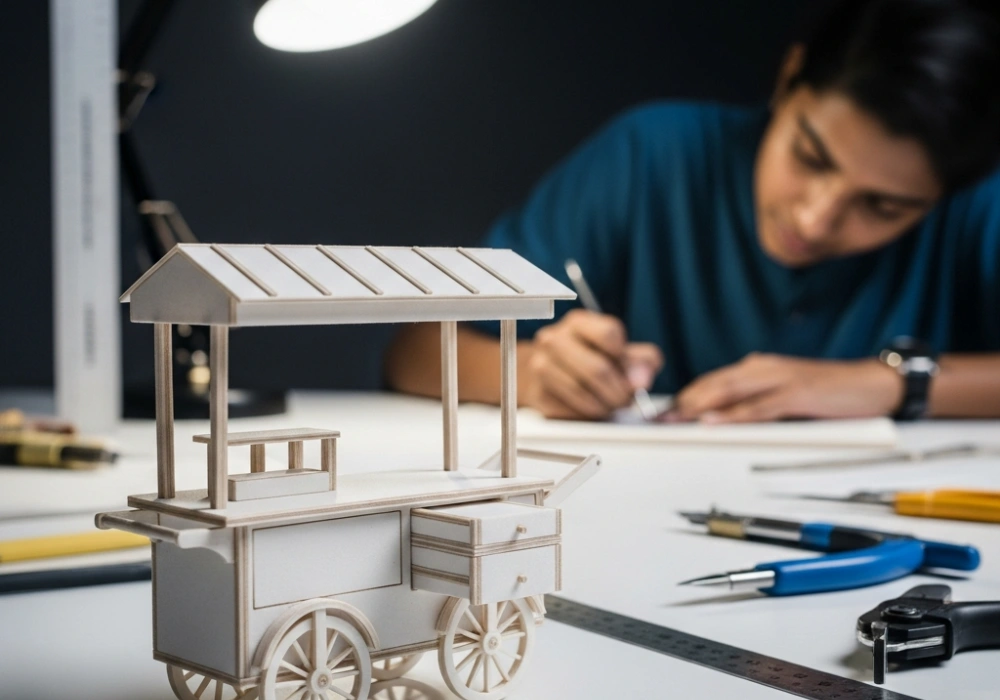
Introduction: The Rigor of the NIFT Situation Test
Welcome, future designers. As an elite panelist for the NIFT entrance examination, I have witnessed thousands of students navigate the high-pressure environment of the Situation Test. This final stage is not merely about model-making; it is about material intelligence, problem-solving, and empathy-driven design. Today, we are tackling one of the most challenging prompts: Constructing a space-saving portable workstation for a street food vendor using functional hinges and sliding mechanisms made from ivory board.
This specific task tests your ability to transform a 2D material (Ivory Board) into a 3D mechanical solution. A street food vendor operates in chaotic, cramped urban environments. Their workspace must be compact for transit yet expansive for service. To succeed, you must think like an engineer and feel like a designer.
💡 Why Ivory Board is the ‘Panelist’s Favorite’
Ivory board is thick, rigid, and has a smooth finish. It is excellent for structural integrity but requires precise scoring. Unlike corrugated sheets, it doesn’t hide mistakes. Clean cuts and invisible joints here demonstrate superior craftsmanship.
I. The Evaluation Criteria: What We Are Secretly Looking For
When I walk around the examination hall, I am not just looking at the finished model. I am observing your process. Here are the five pillars we use to grade your performance:
- Conceptual Innovation: Did you just build a box, or did you consider the vendor’s specific needs? Does it have a place for waste? Is there a shade? Does it fold logically?
- Mechanical Functionality: Do the hinges actually move? Do the sliding trays glide without snagging? This is the core of this specific prompt.
- Material Manipulation: How have you treated the ivory board? Is it messy with glue? Are the edges frayed? We look for ‘clean’ construction.
- Structural Stability: If a customer leans on the workstation, would the miniature collapse? The model must stand firm.
- The Write-up: Your 100-word explanation must articulate the ‘Why’ behind your design choices, linking ergonomics to portability.
“The best designs in the NIFT Situation Test aren’t the most complex ones; they are the most intuitive ones.”
II. Understanding the User: The Street Food Vendor
Before you touch your cutter, analyze the persona. A street vendor needs:
- Vertical Efficiency: When horizontal space is limited, go up.
- Hygiene Integration: A designated spot for a dustbin or a hand-wash nozzle.
- Quick Setup: The transition from ‘folded/transit’ mode to ‘open/working’ mode should take seconds.
- Safety: Protection from wind (for the stove) and sun (for the vendor).
💡 Pro-Tip: The ‘Golden Ratio’ of Model Making
Spend 15 minutes planning/sketching, 90 minutes building, and 15 minutes on the write-up. Never skip the planning phase; a mechanical model fails if the measurements are off by even a millimeter.
III. Mastering Ivory Board Mechanisms
1. Creating Functional Hinges
Ivory board is brittle if folded incorrectly. To create a hinge: Half-score the board on one side. Do not cut through. Fold it away from the score for a clean 90-degree edge. For a 180-degree swing hinge, use a thin strip of fabric or reinforced paper glued between two layers of ivory board to act as a ‘flexible spine’.
2. Engineering Sliding Mechanisms
To create a sliding tray for extra counter space: Build a ‘C-channel’ (a track) using three strips of ivory board. The tray should be slightly narrower than the track. Use a tiny bit of wax or a pencil lead on the edges to reduce friction—this shows a high level of technical awareness.
3. The ‘Telescopic’ Pillar
If your workstation needs a roof, use rolling techniques. Roll the ivory board into tight cylinders of varying diameters so one fits inside the other. Secure them with a ‘pin’ (a toothpick or a wire) to create an adjustable height mechanism.
IV. Step-by-Step Construction Strategy
Step 1: The Chassis (The Foundation)
Start with a sturdy base. Use a double-layered ivory board for the floor of the workstation. Incorporate four wheels (made by layering circular cutouts). Ensure the base is heavy enough to prevent the model from tipping when the sliding trays are extended.
Step 2: The Main Vertical Unit
Build the central storage unit. Use internal ‘ribs’ (support walls) to keep the ivory board from bowing. This is where the vendor would store raw materials. Leave an opening for the ‘sliding tray’ to emerge.
Step 3: Integrating the Expandable Counter
Construct a flat surface that slides out from the main unit. This increases the surface area by 50% without increasing the footprint during transit. Ensure you add a ‘stopper’ so the tray doesn’t fall out completely.
Step 4: The Fold-Down Display
Use your hinge technique to create a front panel that folds down to become a customer serving ledge. When closed, it protects the inventory; when open, it creates an ergonomic interaction point.
Step 5: Aesthetics and Detailing
Use bits of wire for handles or a small piece of mesh for a ventilation window. These ‘micro-details’ are what push a score from ‘Average’ to ‘Excellent’.
V. Common Mistakes to Avoid
- Over-gluing: Fevicol stains on white ivory board are a major turn-off for panelists. Use it sparingly.
- Ignoring Scale: Ensure a human hand (hypothetically) could reach the controls. If the counter is too high or the sliding tray too low, the design is ergonomically flawed.
- Weak Hinges: If the hinge flops or tears, your ‘functional’ claim is void. Reinforce the fold with a thin layer of tape on the inside where it’s not visible.
- Generic Design: Don’t just build a cart. Add a specific feature like a built-in spice rack or a waste segregation slot to show design depth.
🔍 Quick Quiz: The Panelist’s Perspective
Q: What is more important: A beautiful model that doesn’t move, or a slightly rough model with perfect mechanisms?
A: In this specific prompt, the ‘functional’ aspect is key. However, at NIFT, we expect both. If you must choose, prioritize the mechanism but keep the finish as clean as possible. A broken mechanism usually results in a significant mark deduction.
Need Personalized Feedback on Your Models?
The Situation Test is the final hurdle between you and your dream NIFT campus. Don’t leave it to chance. Our experts provide one-on-one sessions, mock tests, and material handling workshops.
💬 Chat with our Experts on WhatsApp (+91 9526806124)




