
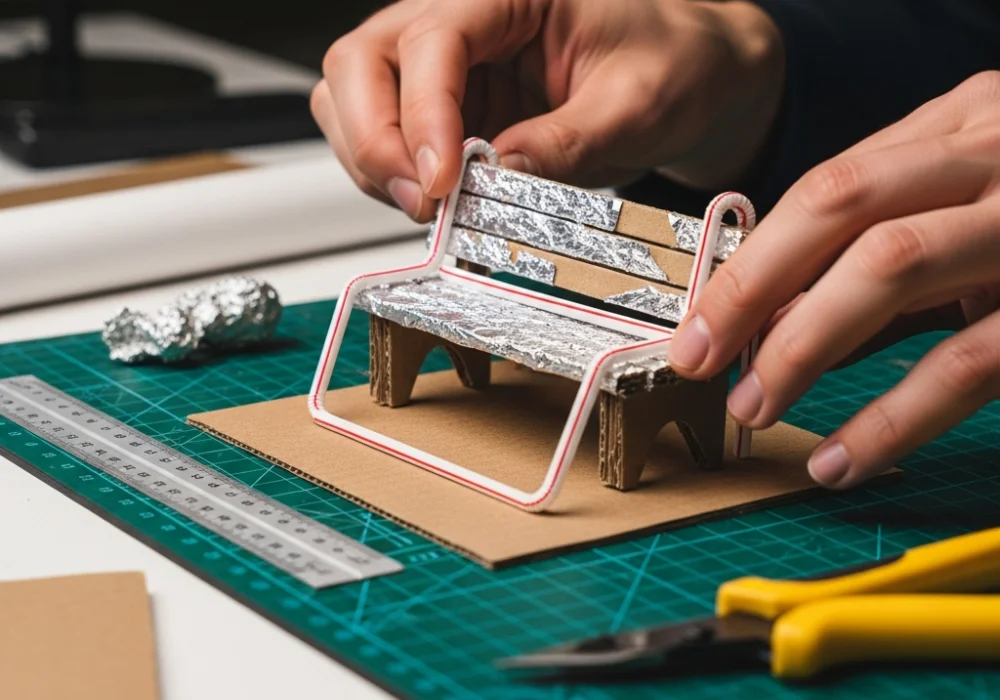
Introduction: The Gateway to NIFT
The Situation Test is perhaps the most nerve-wracking yet exhilarating stage of the National Institute of Fashion Technology (NIFT) admission process. As an elite panelist who has observed thousands of models, I can tell you that we aren’t just looking for a ‘pretty’ object. We are looking for a designer’s mind at work. This masterclass focuses on a complex, multi-layered brief: Designing a futuristic, eco-friendly park bench with a self-watering planter system.
This scenario tests your ability to merge ergonomics (comfort), innovation (futuristic elements), and utility (the self-watering system). In the next 120 minutes of your life—if this were the actual exam—you would need to transform raw cardboard, flimsy straws, and shiny aluminum foil into a narrative-driven prototype. Let’s dive deep into how you can dominate this challenge.
The Panelists’ Perspective: What We Secretly Look For
Before you pick up your cutter, you must understand the scorecard. Many students focus solely on the model, but the evaluation is holistic. Here is the breakdown of our secret criteria:
- Conceptual Innovation: Does the bench look like a standard park seat, or does it push the boundaries of ‘futuristic’? We look for organic shapes, modularity, and smart integration of technology.
- Material Manipulation: Can you make cardboard look like something else? Have you used the foil for texture or just as a wrapper? The way you score, fold, and join materials tells us about your technical dexterity.
- Structural Integrity: If a tiny imaginary person sat on your bench, would it collapse? A design that cannot stand on its own or looks fragile will lose marks.
- Observation of the Brief: Did you include the self-watering system? Many students get so caught up in the bench that they forget the ‘integrated planter’ requirement.
💡 Click to Reveal: The ‘X-Factor’ Tip
The ‘X-Factor’ is Empathy. Design for a specific user. Is it a bench for an elderly person who needs armrests? Or a sleek pod for tech-savvy youth? Mentioning your ‘target user’ in your write-up adds immediate depth to your score.
Material Mastery: Cardboard, Straws, and Foil
Each material provided in the NIFT kit has a personality. You must respect the material to master it.
1. The Strength of Cardboard
Cardboard is your primary structural element. Use the ‘grain’ of the cardboard to your advantage. For curved seating surfaces, ‘score’ the cardboard (make light cuts halfway through) to create smooth, rounded edges without snapping the material. Avoid using too much glue; visible glue marks are a sign of an amateur.
2. The Versatility of Straws
In this specific prompt, straws are your best friend for the self-watering system. Use them as ‘pipes’ or ‘conduits’ that connect the reservoir to the planters. You can also use straws as internal skeletons for cardboard structures to provide extra load-bearing support.
3. The Magic of Aluminum Foil
Foil represents the ‘futuristic’ and ‘eco-friendly’ aspects. Use it to simulate solar panels, metallic finishes, or even a water-reflective surface within your irrigation system.
Pro Tip: Crumple the foil and then flatten it out to create a unique ‘mercurial’ texture that catches the light beautifully.
Step-by-Step Construction Strategy
Manage your 2 hours (120 minutes) using the 10-90-20 rule: 10 mins planning, 90 mins building, 20 mins for the write-up and cleaning.
Step 1: Ideation & Sketching (0-10 Mins)
Do not skip this. Quickly sketch a 3D isometric view of your bench. Decide where the planters will sit. For a futuristic look, consider a ‘Cantilever’ design or a ‘Mobius Strip’ inspired loop. Label the self-watering mechanism: Reservoir → Pipes (Straws) → Planter.
Step 2: Base & Foundation (10-30 Mins)
Create a sturdy base using a double layer of cardboard. This provides a ‘site’ for your park. Use the foil to create a path or grass texture (by coloring or shredding cardboard) around the bench area.
Step 3: The Main Structure (30-70 Mins)
Construct the seating. To make it ‘futuristic’, avoid 90-degree angles. Use triangles or hexagons. Integrate the planters directly into the armrests or the backrest. Use the scoring technique to create a comfortable, ergonomic curve for the seat.
Step 4: The Self-Watering System (70-90 Mins)
This is your USP. Use straws to create a visible ‘piping’ network that runs from a central reservoir (made of foil-covered cardboard) to the planters. Make it look like a high-tech irrigation system. The foil can represent a ‘smart sensor’ that triggers watering.
Step 5: Finishes & Details (90-100 Mins)
Add ‘aesthetic’ details. Use straws to create a trellis for the plants to grow on. Use foil to create buttons or an interface on the bench where a user could check the water levels.
The Crucial Component: The Write-Up
In the latest NIFT evaluation cycles, the write-up has gained immense importance. Your model might be abstract, but your words must be concrete. Your write-up should include:
- Design Concept: Explain why it is ‘futuristic’ (e.g., ‘The Helios Bench’ uses solar-reflective foil to power its internal pump).
- Sustainability Quotient: How is it eco-friendly? (e.g., The system uses harvested rainwater stored in the base).
- Material Usage: Explicitly state why you chose certain materials for certain parts (e.g., ‘Straws were utilized to mimic the industrial aesthetics of water conduits’).
💡 Quick Quiz: Test Your Strategy
Question: What should you do if your model feels unstable 15 minutes before the end?
Answer: Do not try to rebuild. Instead, use ‘buttresses’ (triangular cardboard supports) at the base and integrate them as ‘aesthetic design elements’ in your write-up. Always turn a technical failure into a design feature!
Expert Checklist for the Final 5 Minutes
Before the invigilator says “Stop,” ensure you have ticked these boxes:
- Cleanliness: Have you removed all the ‘glue cobwebs’ (dried glue strands)?
- Stability: Does the model stay upright if someone bumps the table?
- Waste Management: Is your workspace clean? Panelists hate a messy worker.
- Tagging: Is your roll number and name clearly visible on the provided tag?
Remember, the Situation Test is a test of your temperament as much as your design skill. Stay calm, keep a steady hand, and let your creativity flow into the cardboard.
Ready to Crack the Latest NIFT Entrance?
Don’t leave your design dreams to chance. Get personalized feedback on your models and professional guidance for the upcoming NIFT Situation Test.
💬 Chat with our Experts on WhatsApp (+91 9526806124)




