
Introduction: The Intersection of Biology and Technology
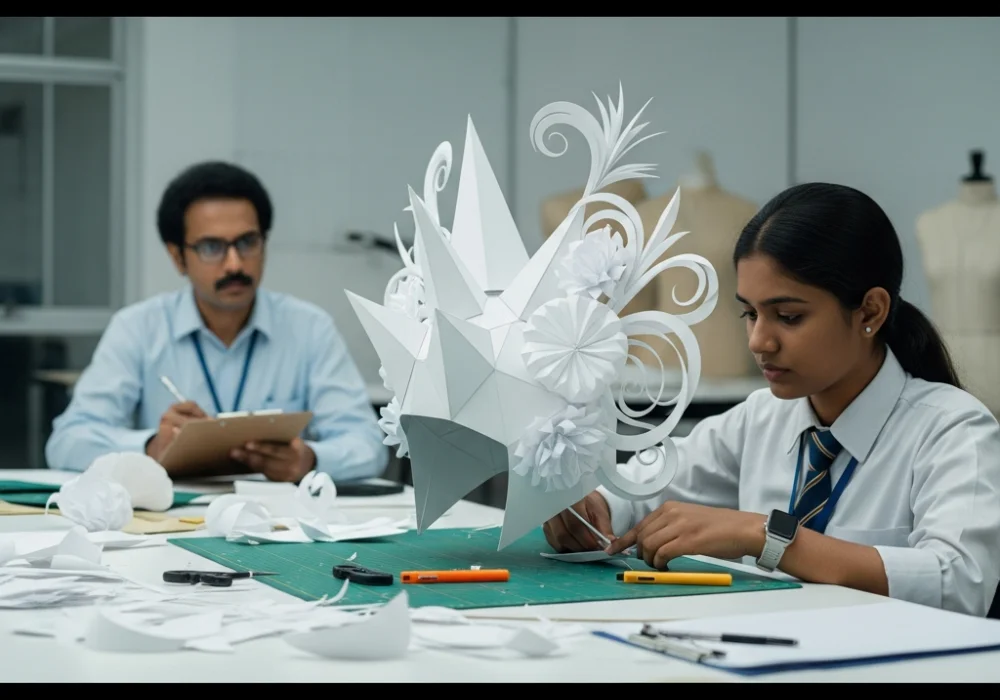
Welcome, future designers, to a masterclass designed to sharpen your creative instincts for the NIFT Situation Test. Today, we tackle one of the most intellectually stimulating and technically demanding scenarios: constructing a conceptual headgear based on the theme ‘Cybernetic Nature’. As an elite admission panelist, I have witnessed thousands of models, but the ones that truly stand out are those that transcend simple mimicry and enter the realm of conceptual storytelling. The theatrical stage demands visibility, drama, and a clear narrative. Your task is not just to build a hat, but to define a character who exists at the edge of the organic world and the digital frontier. In this guide, we will explore how to harmonize the fluidity of nature with the rigid precision of cybernetics, ensuring your model is both structurally sound and aesthetically groundbreaking.
💡 Click to Reveal: The Panelist’s Secret Perspective
When we walk around the tables, we don’t just look for ‘pretty’ models. We look for ‘intentionality’. Every fold, every geometric shard, and every organic curve must have a reason for existing. Avoid ‘over-decorating’; instead, focus on ‘designing’ a solution to the prompt.
The Evaluation Rubric: What We Are Secretly Looking For
To excel in the Situation Test, you must understand the four pillars of assessment used by the NIFT jury. Your ‘Cybernetic Nature’ headgear will be judged on:
- Concept Innovation (25%): How have you interpreted the theme? Are you just sticking a paper gear onto a leaf shape, or have you integrated them? A truly ‘cybernetic’ nature might mean a leaf where the veins are represented by copper wires or a flower that unfolds like a mechanical aperture.
- Material Handling & Technique (25%): This is about your ‘craftsmanship’. Are there visible glue marks? Is the paper frayed? Have you used the materials provided in a way that respects their properties? Using a soft material to create a sharp edge, or a rigid material to simulate a curve, shows mastery.
- Aesthetic Appeal & Composition (25%): This involves the ‘visual balance’. Does the headgear look heavy on one side? Is the scale appropriate for a theatrical performer? The mix of organic (curved, soft, irregular) and geometric (sharp, angular, symmetrical) must feel like a single, cohesive language.
- Structural Stability (25%): A headgear must be wearable. If it collapses when someone moves their head, it fails as a functional design. Your internal structure—the ‘skeleton’ of your model—is as important as the ‘skin’.
💡 Pro-Tip: The ‘Shake’ Test
Gently shake your table. If your model wobbles or parts fall off, the jury will notice. Ensure every joint is reinforced with ‘mechanical’ connections like slots or tabs, not just a thin layer of glue.
The Design Philosophy: Cyber-Organicism
Before touching your materials, you must conceptualize. ‘Cybernetic’ refers to control systems, computers, and mechanical logic. ‘Nature’ refers to the wild, the floral, and the biological. When combined, we get a futuristic evolution. Think about Biomimicry—where technology copies nature. For your theatrical headgear, consider the following visual elements:
The Organic Elements
- Fractals: Repeating patterns found in ferns and snowflakes. Use these to bridge the gap between nature and math.
- Growth Patterns: Spirals (like a nautilus shell) or radial symmetry (like a sunflower).
- Fluidity: Using paper to create ‘flowing’ surfaces that mimic petals or muscles.
The Geometric Elements
- Crystalline Structures: Hexagons and triangles signify digital precision.
- Exoskeletons: Hard, outer shells that look like armor or computer casings.
- Circuits: Linear paths and 90-degree angles that suggest the flow of information.
“Design is not just what it looks like and feels like. Design is how it works, especially when merging two opposing worlds like the organic and the synthetic.”
Material Handling Strategy: Mastering Your Toolkit
In the upcoming Situation Test, you will likely be given cardstock, corrugated sheets, wire, translucent paper, and perhaps some thread or clay. Here is how to handle them for this specific theme:
1. Paper Manipulation
To create the organic side of ‘Cybernetic Nature’, use curving and quilling. By drawing the edge of a scissor along a strip of paper, you can create vines or stamens. For the cybernetic side, use scoring. By lightly cutting halfway through the cardstock, you can create sharp, professional 90-degree or 45-degree folds that mimic metallic plates.
2. Wire as the ‘Nervous System’
Wire is perfect for the ‘Cyber’ aspect. Instead of hiding it, make it visible. Run it through your model like a glowing circuit or a robotic spine. If you provide a ‘root’ system at the base of the headgear, twist the wires together like a bundle of cables.
3. The Corrugated Sheet: The Foundation
The corrugated sheet is your strongest material. Use it for the base ring of the headgear. If you peel the top layer off, you get a ‘ribbed’ texture that looks incredibly industrial—perfect for a cybernetic aesthetic. Use these ribs to represent the ‘motherboard’ of your nature-machine hybrid.
💡 Quick Quiz: Which glue technique is best?
Answer: ‘Invisible’ gluing. Always apply glue to a scrap piece of paper first, then use a toothpick to apply a tiny amount to your model. ‘Globs’ of glue are the quickest way to lose marks for neatness.
Step-by-Step Construction Strategy
Time management is your greatest enemy. You have two hours. Break them down as follows:
Phase 1: The Skeleton (00:00 – 00:20)
Measure a strip of corrugated sheet or thick cardstock to fit a standard human head circumference (approx. 22-23 inches). Secure it into a circle. This is your ‘chassis’. Everything else will hang from or sit on this ring. Ensure it is sturdy.
Phase 2: The Organic Growth (00:20 – 00:50)
Create the ‘Nature’ base. I recommend building a large, stylized flower or a series of overlapping leaf-like petals using translucent paper. Use a ‘pleating’ technique to give the petals volume. Position these as the dominant aesthetic on one side of the headgear to create an asymmetrical, dramatic theatrical look.
Phase 3: The Cybernetic Integration (00:50 – 01:20)
Now, ‘invade’ the organic shapes with geometry. Construct small cubes, pyramids, or hexagonal prisms from white cardstock. Nestle these inside the petals or have them erupting from the center of the flower. Use wire to connect the geometric shapes, creating a ‘network’ that spans across the organic forms.
Phase 4: Detailing and Texturing (01:20 – 01:45)
Add ‘micro-details’. Cut tiny squares to represent pixels falling from a leaf. Peel the corrugated sheet to reveal the texture. If you have thread, wrap it around sections of the wire to represent ‘insulated cables’. Ensure every angle of the headgear (front, back, and sides) has a visual interest.
Phase 5: The Cleanup (01:45 – 02:00)
Remove all stray glue strings. Ensure the model is firmly attached to the base. If you have extra time, reinforce any weak joints.
The Concept Note: Articulating Your Vision
In the final 10-15 minutes, you must write a brief explanation. Do not just describe what you built; explain why. A sample write-up for this topic might look like this:
“Title: The Techno-Flora Crown. This headgear represents the symbiotic relationship between biological life and synthetic intelligence. The base utilizes fluid, translucent petals to symbolize the fragility of nature, while the central geometric core signifies the calculating precision of a cybernetic mind. The ‘circuit-wire’ roots emerging from the organic forms suggest a future where nature no longer grows from soil, but from data and energy. For a theatrical performer, the height and sharp angles provide a commanding presence on stage, while the asymmetrical balance suggests a character in a state of evolution.”
💡 Pro-Tip: The ‘Keywords’ Advantage
Use design terminology in your write-up: ‘Negative space’, ‘Asymmetry’, ‘Juxtaposition’, ‘Ergonomics’, and ‘Visual Rhythm’. This signals to the panelist that you have a formal design vocabulary.
Final Preparation Checklist
Before you walk into that exam hall, remember these three rules:
- Keep it Clean: A simple, clean model beats a complex, messy one every time.
- Use Every Material: Even if you only use a small piece of each material provided, it shows the jury you are resourceful.
- Don’t Panic: If something breaks, incorporate it. A broken geometric piece can become a ‘system error’ in your cybernetic theme!
The Situation Test is a test of your 3D thinking and your ability to remain calm under pressure. By following this ‘Cybernetic Nature’ strategy, you are not just making a model; you are demonstrating the mindset of a future NIFT graduate. Good luck!
🚀 Ready to Ace your NIFT Entrance?
Don’t leave your design career to chance. Get expert feedback on your models, practice with real-time mock tests, and clear all your doubts with our specialized mentors.
💬 Chat with our Experts on WhatsApp (+91 9526806124)




