
Introduction: Your Path to NIFT Success
The NIFT Situation Test is a crucial phase of the National Institute of Fashion Technology entrance examination, accounting for a significant weightage in the final merit list. Unlike the preliminary written tests (CAT and GAT) which assess your imagination and logic on paper, the Situation Test evaluates your ability to translate concepts into three-dimensional forms using a limited set of materials. Preparing at home might seem daunting without a studio environment, but with the right strategy, material kits, and guidance from myentrance.in, you can master this practical challenge.
Table of Contents
1. Understanding the Evaluation Criteria
Before you pick up a cutter, you must understand what the NIFT examiners are looking for. It is not just about a ‘pretty’ model; it is about design thinking. The evaluation is multifaceted, focusing on several core competencies:
- Innovation & Creativity: How unique is your solution to the given problem?
- Material Handling: Can you manipulate difficult materials like wire or plastic sheets effectively without creating a mess?
- Structural Stability: Does your model stand on its own, or is it flimsy?
- Aesthetic Appeal: Is the model visually balanced and neat? (No visible glue marks!)
- Concept Transformation: How well did you translate the theme (e.g., ‘A Tea Stall for a Busy Subway’) into the 3D model?
💡 Pro-Tip: The ‘Neatness’ Factor
NIFT examiners look at the bottom and back of your model. Ensure there are no loose threads, jagged edges, or excessive glue blobs. A simple, clean model often scores higher than a complex, messy one.
2. The Essential Home Practice Toolkit
To simulate the actual exam environment at home, you need to procure a specific kit. The NIFT provides a limited set of materials on the day of the exam. Here is what you should have at your desk:
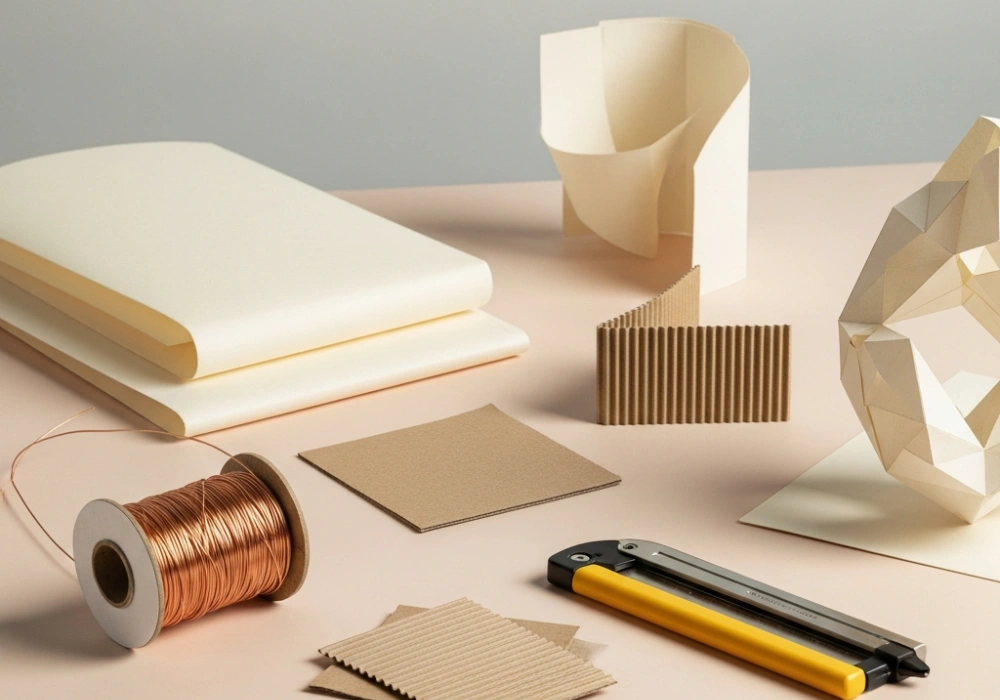
- Papers & Boards: Ivory sheets, corrugated sheets, pastel paper, and handmade paper.
- Flexibles: Copper/Aluminum wire, thread, wool, and ribbon.
- Found Objects: Straws, ice cream sticks, toothpicks, and cotton balls.
- Tools: Paper cutter, scissors, steel ruler, and a variety of adhesives (Fevicol, double-sided tape, and clear tape).
- Optional items for texture: Sandpaper, foil, or bubble wrap.
By practicing with these specific items, you build muscle memory for how each material behaves when cut, folded, or bonded. Check out the mock tests on myentrance.in to see the types of material lists provided in previous years’ exams.
3. Mastering Material Manipulation Techniques
Material manipulation is the core of the Situation Test. You are expected to show professional-grade craft. Here are the techniques you must master during your home preparation:
Paper Engineering
Don’t just fold paper; engineer it. Learn techniques like ‘Pleating’ for volume, ‘Quilling’ for detail, and ‘Scoring’ for sharp, geometric folds. Scoring is using a blunt edge (or light pressure with a cutter) to create a crease that allows for a perfectly straight fold without cracking the paper fiber.
Working with Wire
Wire is often the ‘skeleton’ of your model. Learn how to wrap thread around wire for color and texture, or how to create spiral structures that provide both height and stability. Avoid using too much tape on wire; try ‘interlocking’ or ‘looping’ instead.
Corrugated Sheet Mastery
Corrugated sheets are excellent for providing structural strength. However, they are difficult to curve. To create a curved surface with corrugated board, peel off one side of the paper layer to expose the internal ‘fluting’. This makes the board flexible and adds a rhythmic texture to your model.
4. The Art of the Explanatory Write-Up
Many students spend 1.5 hours on the model and only 5 minutes on the write-up. This is a mistake. The write-up is where you justify your design choices to the examiner. It should follow a logical flow:
- Concept/Inspiration: What is the core idea behind your design?
- Material Usage: Why did you choose corrugated board for the roof? (e.g., “To represent durability and urban grit”).
- User Experience: How does the intended user interact with your model?
- Design Elements: Mention the use of rhythm, balance, or focal points.
💡 Pro-Tip: Vocabulary Matters
Use design terminology in your write-up. Words like ‘Ergonomics’, ‘Abstract’, ‘Juxtaposition’, and ‘Symmetry’ demonstrate a mature design mindset that examiners appreciate.
5. Structured Practice Schedule
Consistency is key. Follow this 4-week plan at home to sharpen your skills:
- Week 1: Exploration. Spend time manipulating one material daily. Day 1: Only Wire. Day 2: Only Paper. Understand their limits.
- Week 2: Component Building. Practice making specific items like a human figurine, a tree, a chair, or a futuristic vehicle.
- Week 3: Speed Tests. Set a timer for 2 hours. Pick a prompt from myentrance.in and complete the model and write-up within the time limit.
- Week 4: Mock Exams. Simulate the full exam experience twice a week. Work in a restricted space with only the allowed materials.
Material Mastery Comparison Table
| Material | Best Use Case | Common Mistake | Pro Handling Tip |
|---|---|---|---|
| Ivory Sheet | Clean walls, geometric shapes | Fingernail marks / dirty edges | Always score before folding. |
| Copper Wire | Linear forms, supports, figurines | Visible tape or messy joints | Use ‘intertwining’ for joints. |
| Corrugated Sheet | Base plates, heavy structures | Rough cutting edges | Use a sharp blade at a 45-degree angle. |
| Clay / Dough | Organic forms, small details | Cracking as it dries | Smooth with a drop of water. |
Frequently Asked Questions (FAQs)
Can I use colors in the NIFT Situation Test?
Usually, you are only allowed to use the materials provided in the kit. If colored paper or pens are provided, you can use them. Using external materials is strictly prohibited and can lead to disqualification.
What if my model falls down during the evaluation?
Structural stability is a key marking criterion. Ensure your model has a sturdy base. Use ‘triangulation’ in your structures to provide extra strength and prevent collapses.
How important is the write-up compared to the model?
While the model is primary, the write-up accounts for roughly 20-30% of the Situation Test marks. It provides context to your design and helps the examiner understand your creative process.
Quick Knowledge Check
Test your understanding of the NIFT Situation Test requirements!
1. Which technique is used to create a clean, sharp fold in thick paper?
See Answer
The answer is Scoring. Using a blunt edge to compress the fibers makes folding precise.
2. What should you do if you have excess glue on your model?
See Answer
Wipe it off immediately using a scrap piece of paper or a toothpick. Visible glue marks reduce your ‘Neatness’ score.
3. Is it better to make a very complex model or a clean, simple one?
See Answer
A clean, simple model with a strong concept is usually preferred over a complex but messy and unstable one.
Ready to Ace the Situation Test?
Get access to the latest pattern mock tests, material handling tutorials, and expert feedback at myentrance.in. Join thousands of successful NIFT aspirants today!
💬 Chat with our Experts on WhatsApp (+91 9526806124)




