
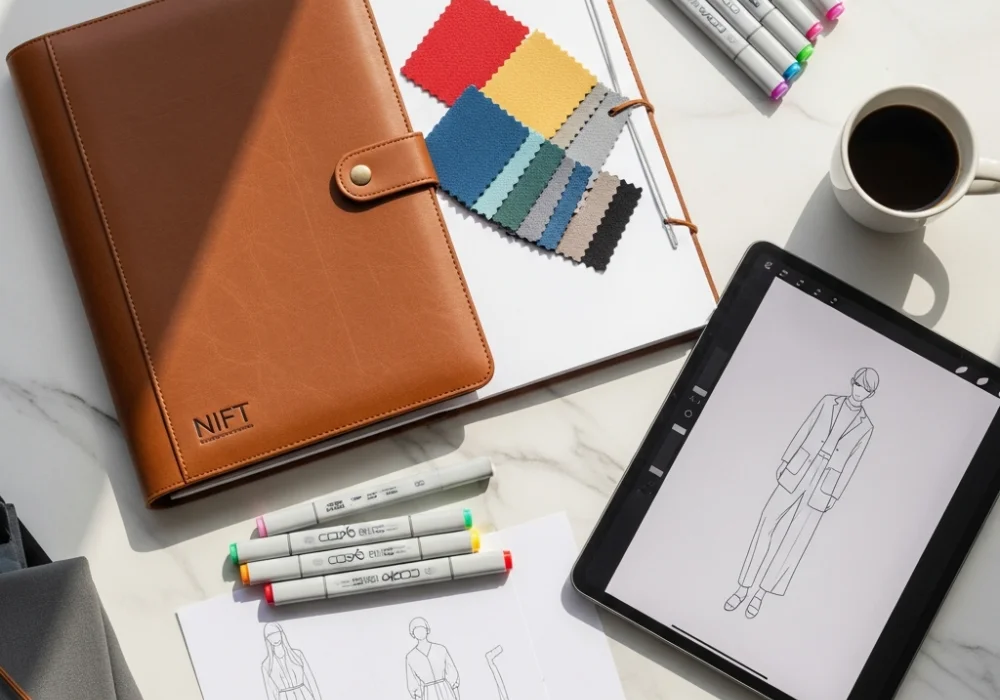
Introduction: The Gateway to Design Excellence
For aspiring designers aiming to secure a seat at the National Institute of Fashion Technology (NIFT), the portfolio is more than just a collection of drawings; it is a visual autobiography. Whether you are preparing for the Bachelor of Design (B.Des) or Master of Design (M.Des) programs, your portfolio serves as a testament to your creativity, technical aptitude, and unique perspective. In the current competitive landscape, merely having good sketches is insufficient. To stand out, candidates must adhere to industry-level presentation standards that reflect a deep understanding of design thinking and professional aesthetics.
While the NIFT Situation Test and GAT/CAT examinations evaluate your immediate problem-solving and aptitude skills, the portfolio (often required during personal interviews for PG courses or as a supplementary tool for UG interactions) showcases your long-term growth. At myentrance.in, we understand the nuances of these creative assessments. Beyond practicing with our latest pattern mock tests, crafting a winning portfolio is the final hurdle in your journey toward a design career.
Table of Contents
The Strategic Purpose of a Design Portfolio
In the academic and professional design world, a portfolio is used to assess four critical domains: Innovation, Technical Skill, Documentation, and Consistency. Unlike a standard art folder, a winning NIFT portfolio must demonstrate the evolution of an idea from its inception to its final execution. This process is often more valuable to the jury than the finished product itself.
- Ideation: Showing how you brainstormed and conceptualized your project.
- Material Exploration: Your ability to handle various mediums like charcoal, watercolors, clay, or digital software.
- Visual Literacy: Understanding of color theory, typography, and composition.
- Perspective: Your unique voice as a designer and what you can contribute to the industry.
💡 Pro-Tip: The ‘Process Over Result’ Rule
Always include rough sketches, mind maps, and discarded iterations. This shows the jury that you possess design thinking skills and are not just ‘lucky’ with a final drawing.
Core Requirements for NIFT Portfolios
NIFT expectations vary slightly depending on the specialization, but the general requirements for the latest pattern include a balanced mix of creative and analytical work. An ideal portfolio should contain 15 to 20 high-quality projects rather than 50 mediocre ones.
Essential Components
- Freehand Sketching: Still life, human anatomy, and live sketching.
- Color & Composition: 2D and 3D designs demonstrating the principles of balance, rhythm, and contrast.
- Design Specialization: If you are interested in Fashion Design, include garment illustrations; for Accessory Design, show product sketches; for Communication Design, include photography or graphic layouts.
- Creative Writing & Narrative: Brief descriptions (30-50 words) explaining the ‘Why’ behind each project.
Physical vs. Digital: A Comparative Analysis
In the current admission cycle, many interviews have moved to a hybrid or fully online format. Understanding how to present your work across different mediums is crucial.
| Feature | Physical Portfolio | Digital Portfolio (PDF/Website) |
|---|---|---|
| Tactile Feel | High – Allows jury to touch fabrics/textures. | None – Relies on high-res photography. |
| Portability | Low – Bulky and heavy to carry. | High – Instantly shareable via link or USB. |
| Editing | Hard – Requires physical re-printing. | Easy – Can be updated in minutes. |
| Visual Impact | Traditional and professional aesthetic. | Modern and tech-savvy aesthetic. |
Industry Standards for Presentation
To reach international standards, your portfolio must follow a specific layout philosophy. The design industry currently favors minimalism, where the work takes center stage without distracting backgrounds.
1. The Rule of Consistency
Use a maximum of two font families throughout your portfolio. One for headings (Sans-serif like Montserrat or Helvetica) and one for body text. Ensure margins are consistent across all pages.
2. Photography Quality
If you are digitizing physical artwork, ensure they are photographed in natural daylight. Avoid using flash, as it creates harsh glares on pencil strokes or glossy paints. Use a tripod to ensure there is no motion blur.
3. The “Hook” Page
Your first project should be your strongest. It needs to grab the examiner’s attention within the first 10 seconds. Conversely, your last project should be memorable, leaving a lasting impression on the jury.
💡 Click to Reveal: The Best Portfolio Size
While A3 is the traditional standard for physical folders, A4 is often preferred for digital PDFs as it scales perfectly on laptop screens. For NIFT, stick to A3 for physical submissions unless specified otherwise.
Step-by-Step Construction Guide
Building a winning portfolio doesn’t happen overnight. It requires a structured approach similar to how you would study for your entrance exams on myentrance.in.
- Curation: Go through all your sketches from the past year. Select works that show variety. Don’t just show 10 portraits; show one portrait, one landscape, one abstract piece, and one product design.
- Digitization: Scan your work at 300 DPI for high-quality printing or digital display.
- Layouting: Use software like Adobe InDesign, Canva, or even PowerPoint to arrange your work. Each page should have a clear title and a brief description.
- Peer Review: Show your portfolio to mentors or fellow design aspirants. Fresh eyes can catch errors you might have missed.
Common Mistakes to Avoid
Many talented students fail the interview stage because of these avoidable errors:
- Plagiarism: Never include work inspired too heavily by Pinterest or Instagram without giving it your unique twist. The NIFT jury can spot ‘copied’ styles easily.
- Over-decoration: Using glitter, excessive stickers, or messy borders distracts from your actual art. Keep it clean.
- Lack of Variety: Showing only one type of medium (e.g., only pencil shading) suggests you are afraid to experiment with color or 3D forms.
Quick Knowledge Check
Test your understanding of NIFT portfolio standards!
1. What is more important to the NIFT jury: the final result or the design process?
💡 See Answer
The design process. Showing how you reached a solution is more critical than the final artwork.
2. How many projects are typically recommended for a professional portfolio?
💡 See Answer
15 to 20 high-quality projects that demonstrate a range of skills.
3. True or False: You should only use one font throughout your portfolio.
💡 See Answer
False. You can use up to two font families to create a visual hierarchy between headings and body text.
Frequently Asked Questions (FAQs)
Is a portfolio mandatory for NIFT B.Des?
While not strictly mandatory for the initial entrance exams, it is highly recommended to carry one for the Situation Test or any interaction sessions to showcase your aptitude and dedication.
Can I include digital art in my portfolio?
Yes! Including digital illustrations, 3D renders, or graphic designs shows that you are updated with the latest industry tools and software.
How do I explain my projects if I’m not good at writing?
Use bullet points. Mention the ‘Inspiration’, ‘Materials Used’, and ‘Key Learning’. Keep it concise and professional.
Ready to Ace Your NIFT Entrance?
Preparing a portfolio is just one part of the journey. To ensure you clear the cutoff, you need rigorous practice with the latest exam patterns. Explore our comprehensive mock test series and study material designed by experts.
💬 Chat with our Experts on WhatsApp (+91 9526806124)




