
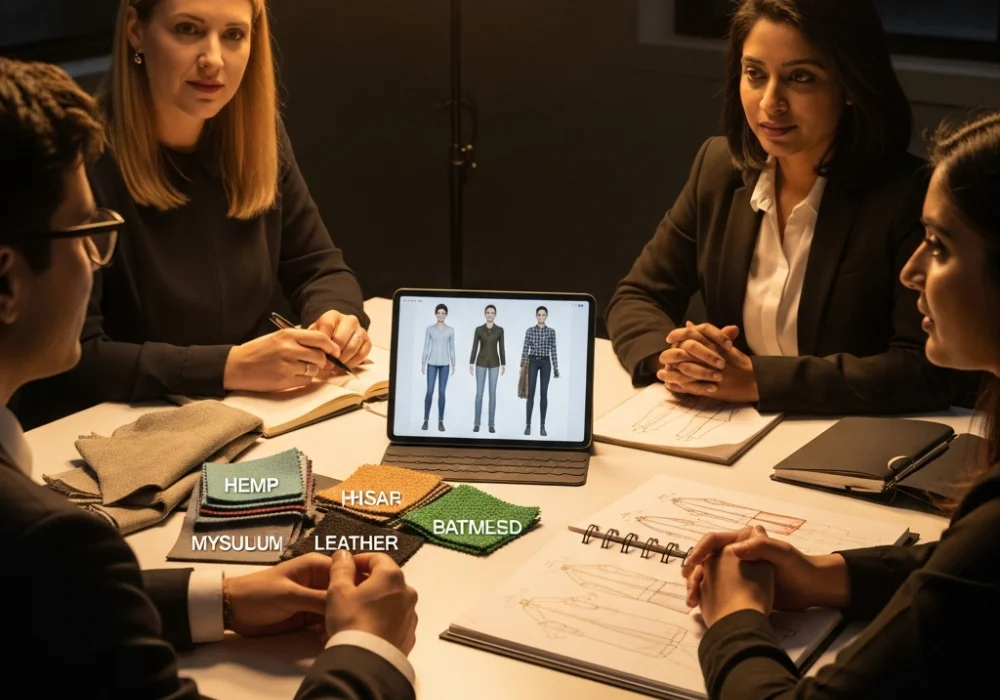
Introduction: The Strategic Edge in Your NIFT Interview
Welcome, future designers and fashion tech specialists. As an elite admission panelist, I have sat across the table from thousands of hopeful candidates. While many can talk about their favorite colors or childhood inspirations, very few can navigate the complex, technical landscape of current textile trends and global sustainability movements. This is where the wheat is separated from the chaff.
In the current fashion climate, technical knowledge is no longer ‘extra credit’; it is a core requirement. The NIFT Personal Interview (PI) panel is looking for candidates who are not just creative dreamers but informed professionals who understand the ecological and technological impact of the industry they are about to enter. This guide will provide you with a deep dive into how to articulate your thoughts on these critical subjects.
What the Panel is Secretly Looking For (Evaluation Criteria)
When we ask you about the ‘latest trend in bio-fabrics’ or ‘the impact of the circular economy,’ we aren’t just testing your memory. We are evaluating several psychological and professional layers:
- Analytical Thinking: Can you connect a global movement (like climate change) to a specific industry shift (like the rise of hemp textiles)?
- Depth of Curiosity: Do you read beyond the surface-level fashion magazines? Are you following industry journals or research on material science?
- Adaptability: Do you understand that the fashion industry is in a state of flux and show a willingness to evolve with it?
- Ethical Alignment: Does your personal design philosophy align with the global necessity for ethical production and consumption?
💡 Click to Reveal: The Panelist’s ‘Cheat Code’
Always mention the ‘Why’ before the ‘What’. If you mention mushroom leather (Mycelium), explain why it matters (it reduces dependence on livestock and harmful chemicals) before describing how it looks.
Deep Dive: Technical Textile Trends to Watch
To impress the panel, you must be conversant with the intersection of technology and textiles. Here are the pillars you should master:
1. Smart and Interactive Textiles
We are moving past fabrics that just cover the body. Current trends include textiles embedded with sensors that monitor health, regulate body temperature, or even change color based on UV exposure. Mentioning innovations like conductive yarns or shape-memory alloys in fabrics shows high-level awareness.
2. Bio-Fabrication and Synthetic Biology
This is the frontier of sustainability. Discussing Lab-grown leather, algae-based dyes, and spider silk proteins demonstrates that you are looking at the future of manufacturing. These are not just ‘trends’; they are potential solutions to the resource depletion caused by traditional cotton and polyester.
3. Digital Twin Technology in Textiles
The digitization of textiles—where a digital version of a fabric is created to test drape, fit, and durability before a single physical thread is spun—is revolutionizing waste reduction. Mentioning how 3D prototyping reduces the carbon footprint of the sampling process is a massive plus.
Navigating Global Sustainability Movements
Sustainability is a broad term. To stand out, you must be specific. Avoid vague statements like “I want to save the planet.” Instead, use professional terminology:
The Circular Economy vs. Linear Model
Explain your understanding of the ‘Take-Make-Waste’ linear model and why the industry is shifting toward a Circular Model (Reduce, Reuse, Recycle, Regenerate). Talk about ‘Closing the Loop’ where garments are designed for eventual disassembly and composting.
The Slow Fashion Movement
Contrast this with Fast Fashion. Discuss the importance of quality over quantity, fair wages for artisans, and the revival of traditional Indian crafts (like Handloom) as a sustainable alternative to mass-produced synthetics.
Transparency and Traceability
The modern consumer wants to know who made their clothes. Discuss the role of Blockchain technology in tracking the journey of a garment from the cotton farm to the retail shelf. This level of technical insight is exactly what a NIFT panel craves.
Sample Mock Interview: The Technical Challenge
Panelist: “Candidate, you mentioned an interest in sustainable fashion. Everyone says that. Can you tell us about a specific movement or technology that you think will actually change the industry in the next five years?”
Candidate: “Certainly. Beyond the general idea of recycling, I am particularly fascinated by the Regenerative Agriculture movement in textile sourcing. Currently, even organic cotton can deplete soil health. Regenerative practices actually restore the soil biology. When combined with Microbial Dyeing—where bacteria are engineered to produce pigment without toxic chemicals—we move from ‘doing less harm’ to ‘doing actual good.’ This shift from a destructive to a restorative industry is what I find most promising.”
Panelist Feedback: This is a 10/10 answer. Why? Because the candidate used specific terminology (Regenerative Agriculture, Microbial Dyeing), showed a philosophical understanding (less harm vs. doing good), and provided a clear vision for the future.
💡 Click to Reveal: Common Pitfall to Avoid
Don’t confuse ‘Sustainable’ with ‘Cheap.’ Often, sustainable innovations are more expensive initially. If the panel asks about the cost, acknowledge it as an investment in long-term brand value and environmental health rather than a short-term expense.
Strategic Interview Tactics for Technical Questions
When hit with a technical question you might only partially know the answer to, use the Bridge Method:
- Acknowledge: “That is a very relevant question regarding the current shift in textile manufacturing…”
- Connect: “While my specific research has been more focused on [Topic A], I see a strong parallel with [The Question asked] in terms of…”
- Conclude: “This leads me to believe that the industry’s focus on [Key Concept] is the ultimate solution.”
Mastering the Jargon
Practice using these terms naturally in your speech: Upcycling, Biodegradability, Carbon Neutrality, Ethical Sourcing, Zero-Waste Pattern Cutting, and Post-Consumer Waste.
Final Thoughts from the Panel
Your interview is a conversation between professionals. We want to see that you have done your homework. The fashion world is no longer just about the runway; it is about the lab, the farm, and the digital world. By mastering these technical aspects of textile trends and sustainability, you prove that you are ready for the rigors of NIFT.
Stay Curious. Stay Informed. Stay Bold.
Still have doubts about your NIFT Interview preparation?
Don’t leave your dreams to chance. Get expert guidance and mock interview practice today!
💬 Chat with our Experts on WhatsApp (+91 9526806124)




