
Table of Contents
🛡️ Expert Methodology: Why Trust This Content
At MyEntrance.in, we don’t just provide NID DAT mock tests; we analyze the psychology of design admissions. This guide is built upon the collective wisdom of NID alumni, professional design consultants, and official NID admission guidelines. We focus on E-E-A-T (Experience, Expertise, Authoritativeness, and Trustworthiness) to ensure that every tip you read is actionable and academically sound. Our methodology involves cross-referencing successful portfolios from the last decade to identify the patterns that catch a juror’s eye.
Introduction: Your Portfolio is Your Silent Interviewer
Imagine walking into a room at the National Institute of Design (NID). The air is thick with creativity. Before you even speak a word, the jurors are already looking at your work. Your portfolio is not just a collection of drawings; it is a visual narrative of your soul, your problem-solving abilities, and your potential as a future designer. If you have cleared the NID DAT Prelims, the portfolio and studio test are the final hurdles standing between you and your dream career.
But how do you condense years of curiosity into a single folder? This guide will break down the complex process into simple, manageable steps, ensuring you present the best version of your creative self.
💡 Pro-Tip: The ‘Hook’ Principle
Start your portfolio with your second-best work and end with your absolute best. This ensures you grab attention early and leave a lasting impression at the end.
What is an NID Portfolio?
Many students mistake a portfolio for an art gallery. Let’s clarify: NID is not looking for perfect artists; they are looking for observant designers. An NID portfolio should showcase your journey—the messy sketches, the failed attempts, and the final ‘Eureka’ moments. It must demonstrate Design Thinking, a process emphasized in NCERT’s vocational education principles and globally recognized design standards.
- Variety: Show that you can work with different mediums (clay, wire, paper, digital).
- Process: The ‘how’ is more important than the ‘what’.
- Personality: Your unique perspective on the world.
The 5 Pillars of a Winning Portfolio
To stand out, your portfolio must rest on these five foundational pillars:
- Observation Skills: Can you notice things others miss? Include sketches of daily life or street scenes.
- Technical Proficiency: While design is about ideas, you need the skills to execute them. Show mastery over light, shadow, and perspective.
- Social Awareness: Does your design solve a real-world problem? Designs addressing sustainability or inclusivity get extra points.
- Storytelling: Each project should have a beginning (problem), middle (exploration), and end (solution).
- Authenticity: Do not copy from Pinterest. Jurors have seen those designs a thousand times. Be you.
Step-by-Step Guide to Building Your Portfolio
Step 1: The Audit
Gather everything you have ever created. Paintings, photography, school projects, even doodles on the back of your notebooks. Sort them into ‘Good’, ‘Maybe’, and ‘Not for NID’.
Step 2: Identifying Gaps
Look at your ‘Good’ pile. Is it all just pencil sketches? If so, you need to add 3D models or photography. A balanced portfolio shows versatility.
Step 3: Documenting the Process
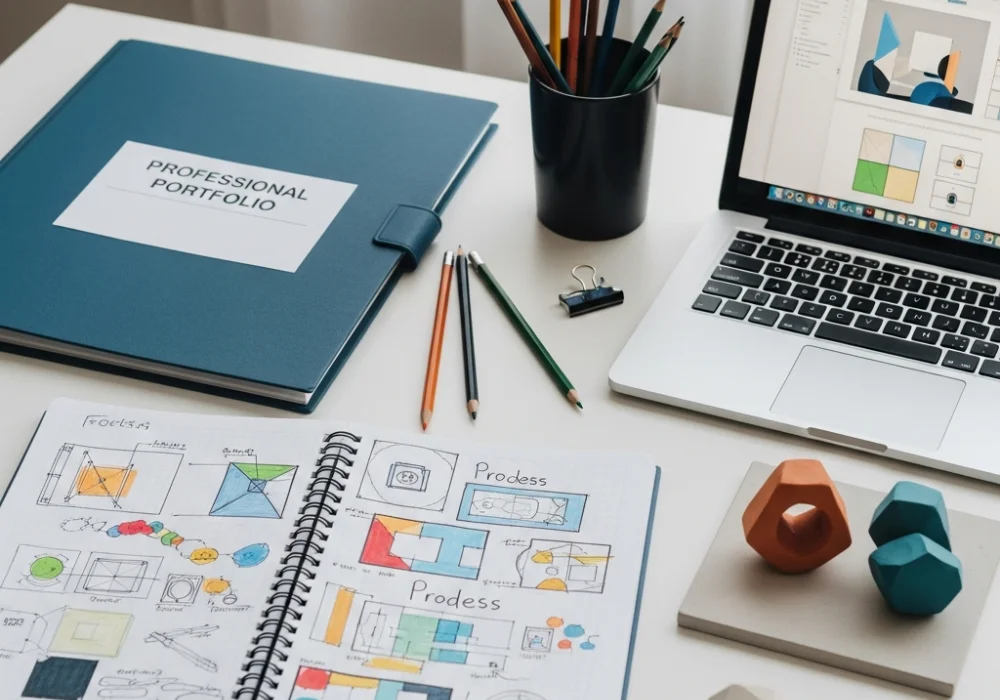
For your best 5-8 projects, create a ‘Process Journal’. This is a collection of rough notes, mind maps, and initial prototypes. This is what NID faculty loves to see during the interview.
Step 4: Layout and Curation
Keep the layout clean. Use high-quality photographs of your 3D works. Ensure that text is minimal but impactful. Use a professional font if you are creating a digital layout.
Step 5: Peer Review
Show your portfolio to a mentor or a friend who isn’t an artist. If they can’t understand the story behind a project, you need to simplify the presentation.
Digital vs. Physical: Making the Right Choice
In the current pattern, NID often asks for a digital upload first, followed by a physical portfolio during the Studio Test. Here is how they compare:
| Feature | Digital Portfolio | Physical Portfolio |
|---|---|---|
| Accessibility | Easy to share and update. | Tangible; shows craft skills. |
| Best For | Photography, UI/UX, Graphic Design. | Sketches, Models, Textiles. |
| Interaction | Static; depends on screen quality. | Dynamic; jurors can touch the work. |
Fatal Mistakes to Avoid
Even the most talented students can get rejected if they fall into these traps:
- Quantity Over Quality: 10 amazing projects are better than 50 mediocre ones.
- Lack of Context: A beautiful painting with no explanation of why you made it is useless to a designer.
- Inconsistent Style: Your portfolio should have a cohesive visual identity.
- Ignoring the Mock Tests: Students often focus so much on the portfolio that they forget the Studio Test tasks. Practice with MyEntrance.in mock tests to keep your sharp skills ready for the on-the-spot challenges.
💡 Pro-Tip: The ‘Why’ Test
For every piece in your portfolio, ask yourself: ‘Why is this here?’ If the answer is ‘because it looks pretty,’ consider removing it or adding a design purpose.
🧠 Quick Knowledge Check
Test your portfolio readiness with these quick questions!
1. What is the most important element jurors look for in an NID portfolio?
Click to Reveal Answer
The Design Process and your ability to think through a problem, not just the final finished artwork.
2. Should you include failed projects in your portfolio?
Click to Reveal Answer
Yes! If you can explain what you learned from the failure and how it led to a better solution, it shows maturity and growth.
3. How many projects are generally recommended for a balanced portfolio?
Click to Reveal Answer
Usually 8 to 12 high-quality projects covering various mediums and styles.
Frequently Asked Questions (FAQs)
Does my portfolio need to be digital for NID DAT Mains?
It depends on the latest guidelines provided in your call letter. Generally, a digital upload is required for initial screening, and a physical portfolio is required during the offline interview/studio test phase.
Can I include photography if I’m applying for Industrial Design?
Absolutely! Photography shows your sense of composition, light, and observation, which are vital for any design discipline.
How do I showcase large 3D models in my portfolio?
Don’t carry bulky models. Take high-resolution photographs from multiple angles, including one with an object (like a coin or a hand) for scale, and include those in your portfolio folder.
Ready to Conquer the NID Studio Test?
Your portfolio is just one half of the battle. The Studio Test requires speed, creativity, and precision. Practice with our expert-curated mock tests today!
💬 Chat with our Experts on WhatsApp (+91 9526806124)




