
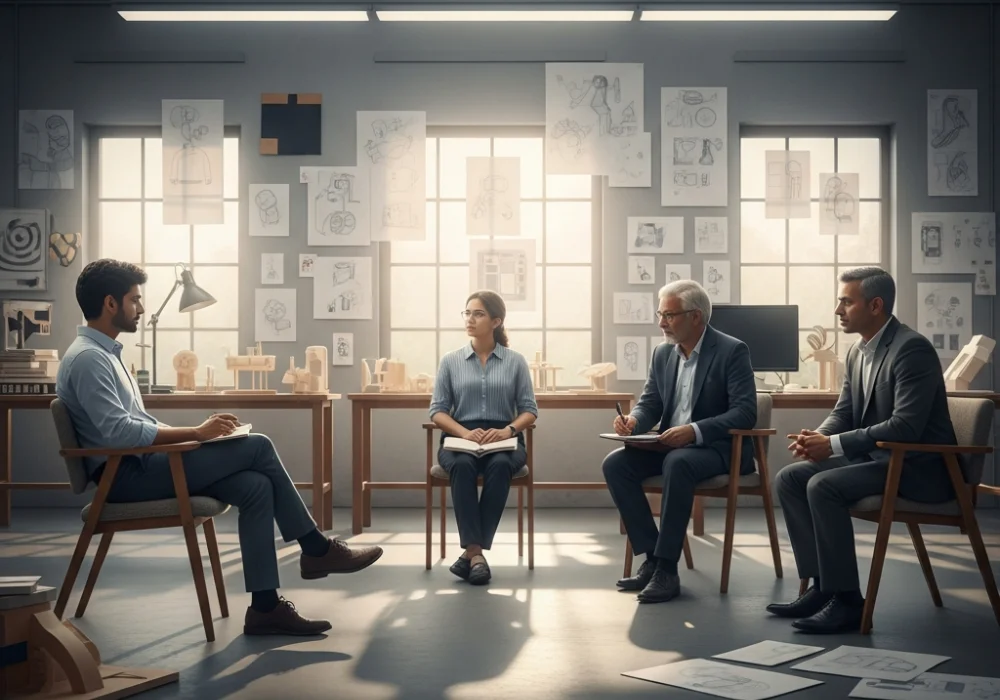
Introduction: The Paradox of Collaborative Design
In the upcoming NID Personal Interview (PI) sessions, one of the most frequently asked yet misunderstood questions revolves around group projects. While design is inherently collaborative, the panel is tasked with evaluating you, the individual. This creates a psychological tension for the candidate: how do you demonstrate that you are a team player without fading into the background of a collective effort? At myentrance.in, we believe that mastering this balance is the key to unlocking a high score in the interview round. This guide serves as a masterclass on how to navigate the ‘Teamwork’ question by articulating your specific individual contribution with clarity, humility, and professional precision.
The Panel’s Secret Lens: What Are We Evaluating?
As panelists, when we look at a group project in your portfolio, we aren’t just looking at the final product. We are looking at the process of interaction. Here is what we are secretly assessing:
- Role Clarity: Can you clearly define where your work started and where it ended? Vague answers like ‘we all did everything’ are a red flag indicating a lack of specialization or accountability.
- Conflict Resolution: Every group project has friction. We want to see if you have the emotional intelligence to navigate disagreements constructively.
- Humility vs. Ownership: Do you give credit to others while firmly owning your successes? We look for candidates who avoid the ‘I did it all’ trap while also avoiding the ‘I was just there’ passivity.
- Systems Thinking: How did your specific contribution affect the whole? If you designed the interface, how did it influence the user experience designed by your partner?
- Leadership Potential: Even if you weren’t the ‘designated leader,’ did you lead a specific vertical or initiative within the project?
The Anatomy of a High-Impact Project Description
When presenting a collaborative piece, your verbal narrative must follow a structured path. We recommend the ‘I-Within-We’ framework. First, briefly explain the ‘We’ (the collective goal and the problem the team solved). Second, dive deep into the ‘I’ (your specific tasks, the tools you used, and the decisions you made). Finally, conclude with the ‘Impact’ (how your work improved the team’s final output).
Mock Interview Transcript: Navigating the Teamwork Question
Let us look at a simulated dialogue between a candidate (C) and an NID Panelist (P) regarding a group project on sustainable packaging.
P: I see this project on biodegradable milk pouches was a group effort by four people. It looks impressive, but tell me, if I were to remove your specific contribution from this project, what would fall apart?
C: That is a great question. While the project was a collective success, my primary responsibility was the Material Research and Prototyping phase. If you removed my contribution, the team would have lacked the physical data on the tensile strength of the seaweed-based polymer we used. My role was to conduct the stress tests and determine the exact thickness required to prevent leakage.
P: Interesting. But surely the others helped with the research? Did you ever disagree on which material to use?
C: Yes, initially, two members wanted to use recycled plastic. I advocated for the seaweed-based approach because our brief focused on ‘zero-waste’ rather than just ‘recycling.’ To resolve this, I didn’t just argue; I created two small-scale prototypes of both. When the team saw that the seaweed polymer was more aesthetically aligned with our brand identity, we reached a consensus. I facilitated that decision through tangible evidence rather than just debate.
Panelist Feedback & Analysis
In this dialogue, the candidate succeeded for three reasons: 1. Specificity: They didn’t just say ‘I did research’; they mentioned ‘tensile strength’ and ‘thickness’—technical details that prove involvement. 2. Constructive Conflict: They showed how they used design (prototyping) to solve a team disagreement, which is a high-level leadership trait. 3. Alignment: They tied their individual work back to the project’s core brief (zero-waste).
Common Pitfalls to Avoid
In our experience at NID, many talented students lose marks here. Avoid these traps:
- The ‘Invisible Man’ Syndrome: Using the word ‘We’ exclusively. If you say ‘We designed this,’ we assume you were a passenger, not a driver. Use ‘I’ for your specific actions.
- The ‘Credit Hog’: Taking credit for the visual design when your role was user research. We can usually tell if your verbal description doesn’t match the quality of the work.
- The Blame Game: If asked about a project failure, never blame a teammate. Frame the failure as a collective learning experience. For example: ‘Our team struggled with time management, but I initiated a daily check-in system to get us back on track.’
- The Technical Gap: Not knowing how a part of the project was done because ‘someone else did it.’ Even if you didn’t do the coding, you must understand the logic behind what your teammate did.
Strategic Exercise: Mapping Your Contributions
Before your interview, take every group project in your portfolio and fill out this ‘Individual Impact Map’:
- What was the collective objective? (e.g., Designing a low-cost water filter).
- What was my specific ‘Designation’? (e.g., Ergonomics Lead).
- What was a specific problem I solved for the team? (e.g., I redesigned the handle to fit 5th to 95th percentile hand sizes, which the original team sketch overlooked).
- What tool/method did I uniquely bring? (e.g., I was the only one who knew Rhino 3D, so I translated the 2D sketches into a manufacturable 3D model).
Conclusion: Be the Designer Teams Want
The NID studio environment is a microcosm of the real world. Designers rarely work in isolation. By demonstrating that you can carve out your own niche while supporting a larger vision, you prove to the panel that you are ready for the rigors of a professional design education. Remember, your portfolio is the evidence of your skill, but the interview is the evidence of your character. Speak about your teammates with respect, speak about your work with authority, and speak about your role with absolute clarity.
🚀 Ready to Ace Your NID Interview?
Don’t leave your design dreams to chance. Get personalized feedback on your portfolio and mock interview practice from NID alumni and industry experts at myentrance.in.
💬 Chat with our Experts on WhatsApp (+91 9526806124)




