
Introduction: The Ultimate Test of a Designer’s Agility
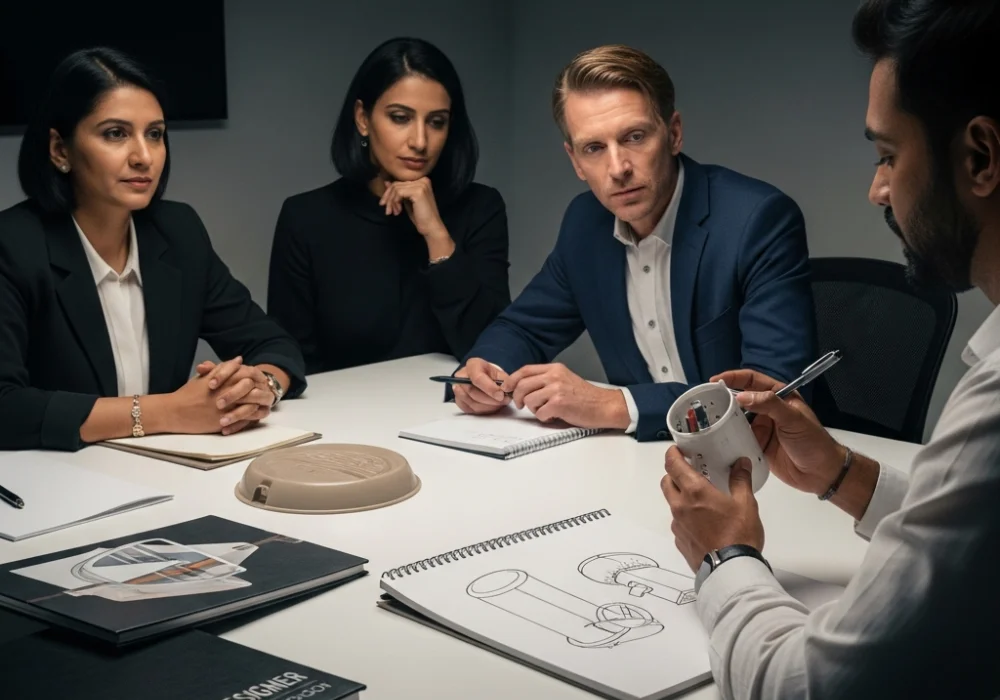
In the final stages of the National Institute of Design (NID) admission process, the Personal Interview (PI) stands as the most unpredictable and critical hurdle. While your portfolio showcases what you have done in the past, the ‘on-the-spot’ redesign challenge is designed to see how you think in the present. This scenario involves an interviewer handing you a mundane, everyday object—perhaps a stapler, a water bottle, a remote control, or even a simple pebble—and asking you to redesign it. However, the catch is not just to make it ‘better,’ but to redesign it by applying the unique ‘Design DNA’ established in your portfolio.
As an elite panelist, I can tell you that we are not looking for a finished, polished product in these five minutes. We are looking for a process. We want to see if your design philosophy is a skin you wear for your portfolio or if it is a fundamental part of your cognitive DNA. This guide will break down how to bridge the gap between your previous work and a random object under high-pressure interview conditions.
Understanding the Evaluation Criteria: What the Panel Secretly Wants
When we hand you an object, we are evaluating four distinct pillars of your design personality:
- Consistency of Thought: Does your redesign reflect the same values seen in your portfolio? If your portfolio emphasizes ‘Extreme Sustainability,’ but your redesign of a plastic pen involves adding more electronics, you have failed the consistency test.
- Analytical Observation: Can you deconstruct an object’s current flaws and strengths beyond just aesthetics? We look for candidates who analyze ergonomics, material usage, and user psychology.
- The ‘Pivot’ Speed: How quickly can you move from the shock of the ‘random’ object to the logic of the redesign? We value candidates who take a thoughtful pause rather than those who start rambling immediately.
- Communication and Justification: Can you sell your idea? A mediocre design backed by a brilliant, logical narrative often scores higher than a brilliant design that the candidate cannot explain.
Step 1: Identifying Your Design DNA
Before you enter the interview room, you must define your ‘Design DNA’ in three words or a single core philosophy. This DNA should be the recurring theme in your portfolio. Examples include:
- Modular Adaptability: Objects that change based on user needs.
- Bio-Mimicry/Organic Fluidity: Designs inspired by natural systems and shapes.
- Minimalist Functionality: Stripping away the excess to improve the core utility.
- Inclusive Design: Focusing on accessibility for the elderly or differently-abled.
“Your Design DNA is the lens through which you see the world. If your lens is ‘Emotional Design,’ then even a hammer should be redesigned to evoke a feeling of safety and reliability.”
The Strategy: The ‘Deconstruct-Link-Reconstruct’ Framework
When the panelist places an object in front of you, follow this systematic framework to ensure a high-scoring response.
1. Deconstruction (60 Seconds)
Look at the object. Don’t just see it; observe it. Identify its primary function, its material constraints, and its current user frustrations. If it is a coffee mug, ask yourself: Why is the handle this shape? Does it retain heat? Is it easy to clean? State your observations aloud to involve the panel in your thought process.
2. Linking (30 Seconds)
Mentally pull a thread from your portfolio. If your portfolio featured a project on ‘Foldable Urban Furniture,’ link the coffee mug to the concept of ‘Space-Saving’ or ‘Portability.’ This shows the panel that your design thinking is a cohesive system rather than a series of isolated projects.
3. Reconstruction (2 Minutes)
This is where you apply your DNA. Verbally and visually (using the notepad provided) redesign the object. Use phrases like, “In my portfolio, I explored the concept of X, and I believe applying that same logic to this object would result in Y.”
Sample Mock Interview Transcript & Panelist Feedback
Context: The candidate, Rahul, has a portfolio focused on ‘Tactile Sustainability’ (using textured, eco-friendly materials to improve grip and user connection). The Interviewer hands him a standard plastic TV Remote.
Interviewer: “Rahul, you’ve spoken a lot about tactile sustainability. Here is a standard television remote. It’s plastic, it has 40 buttons, and it feels cold. Redesign this for me in the next three minutes using your design DNA.”
Rahul: (Takes the remote, feels the weight) “Thank you. Looking at this remote, the first thing I notice is that it’s designed for the eyes, not the hand. There are too many identical buttons, which forces the user to look down constantly, breaking the immersion of watching TV. My Design DNA focuses on using texture to guide the user without visual aid, while staying eco-conscious.”
Rahul: “Firstly, I would replace this high-impact polystyrene shell with a molded mycelium or cork composite. This provides a warm, ‘living’ texture that improves grip. Secondly, applying my DNA of ‘Tactile Navigation,’ I would reduce the buttons to a single multidirectional ‘haptic disc.’ Different regions of the disc would have varying textures—rough for volume, smooth for channels—so the user knows exactly what they are doing by touch alone, just like the tactile projects in my portfolio.”
Interviewer: “But won’t cork degrade faster than plastic?”
Rahul: “Actually, that’s part of the sustainability DNA. Design shouldn’t be eternal if the technology inside isn’t. The shell is compostable, while the internal modular chip can be popped out and placed into a new shell every five years. It’s a ‘Cradle-to-Cradle’ approach.”
Panelist Feedback on Rahul’s Performance:
What worked: Rahul didn’t panic. He immediately identified a flaw (visual dependency) and solved it using his specific DNA (Tactile Navigation). He justified his material choice not just as an aesthetic one, but as a systemic solution to the lifecycle of the product. He successfully linked the ‘random’ object back to the core strengths of his portfolio.
Advanced Tips for Success
1. Use Your Hands
Designers think with their hands. If there is a notepad, draw. Even if your drawing is a rough thumbnail, it shows that you are comfortable with visual communication. If you are allowed to pick up the object, rotate it, feel its weight, and demonstrate the ergonomics you are talking about.
2. Embrace the ‘User Persona’
If you feel stuck, quickly assign a user to the object. “I am redesigning this stapler for a primary school student.” This instantly gives you a set of constraints and directions to follow, making the redesign more focused and less generic.
3. The ‘Failure’ Pivot
If you realize halfway through your explanation that your idea has a flaw, don’t hide it. Say, “Actually, I just realized that this material might be too heavy, so I would pivot to a honeycomb internal structure to maintain the DNA of ‘Lightweight Efficiency’ while keeping the strength.” This shows incredible maturity and self-awareness.
Common Pitfalls to Avoid
- Ignoring the Portfolio: If you suggest a redesign that contradicts everything you’ve shown in your works, the panel will think your portfolio was not your own work or that you don’t have a solid design philosophy.
- Over-Engineering: Don’t try to add AI, Bluetooth, and lasers to a simple object unless it’s relevant. Simplicity is often the hardest thing to design.
- Being Defensive: When the panelist challenges your redesign (like they did with Rahul’s cork material), don’t get defensive. Treat it as a collaborative brainstorming session.
Conclusion: The Designer’s Mindset
The NID Personal Interview is not a test of how many ‘correct’ answers you know. It is a test of how you handle the unknown. By mastering the art of applying your Design DNA to any object, you prove to the panel that you are ready to be a student at India’s premier design institute. You are showing them that you don’t just ‘do’ design; you ‘are’ a designer.
Practice this at home. Pick up a random object every day—a spoon, a lightbulb, a shoe—and give yourself three minutes to redesign it using your core philosophy. With time, this way of thinking will become second nature.
Need Personalized Guidance for your NID Interview?
Our experts include NID alumni and former panelists who can help you identify your Design DNA and ace the on-the-spot challenges through 1-on-1 mock interviews.
💬 Chat with our Experts on WhatsApp (+91 9526806124)




