
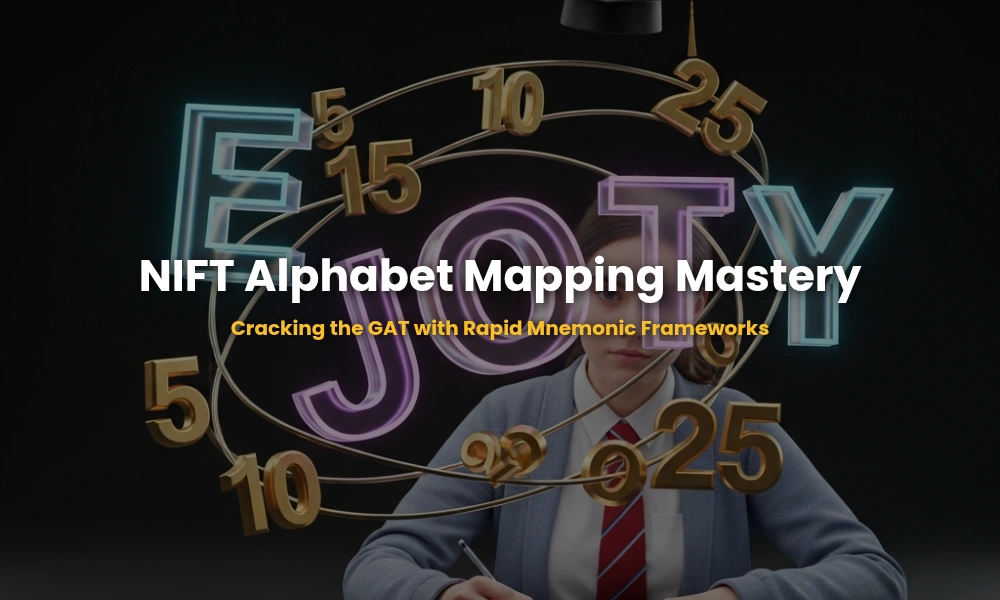
Mastering NIFT Mnemonics: The Ultimate Guide to EJOTY & VQLGB Frameworks
Success in the NIFT General Ability Test (GAT) is as much about speed as it is about accuracy. In the high-pressure environment of the NIFT entrance exam, the ability to instantly decode alphabet positions can save precious minutes. As a world-class memory coach, I have designed this guide to help you internalize the EJOTY and VQLGB frameworks through neuro-linguistic programming and advanced mnemonic stories.
🚀 Key Takeaways
- Master the EJOTY system for 5-multiple forward mapping.
- Utilize the VQLGB framework for secondary rapid triangulation.
- Develop a Memory Palace for the entire 26-letter sequence.
- Apply 10 distinct creative hacks to ensure zero recall latency.
Table of Contents
What is the EJOTY Framework?
EJOTY is a mental anchor system where specific letters are assigned numerical values in multiples of five: E (5), J (10), O (15), T (20), and Y (25). By memorizing these five points, NIFT candidates can quickly identify any letter’s position by calculating its distance from the nearest EJOTY anchor.
Think of EJOTY as the ‘mile markers’ on a highway. If you need the position of ‘R’, you don’t start from ‘A’. Instead, you start from ‘T’ (20) and move back two steps (S=19, R=18). This reduces the cognitive load during logical reasoning sessions where alphabet coding-decoding is a staple. Expert examiners suggest that candidates who master this framework typically solve series-based questions 40% faster than those who use finger-counting methods.
How does the VQLGB framework complement EJOTY?
VQLGB is a specialized mnemonic sequence used to map the alphabet in descending intervals of five, starting from V (22). By mastering V=22, Q=17, L=12, G=7, and B=2, students create a secondary mental grid that ensures no letter is more than two steps away from a known anchor.
While EJOTY focuses on the 5-10-15-20-25 sequence, VQLGB targets the ‘2’ and ‘7’ endings (2, 7, 12, 17, 22). This dual-layer approach means your brain has more ‘hooks’ to hang information on. For instance, if you need the position of ‘H’, instead of counting up from E (5), you can look at G (7) from the VQLGB set and instantly know H is 8. This cross-referencing is a hallmark of advanced memory hacks used by competitive exam toppers.
10 Distinct Memory Hacks for Rapid Recall
To truly master these frameworks, you must move beyond rote memorization and use high-octane imagery. Here are 10 distinct tricks to cement these letters in your long-term memory:
- The High-Five Hand (E=5): Visualize the letter ‘E’ tattooed on the palm of a hand with 5 fingers. Every time you see ‘E’, feel the sensation of a high-five.
- The Ten-Pin Strike (J=10): Imagine the letter ‘J’ is a bowling ball hook that strikes down 10 pins. The curve of the J is the path of the ball.
- The Orange Orchard (O=15): Visualize a basket of 15 oranges. The oranges are shaped like ‘O’. You are juggling 15 O-shaped oranges in a design studio.
- The T-20 Cricket Match (T=20): This is the easiest association. Visualize a stadium full of people shouting ‘T-20’ as the letter ‘T’ hits a six.
- The Christmas Eve Y (Y=25): While Christmas is the 25th, associate ‘Y’ with ‘Year-end’ or the ‘Yellow’ lights of December 25th.
- The V-Neck Victory (V=22): Imagine two fingers held up in a ‘V’ for victory. Two fingers + two fingers = 22. Visualize a V-neck sweater with the number 22 embroidered on it.
- The Queen’s Seventeen (Q=17): Visualize a Queen (Q) wearing a crown with 17 sharp points. She is 17 years old in your story.
- The Dozen Logs (L=12): ‘L’ stands for Log. Visualize a bundle of 12 logs tied together. The shape of the logs stacked vertically looks like a thick ‘L’.
- The Seven G-Force (G=7): Imagine a jet pilot pulling ‘7G’ force. The letter ‘G’ has a small ‘7’ hidden in its tail (if you draw it with a cross-bar).
- The Binary Bicycle (B=2): B is for Bicycle, which has 2 wheels. Visualize a ‘B’ turned on its side; it looks like two wheels.
💡 Pro-Tip: The Memory Palace Technique
To store all 10 anchors, imagine your childhood bedroom. Place the High-Five Hand on the door (E=5), the Bowling Pins on your bed (J=10), the Oranges on your desk (O=15), the Cricket Bat in the corner (T=20), and the V-neck sweater in the closet (V=22). Walking through this room mentally ensures you never forget the anchors.
Framework Comparison Table
Which system should you use? The answer is both. Use EJOTY for quick 5-step leaps and VQLGB for 2/7 gaps.
| Letter | Position | Framework | Mnemonic Hook |
|---|---|---|---|
| E | 5 | EJOTY | Hand/High-Five |
| G | 7 | VQLGB | 7-G Force |
| J | 10 | EJOTY | Bowling Pins |
| L | 12 | VQLGB | Dozen Logs |
| O | 15 | EJOTY | Oranges |
| Q | 17 | VQLGB | Queen |
| T | 20 | EJOTY | T-20 Cricket |
| V | 22 | VQLGB | Victory/22 |
Frequently Asked Questions
Why is alphabet mapping important for NIFT GAT?
Alphabet mapping is crucial for the Logical Reasoning section of the NIFT GAT, specifically for coding-decoding, series completion, and analogy questions. Speed in these areas allows you to allocate more time to the Quantitative and Creative sections, increasing your overall score potential.
Can I use these frameworks for reverse alphabet mapping?
Yes! To find a letter’s reverse position (where Z=1), subtract its forward position from 27. For example, the reverse of ‘E’ (5) is 27 – 5 = 22. Knowing the EJOTY values makes this mental subtraction nearly instantaneous.
Need Personalized NIFT Guidance?
Our experts are here to help you crack the GAT and CAT with ease.
💬 Chat with our Experts on WhatsApp (+91 9526806124)




