
Table of Contents
- Understanding the Importance of Drawing for NIFT
- Foundational Exercises for Line and Shape Control
- Mastering Perspective: 1, 2, and 3-Point Views
- Human Anatomy and Proportion Drills
- Texture Rendering and Material Representation
- Comparison: Technical Drawing vs. Creative Drawing
- Strategic Preparation with Mock Tests
- Frequently Asked Questions
- Quick Knowledge Check
Understanding the Importance of Drawing for NIFT
The National Institute of Fashion Technology (NIFT) evaluates candidates through the Creative Ability Test (CAT), where drawing isn’t just about making things look pretty—it’s about communication, observation, and innovation. To succeed in the latest pattern of the NIFT entrance exam, a student must transition from being a hobbyist to a design-oriented artist. Drawing for NIFT requires a balance of technical accuracy and imaginative flair. Whether you are illustrating a futuristic garment or a complex social scene, your ability to translate a 3D concept onto a 2D surface is paramount. At myentrance.in, we emphasize that consistent practice is the only bridge between raw talent and professional execution.
💡 Pro-Tip: The Designer’s Mindset
NIFT examiners look for ‘Design Sensitivity.’ This means your drawings should show an understanding of scale, utility, and aesthetics simultaneously. Don’t just draw a chair; draw a chair that solves a specific problem or fits a specific theme.
Foundational Exercises for Line and Shape Control
Before diving into complex compositions, you must master the mechanics of your hand. Line quality defines the professionalism of your work. Shaky or ‘hairy’ lines indicate a lack of confidence, which can negatively impact your CAT score.
The Circle and Ellipse Drill
Designers rarely use a compass. You must be able to draw perfect circles and ellipses freehand. Spend 15 minutes every morning filling an A3 sheet with circles of varying sizes. This builds muscle memory in your shoulder and elbow rather than just your wrist.
Line Weight Variation
Practice drawing lines that start thin and gradually become thick. This is essential for creating a sense of depth without using heavy shading. Use a variety of pencils, from H to 6B, to understand how different graphite grades react to pressure.
- Ghosting: Practice the motion of the line in the air before the pencil touches the paper.
- Continuous Line Drawing: Draw an object without lifting your pencil to improve hand-eye coordination.
- Blind Contour: Look only at the object, not the paper, to sharpen your observational skills.
Mastering Perspective: 1, 2, and 3-Point Views
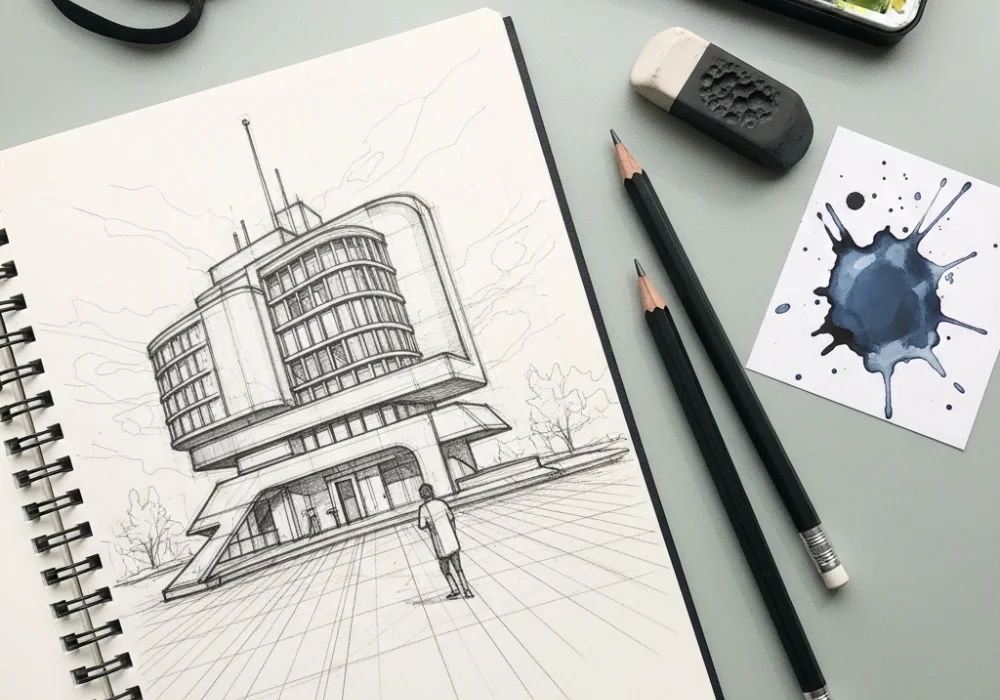
Perspective is the mathematical backbone of realistic drawing. In NIFT exams, questions often require you to draw a scene from a specific ‘Bird’s Eye View’ or ‘Worm’s Eye View.’ Understanding vanishing points is non-negotiable.
1-Point Perspective (Interior Design)
Often used for drawing rooms or hallways. Practice by sketching your bedroom. Identify the horizon line and ensure all receding lines converge at a single point.
2-Point Perspective (Product and Architecture)
This is the most common perspective for design. Practice drawing cubes at various angles. Once you can draw a cube, you can draw a toaster, a building, or a shoe by carving the shape out of that initial box.
3-Point Perspective (Dynamic Angles)
Used to create a sense of scale, like looking up at a skyscraper or down from a mountain. This adds a ‘wow’ factor to your NIFT portfolio sketches by introducing dramatic vertical convergence.
💡 Pro-Tip: Horizon Line Placement
Placing the horizon line lower on the page makes objects appear tall and imposing. Placing it higher makes the viewer feel like they are looking down on the scene. Use this to control the emotional impact of your drawing.
Human Anatomy and Proportion Drills
Fashion design requires a deep understanding of the human form. However, for NIFT CAT, you need to balance realistic anatomy with the ‘fashion croquis’ (an elongated 10-head or 12-head figure).
The 8-Head Method
For standard compositions (like a scene in a market), use the 8-head proportion. The midpoint of the body is the pelvic bone. Ensure the elbows align with the waist and the fingertips reach mid-thigh.
Action Sketches and Gestures
Spend time at a park or railway station. Do 30-second sketches of people moving. Don’t worry about details; focus on the ‘line of action’ and the weight distribution of the body. This prevents your drawings from looking stiff.
Focus on Hands and Feet
These are the hardest parts to draw and often where students lose marks. Practice drawing your own hand in different poses—holding a cup, pointing, or clenched in a fist. Break them down into simple geometric shapes before adding skin and nails.
Texture Rendering and Material Representation
The ability to differentiate between silk, denim, glass, and wood using only a pencil or basic colors is a high-level skill highly valued in NIFT. This is often tested in ‘Product Design’ or ‘Poster Design’ questions.
Light and Shadow Logic
Everything is a sphere, a cylinder, or a cube. Understand how light hits these primary forms. Practice ‘Core Shadows,’ ‘Cast Shadows,’ and ‘Reflected Light.’ Reflected light is the secret to making objects look 3D and realistic.
Texture Practice Table
Try to render the following materials in small 2×2 inch squares to build your rendering library:
| Material | Key Visual Elements | Pencil Technique |
|---|---|---|
| Metallic/Chrome | High contrast, sharp highlights, dark core shadows. | Sharp 4B/6B lines, blended with tissue for smoothness. |
| Wood Grain | Organic parallel lines, occasional knots, matte finish. | Irregular 2B strokes, layered cross-hatching. |
| Fabric (Silk) | Fluid folds, soft gradients, high sheen. | Soft shading with an H pencil, keeping highlights white. |
| Glass/Water | Distorted shapes behind, crisp white highlights. | Very light pressure, use of eraser for ‘negative’ drawing. |
Comparison: Technical Drawing vs. Creative Drawing
Many students confuse technical accuracy with creative ability. While technical skills are the foundation, NIFT is an art school, not just an engineering college. You must show the ability to think outside the box.
- Technical Drawing: Focused on 100% accuracy, correct perspective, and realistic proportions. It tells the viewer *what* the object is.
- Creative Drawing: Focused on storytelling, metaphor, and unique perspectives. It tells the viewer *why* the object matters or what it represents.
For instance, if asked to draw ‘Global Warming,’ a technical artist might draw a melting ice cube. A creative artist might draw an hourglass where the sand is replaced by rising ocean water submerging a city. NIFT rewards the latter approach combined with the former’s execution.
Strategic Preparation with Mock Tests
Knowledge without application is useless in an entrance exam environment. You have a limited time (usually 3 hours) to complete the CAT paper. Managing your speed is as important as managing your strokes.
We recommend students take regular mock tests to simulate the exam pressure. Our platform, myentrance.in, provides a curated collection of previous years’ themes and mock tests designed to challenge your creative limits. By practicing with our time-bound tests, you learn to allocate time effectively: 10 minutes for ideation, 20 minutes for rough sketching, and 30 minutes for final rendering.
💡 Pro-Tip: The Thumbnail Method
Never start your final drawing immediately. Spend 5 minutes drawing three tiny (2×2 inch) thumbnails of your idea. This allows you to check if your composition is balanced before committing to the full page.
Frequently Asked Questions (FAQs)
Is sketching for NIFT different from Fine Arts?
Yes. Fine Arts focuses more on expression and realism, whereas NIFT looks for design-oriented drawing—functionality, material understanding, and creative problem-solving.
What pencils are best for the NIFT CAT exam?
A standard set of 2B, 4B, and 6B pencils is usually sufficient. Avoid using extremely dark charcoal pencils unless you are highly skilled, as they can smudge and make your paper look untidy.
Can I use scales and compasses in the exam?
While allowed for some sections, it is highly recommended to develop freehand skills. Examiners prefer freehand drawings as they demonstrate better motor control and confidence.
How can I improve my speed for the CAT paper?
Practice drawing everyday objects in 5-minute intervals. Gradually reduce the time to 2 minutes. This forces your brain to capture the essence of the object quickly.
Quick Knowledge Check
Test your design entrance exam readiness with these three quick questions!
1. In a 2-point perspective drawing, where do the horizontal lines of a cube converge?
Show Answer
To two distinct vanishing points located on the horizon line.
2. Which pencil grade is harder and leaves a lighter mark: 2H or 4B?
Show Answer
2H. The ‘H’ stands for Hardness, while ‘B’ stands for Blackness.
3. What is a ‘Fashion Croquis’?
Show Answer
A quick, elongated sketch of a human figure used as a template to design and draw clothes.
Ready to Ace Your Design Entrance?
Get access to expert-led mock tests, personalized feedback, and the latest study material at MyEntrance.
💬 Chat with our Experts on WhatsApp (+91 9526806124)




