
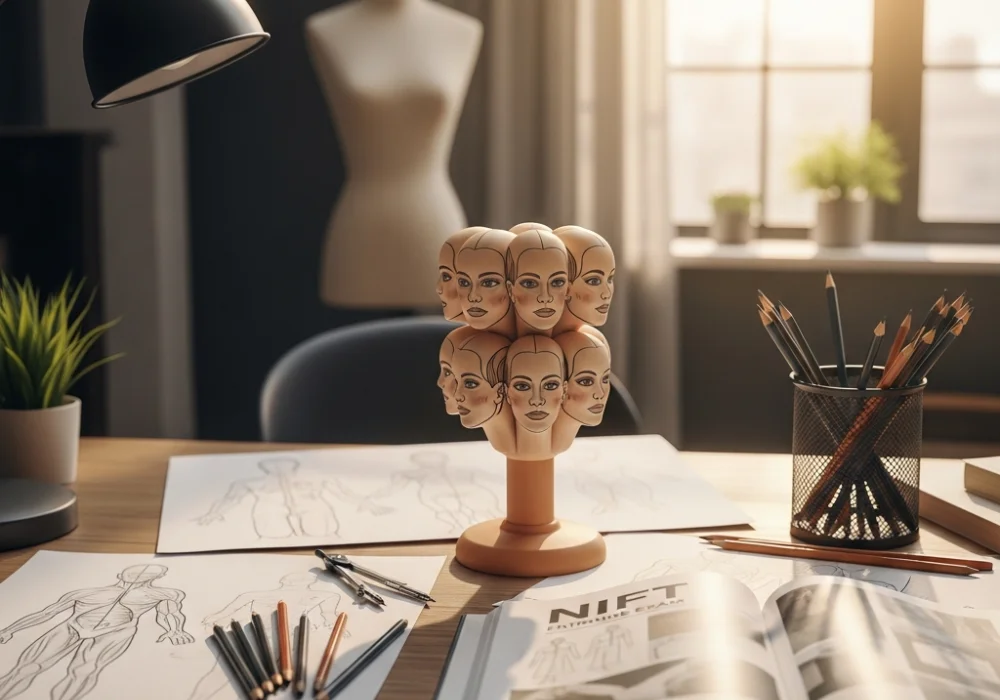
Introduction to Human Anatomy in NIFT CAT
The Creative Ability Test (CAT) is the cornerstone of the NIFT entrance examination, designed to evaluate a candidate’s intuition, observation power, and design ability. Among the various skills tested, human anatomy drawing stands out as a critical component. Whether you are asked to design a uniform for a healthcare worker or illustrate a scene at a busy railway station, the ability to sketch realistic and proportionate human figures is non-negotiable. At myentrance.in, we provide specialized mock tests that help you refine these skills under exam-like conditions.
The Foundation: Understanding the 8-Head Theory
In fashion illustration and design sketching, the human body is traditionally divided into ‘heads’ to maintain proportion. While a standard realistic human figure is usually 7 to 7.5 heads tall, the NIFT Creative Ability Test often requires a blend of realism and stylized fashion figures. The 8-head theory is the most effective standard for design aspirants.
- Head 1: The actual head from the top of the skull to the chin.
- Head 2: From the chin to the mid-chest (nipple line).
- Head 3: From the chest to the waist or navel.
- Head 4: From the waist to the crotch (pelvic region).
- Head 5: From the crotch to the mid-thigh.
- Head 6: From the mid-thigh to just below the knee.
- Head 7: From the knee to the mid-calf.
- Head 8: From the calf to the soles of the feet.
Comparative Proportions for Design Sketching
Understanding the subtle differences between different body types is essential for the latest pattern of NIFT exams. Use the following table as a quick reference guide during your practice sessions.
| Feature | Male Anatomy | Female Anatomy | Fashion Croquis |
|---|---|---|---|
| Shoulder Width | Broad (approx. 2 to 2.5 heads wide) | Narrower (approx. 1.5 to 2 heads wide) | Usually exaggeratedly broad or tilted |
| Waistline | Straight and less defined | Narrower and more defined | Extremely slender and high |
| Hip Width | Narrower than shoulders | Equal to or wider than shoulders | Varies based on the style of illustration |
| Leg Length | Proportionate to torso | Slightly longer than torso | Highly elongated (9-head or 10-head theory) |
Mastering Gesture Drawing and the Line of Action
Static figures often look lifeless in a design portfolio. NIFT examiners look for ‘movement’ in your sketches. This is where gesture drawing comes into play. The ‘Line of Action’ is an imaginary curve that follows the spine and dictates the overall flow of the body. Before drawing details like muscles or clothing, always start with a swift, rhythmic line that defines the pose. This ensures your characters look dynamic and engaged in the scene you are creating.
Translating Anatomy into Fashion Croquis
While the NIFT CAT sometimes asks for realistic scenes, you must also be prepared for fashion-centric questions. A ‘croquis’ is a quick sketch of a fashion model. To master this, you must learn to elongate the legs. In a 10-head croquis, the extra length is added primarily to the legs and the neck to give the figure a graceful, sophisticated look. This allows the garments you design to drape more elegantly on the paper. Practicing these variations through mock tests on myentrance.in will give you the versatility needed for the current syllabus.
Common Pitfalls to Avoid in Human Sketching
Many students struggle with anatomy because they focus on details too early. Here are some common mistakes to avoid:
- Ignoring the Joints: Always mark the placement of shoulders, elbows, hips, and knees with small circles to ensure the limbs are the correct length.
- Stiff Poses: Avoid drawing humans like wooden mannequins. Incorporate a slight tilt in the shoulders and hips (Contrapposto) to add realism.
- Incorrect Hand and Foot Size: A common error is drawing hands too small. Ideally, a hand should be almost the size of the face.
- Over-detailing Musculature: For design exams, focus on the silhouette and form rather than every single muscle fiber, unless specifically asked.
The Role of Mock Tests in Mastering Anatomy
The key to mastering anatomy is repetition. However, drawing aimlessly is less effective than drawing with a purpose. Our mock tests at myentrance.in simulate the exact types of questions asked in the upcoming exams. These tests challenge you to draw figures in various environments—like a marketplace, a factory, or a futuristic city—forcing you to apply anatomical knowledge to complex scenarios. Regular practice helps in building muscle memory, allowing you to sketch complex poses within the limited time provided in the exam hall.
Frequently Asked Questions (FAQ)
1. Is the 8-head theory enough for NIFT CAT?
Yes, the 8-head theory is the standard for realistic figures in the NIFT Creative Ability Test. However, for fashion design specific questions, learning the 9-head or 10-head croquis is highly beneficial.
2. How can I improve my figure drawing speed?
Start with gesture drawing. Spend 5-10 minutes daily doing 30-second sketches of people in motion. This improves your ability to capture the essence of a pose quickly without getting bogged down in detail.
3. Do I need to know skeletal structures for NIFT?
While you don’t need to be a medical expert, a basic understanding of how the ribcage, pelvis, and joints move helps in drawing more accurate and believable poses.
4. Should I draw facial features in detail?
In the CAT, the overall composition and the proportion of the figure are more important than the eyelashes or iris. Focus on the correct placement of eyes, nose, and mouth rather than hyper-realistic rendering.
5. How does myentrance.in help with CAT preparation?
We offer a curated selection of mock tests and study materials that specifically target the creative and drawing aspects of the NIFT entrance exam, providing students with the latest pattern of questions and expert guidance.
Ready to Ace Your Design Entrance Exam?
Get access to premium mock tests, expert feedback, and comprehensive study materials tailored for the latest exam patterns. Don’t leave your design career to chance!
💬 Chat with our Experts on WhatsApp (+91 9526806124)




