
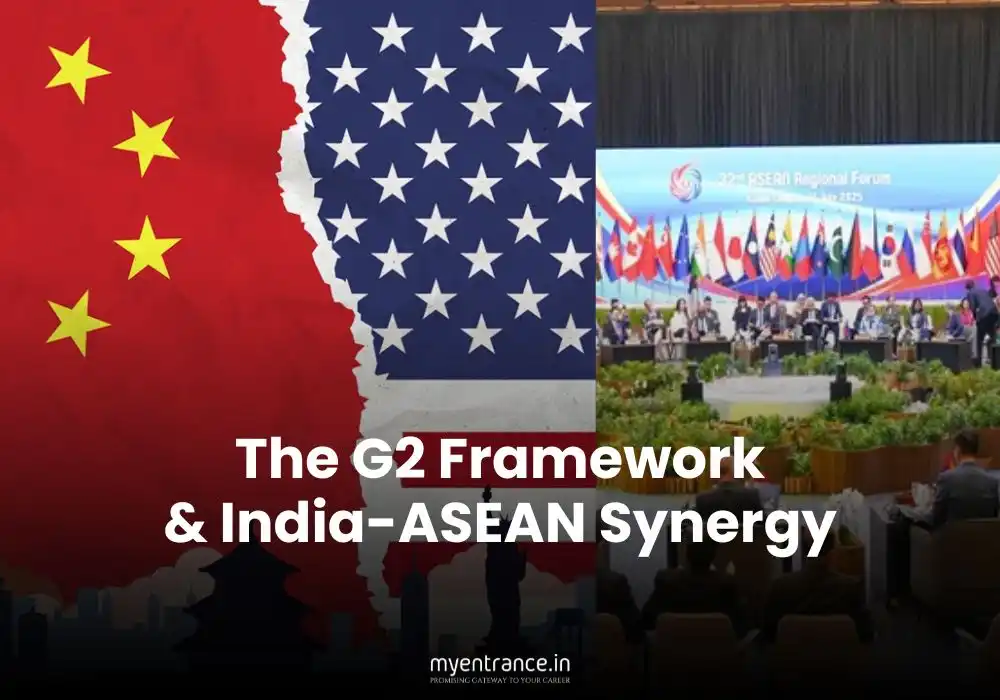
For aspirants targeting top-tier government examinations like UPSC, SSC, and PSC, a profound understanding of contemporary global dynamics and India’s foreign policy is indispensable. This crucial segment delves into the complexities of the emerging ‘G2’ framework and the enduring strategic significance of the Association of Southeast Asian Nations (ASEAN) for India, equipping you with the analytical tools necessary for mains answer practice and comprehensive exam preparation.
Decoding the Evolving Global Landscape: The “G2” Conundrum
The concept of an “emerging G2 framework” primarily refers to the evolving bilateral dynamics between the United States and China, widely considered the world’s two largest economies and military powers. This relationship, characterized by both intense competition and a degree of interdependence, profoundly shapes global governance, international security, and economic trajectories. From trade wars and technological rivalry to geopolitical competition in various regions, the US-China equation exerts a gravitational pull on global affairs, creating both opportunities and challenges for other nations, including India. Understanding this framework is critical for UPSC GS 2, particularly sections on “International Relations” and “Effect of policies and politics of developed and developing countries on India’s interests.” India, committed to a multipolar world order, meticulously navigates this shifting landscape, balancing its strategic autonomy with its national interests, often seeking to strengthen multilateral institutions to mitigate the risks of a bipolar world. Aspiring civil servants must possess the acumen to analyze how this ‘G2’ interaction influences global stability, trade routes, technological advancements, and regional power balances, and consequently, how India positions itself within this complex chessboard.
India’s Eastern Pivot: The Enduring Significance of ASEAN
Beyond the great power dynamics, India’s foreign policy is deeply rooted in regional partnerships, with the Association of Southeast Asian Nations (ASEAN) standing out as a cornerstone of its “Act East Policy.” ASEAN, a bloc of ten dynamic nations, holds immense strategic, economic, and cultural significance for India. Economically, it represents a vibrant market and a crucial link in global supply chains, fostering trade and investment opportunities. Strategically, ASEAN nations are vital partners in ensuring maritime security in the Indo-Pacific region, contributing to a free, open, and rules-based order, especially in the context of increasing geopolitical contestation. Furthermore, robust cultural ties and historical linkages underpin a strong people-to-people connection. India’s engagement with ASEAN extends to various sectors, including security cooperation, connectivity projects, capacity building, and addressing common challenges like climate change and terrorism. For examination purposes, comprehending the nuances of India-ASEAN relations – including their evolution, current state, challenges like the South China Sea dispute, and future potential – is indispensable for answering questions related to “India and its neighborhood relations” and “bilateral, regional and global groupings involving India and/or affecting India’s interests” in GS 2. Analyzing the practical implications of India’s multi-faceted engagement with ASEAN showcases a candidate’s grasp of real-world foreign policy formulation and implementation.
Mastering Mains Answer Writing: Strategy for Success
Excelling in the Mains examination, particularly for GS 2, requires more than mere factual recall; it demands incisive analysis, multi-dimensional perspectives, and a structured presentation of arguments. When tackling questions on topics like the G2 framework or India-ASEAN relations, candidates must integrate current affairs with static general knowledge, demonstrating a comprehensive understanding. Effective answer writing involves a clear introduction that sets the context, a well-structured body presenting various facets of the issue with supporting arguments and relevant examples, and a concluding remark that offers a forward-looking perspective or a balanced assessment. Practicing answers on such intricate topics helps refine your critical thinking, improve your articulation, and ensures you can construct coherent, well-reasoned responses under timed conditions, a skill paramount for success in all government examinations.
Sample Questions and Answers for Practice
Here are five sample questions, complete with concise answers, to sharpen your analytical skills on these critical topics:
1. Question: Critically examine the implications of an emerging ‘G2’ framework (US-China rivalry) on multilateral institutions and global governance.
Answer: The intensified US-China rivalry poses significant challenges to multilateralism, often leading to a paralysis or weakening of global institutions like the WTO and UN Security Council. Divergent national interests and competing visions for global order can hinder consensus-building on crucial issues such as climate change, trade, and pandemic response. This framework risks fragmenting global efforts, fostering parallel institutions, and pushing smaller nations into choosing sides, thereby undermining the universality and effectiveness of existing governance structures designed for collective action.
2. Question: How does India strategically navigate the complexities presented by the evolving ‘G2’ dynamic to safeguard its national interests and promote a multipolar world order?
Answer: India navigates the ‘G2’ dynamic by advocating for strategic autonomy and strengthening multilateralism. It avoids exclusive alignment with either power, instead engaging both the US and China bilaterally on issues of mutual interest. Simultaneously, India actively participates in plurilateral groupings like QUAD and BRICS, while bolstering its partnerships with other middle powers to build a stronger multipolar coalition. This approach allows India to leverage its growing economic and strategic influence, diversify its foreign policy options, and champion an inclusive, rules-based international order over a bipolar one.
3. Question: Discuss the economic significance of ASEAN for India’s “Act East Policy,” highlighting key areas of cooperation and existing challenges.
Answer: ASEAN is a cornerstone of India’s “Act East Policy,” offering substantial economic significance through trade, investment, and connectivity. Key cooperation areas include the ASEAN-India Free Trade Area (AIFTA), promoting regional value chains, and infrastructure development projects like the Trilateral Highway. Challenges persist in maximizing trade potential, addressing non-tariff barriers, and ensuring seamless digital connectivity. Despite these, ASEAN remains vital for India’s economic integration into Southeast Asia and its broader aspiration for a thriving Indo-Pacific economy.
4. Question: Analyze the strategic importance of ASEAN for India’s security interests in the Indo-Pacific region.
Answer: ASEAN holds paramount strategic importance for India’s security in the Indo-Pacific. It acts as a critical fulcrum for stability, safeguarding sea lines of communication vital for trade and energy, and serving as a key partner in maritime domain awareness. India collaborates with ASEAN through various mechanisms like the ASEAN Defence Ministers’ Meeting Plus (ADMM-Plus) and East Asia Summit (EAS) to promote regional security architecture, counter-terrorism efforts, and address non-traditional security threats. This partnership is crucial for upholding a free, open, and inclusive Indo-Pacific and balancing regional power dynamics.
5. Question: In what ways do the dynamics of the emerging ‘G2’ framework influence India’s relationship with ASEAN?
Answer: The ‘G2’ dynamics significantly influence India-ASEAN relations by intensifying the strategic competition for influence in Southeast Asia. As both the US and China vie for greater regional sway, ASEAN countries seek to diversify their partnerships, presenting an opportunity for India to enhance its role as a reliable net security provider and economic alternative. However, it also creates complexities, as ASEAN nations often navigate carefully to avoid being drawn into great power rivalry. India’s approach of focusing on tangible cooperation, capacity building, and championing ASEAN centrality helps to foster trust and deepen engagement amidst these geopolitical shifts.
Why are these Questions Important for Exams?
These types of questions are fundamental for several reasons across various government examinations:
* Current Affairs Integration: They directly connect ongoing global events with India’s foreign policy, requiring candidates to demonstrate knowledge of contemporary issues.
* Analytical Depth: They move beyond factual recall, demanding critical analysis, assessment of implications, and articulation of reasoned arguments, which is crucial for Mains examinations.
* Policy Understanding: Answering these questions showcases an understanding of the complexities of foreign policy formulation, India’s strategic imperatives, and its approach to regional and global challenges.
* GS 2 Syllabus Relevance: Specifically for UPSC, these topics fall squarely within the GS 2 syllabus covering International Relations, India and its neighborhood, and the impact of global events on India.
* Holistic Knowledge: Success in government exams necessitates a comprehensive grasp of India’s position in the world, and these questions test that vital aspect of an aspirant’s knowledge base.
By engaging with such critical analysis and structured answer practice on myentrance.in, you are not just memorizing facts but cultivating the expertise needed to excel in the most challenging government examinations.





