
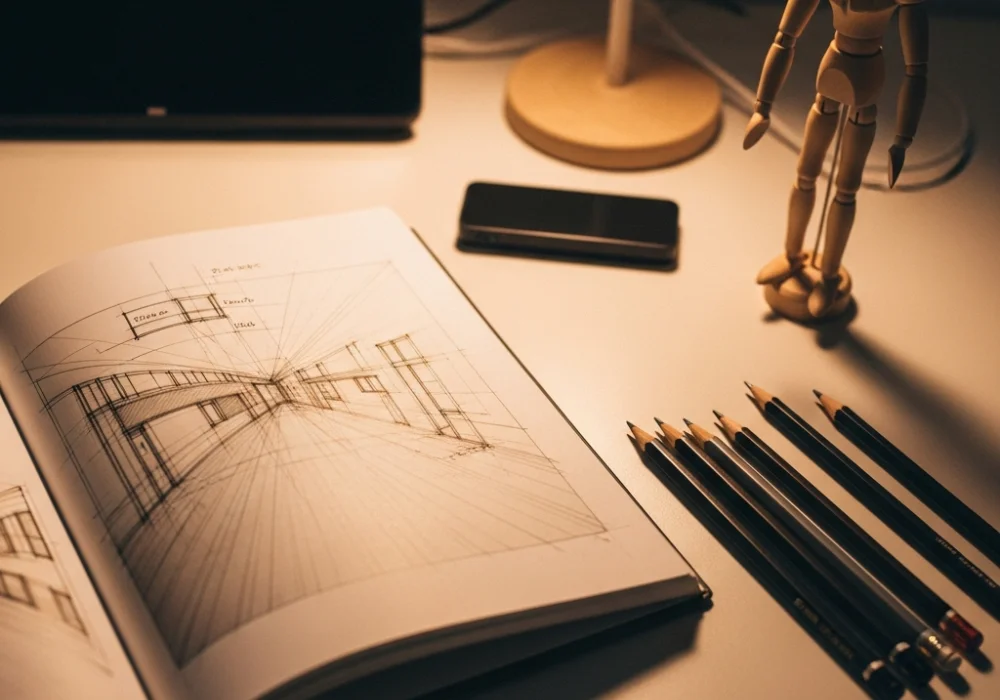
The National Institute of Design (NID) is the dream destination for every aspiring designer in India. However, the path to the Design Aptitude Test (DAT) can feel overwhelming, especially for beginners. The core of the NID entrance is not just about drawing pretty pictures; it is about visual communication, problem-solving, and creative thinking through sketching. If you are starting your journey, this guide is designed to help you build a solid foundation from scratch.
Sketching is a muscle that needs consistent training. Whether you want to master product design, communication design, or animation, your ability to put thoughts onto paper determines your success. At myentrance.in, we provide comprehensive mock tests that mimic the latest pattern of the NID DAT, helping you refine these very skills under timed conditions.
Table of Contents
1. The Power of Lines and Basic Shapes
Before you draw a complex car or a bustling market scene, you must master the simplest element: the line. NID examiners look for confidence in your strokes. A shaky line indicates hesitation, while a firm, fluid line shows clarity of thought.
- Ghosting Technique: Move your hand in the air above the paper in the motion of the line you want to draw before actually touching the lead to the surface.
- Shape Breakdown: Everything in the world can be broken down into circles, squares, and triangles. Start practicing by drawing these shapes in 3D (spheres, cubes, and cones).
- Wrist vs. Shoulder: For small details, use your wrist. For long, straight lines or large curves, use your entire arm moving from the shoulder.
💡 Pro-Tip: The Straight Line Challenge
Fill an entire A4 sheet with parallel straight lines without using a ruler. Do this every morning for 10 minutes to build muscle memory!
2. Mastering Perspective Drawing
Perspective is what gives your 2D paper a 3D feel. In the NID DAT, you might be asked to draw a scene from the point of view of an ant or a bird. Understanding the horizon line and vanishing points is non-negotiable.
Types of Perspective to Practice:
- One-Point Perspective: Ideal for looking down a long hallway or a straight road.
- Two-Point Perspective: Used for drawing buildings or objects viewed from a corner.
- Three-Point Perspective: Perfect for dramatic ‘worm’s eye’ or ‘bird’s eye’ views, adding height and depth.
When practicing for upcoming exams, try drawing your room from different corners. This exercise improves your spatial awareness, a key metric in the NID evaluation process.
3. Understanding Light, Shadow, and Value
A drawing without shading is just a flat outline. Shading adds volume and weight. To master this, you need to understand where your light source is located. If the light comes from the top left, the shadow must fall on the bottom right.
Common Shading Techniques:
- Hatching: Closely spaced parallel lines.
- Cross-Hatching: Layered sets of hatching lines that cross each other.
- Stippling: Using dots to create value (darker areas have more dots).
- Scumbling: Controlled scribbling to create texture.
Remember, contrast is your friend. Don’t be afraid to make your darks really dark and keep your highlights crisp white. This makes your work ‘pop’ off the page, which is essential for catching the examiner’s eye.
4. Human Anatomy and Proportions
Many beginners find human figures intimidating. However, NID frequently asks questions involving people in various scenarios—like a crowded railway station or a family dinner. You don’t need to be a medical illustrator; you need to be a gestural artist.
- The 8-Head Rule: An average adult is roughly 7.5 to 8 heads tall. Use this as a guide for height.
- Stick Figures First: Always start with a ‘skeleton’ or stick figure to get the pose and action right before adding ‘flesh’ or clothes.
- Action Lines: Use a single curved line to define the flow of the body’s movement.
Observation is key. Carry a small sketchbook and draw people at bus stops or cafes. Capturing ‘life’ in your sketches is a hallmark of a great designer.
5. Object Drawing and Material Rendering
Can you make a drawing of a plastic bottle look different from a glass one? Material rendering is a sophisticated skill that NID values highly. It shows your attention to detail and understanding of physical properties.
How to Render Different Materials:
- Glass: Focus on sharp reflections and the distortion of objects behind it.
- Metal: High contrast between deep blacks and bright white highlights.
- Wood: Use organic, flowing lines for grains and matte shading.
- Fabric: Focus on folds, tension points, and how gravity affects the material.
Practicing with real-world objects is the best way to learn. Set up a small still-life on your desk and try to replicate the textures using only a pencil.
7. Tools of the Trade: Pencil Grades
Using the right tool for the right job is vital. Many students make the mistake of using a single HB pencil for everything. Here is a quick guide to understanding pencil grades:
| Pencil Grade | Hardness/Blackness | Best Use Case |
|---|---|---|
| 2H – 4H | Hard & Light | Initial light guidelines & technical layouts |
| HB | Medium | Basic outlines and general writing |
| 2B – 4B | Soft & Dark | General shading and realistic textures |
| 6B – 8B | Very Soft & Black | Deep shadows and high-contrast areas |
Interactive FAQ: NID Sketching Doubts
How much time should I spend on a sketch during the NID DAT?
Ideally, a 15-20 mark question should be completed in 25-30 minutes. This includes conceptualizing, rough layout, and final rendering. Practice with mock tests on myentrance.in to improve your speed.
Is realistic sketching more important than creative ideas?
NID prioritizes creativity and concept over hyper-realism. However, your sketching must be ‘decent’ enough to communicate your idea clearly. A great idea poorly drawn may lose marks.
Should I use colors in my NID sketches?
Unless the question specifically asks for color, it’s better to master monochromatic (pencil) shading first. If you do use color, color pencils or dry pastels are usually preferred over messy wet mediums.
Quick Knowledge Check!
Test your sketching basics with these quick questions:
1. Which perspective is best for drawing a street corner with buildings on both sides?
Answer: Two-Point Perspective. It allows you to see two sides of the buildings receding toward two different vanishing points on the horizon.
2. What does ‘B’ stand for in pencil grades like 2B or 4B?
Answer: ‘B’ stands for Blackness. The higher the number, the softer the lead and the darker the mark it leaves.
3. What is the ‘Horizon Line’ synonymous with in a drawing?
Answer: The Eye Level. It represents where the artist’s eyes are positioned relative to the scene.
Ready to Ace the NID DAT?
Consistent practice with expert guidance is the key to success. Don’t leave your design career to chance. Join the community of successful aspirants at myentrance.in and access the best mock tests, study materials, and design insights.
💬 Chat with our Experts on WhatsApp (+91 9526806124)




