
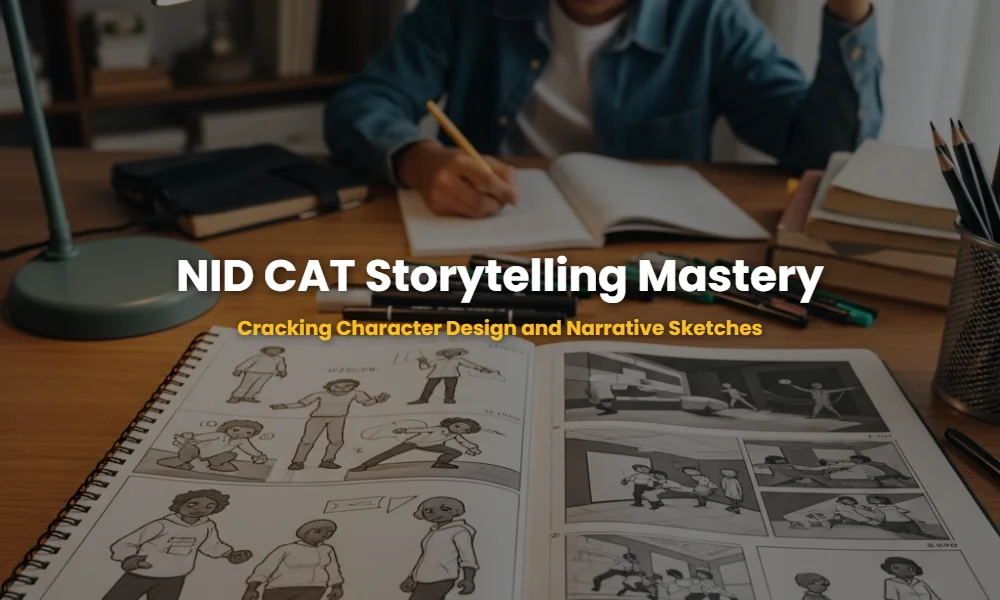
Will Your NID CAT Sketches Fail the Storytelling Test?
The National Institute of Design (NID) doesn’t just look for pretty pictures; they look for thinkers who can sketch. The Creative Ability Test (CAT) is the ultimate battleground where your ability to weave a narrative through character design and sequential art determines your future. If you aren’t using specific, industry-grade sketching techniques, your work might remain ‘just average’ while others secure their seats. This guide reveals the high-stakes techniques you must master to stand out in the NID DAT 2025.
🚀 Key Takeaways
- Master Gesture Drawing to convey emotion instantly.
- Use Dynamic Perspective (3-point and Fish-eye) for immersive storytelling.
- Focus on Character Silhouettes for distinct identity.
- Implement the Rule of Thirds in storyboards for professional composition.
- Develop a unique Visual Vocabulary to handle abstract prompts.
Inside This Exclusive Guide
The Character Design Secret NID Toppers Use
To master NID CAT character design, you must focus on ‘Shape Language’ and ‘Silhouette’ to ensure your characters are recognizable and expressive even without detail. Use circles for friendly characters, squares for reliable ones, and triangles for dynamic or villainous personas. This psychological approach to sketching ensures your design speaks before the examiner even reads your description.
When you are asked to design a character for a specific role, such as a “futuristic postman” or an “anxious vegetable seller,” the examiner is checking your observational skills. Are you looking at NID DAT preparation resources that emphasize character backstory? Every wrinkle, accessory, and posture choice should reflect the character’s life. For example, an anxious character might have hunched shoulders, tucked-in limbs, and erratic, thin line weights.
💡 Pro-Tip: The Silhouette Test
Fill your character sketch with solid black. If you can still tell who the character is and what they are doing just by the outline, you have achieved a high-level design. This is a common technique in animation studios like Pixar and Disney!
Narrative Sketching: The FOMO-Inducing Storyboarding Hacks
Mastering storytelling in NID CAT requires a deep understanding of ‘Visual Pacing’ and ‘Camera Angles’ within your frames. Instead of drawing every scene from eye level, use ‘Worm’s Eye View’ to make a character look powerful or ‘Bird’s Eye View’ to show vulnerability and environmental context. This technical variety demonstrates a superior design sense that most candidates lack.
A common mistake in NID CAT is making every frame in a 4-panel or 6-panel story look the same. To avoid this, vary your ‘Shot Sizes’. Start with a Wide Shot to establish the setting, move to a Medium Shot for interaction, and use a Close-up to highlight an emotional reaction or a crucial detail. This cinematic approach transforms a simple drawing into a compelling narrative.
Remember to consider ‘Eye Flow’. Your sketches should lead the examiner’s eye naturally from one panel to the next. Using diagonal lines and character gestures can act as pointers, guiding the viewer through the story seamlessly. If you aren’t practicing creative sketching techniques daily, you risk producing stagnant, boring layouts.
⚠️ Don’t Let Poor Preparation Ruin Your NID Dreams!
Thousands of students fail the CAT section because they lack professional feedback. Join our elite mock test series and get evaluated by NID Alumni.
🚀 Take Premium Mock Test NowAre Your Proportions Killing Your Score?
Anatomy mastery for NID CAT isn’t about medical accuracy; it is about ‘Gesture Drawing’ and ‘Weight Distribution’. You must be able to sketch the human form in motion—running, jumping, or sitting—within 30 seconds. Using the ‘Bean Method’ for the torso and ‘Cylinders’ for limbs helps in maintaining 3D volume while keeping the sketch fluid and dynamic.
Many students struggle with hands and feet, often hiding them behind objects. This is a red flag for NID examiners. Instead, learn the basic ‘Mitt’ technique for hands to block out the general shape before adding fingers. Mastering the ‘Center of Gravity’ ensures your characters don’t look like they are falling over. If a character is carrying a heavy load, their spine should curve, and their weight should shift significantly—details that prove your mastery of physical reality.
💡 Quick Anatomy Hack
Always draw the ‘Line of Action’ first. A simple ‘S’ or ‘C’ curve that represents the flow of the body. Building your character around this line ensures your sketches never look stiff or ‘wooden’.
Advanced Shading and Line Weight Strategies
In the high-pressure NID CAT environment, shading should be used strategically to create ‘Focal Points’. Use high-contrast cross-hatching or stippling on the main subject while keeping the background in light, gestural lines. This ‘Atmospheric Perspective’ creates depth and ensures the examiner’s eye goes exactly where you want it to.
Line weight is your secret weapon. Thicker lines should be used for the underside of objects (to indicate shadow/weight) and for objects closer to the viewer. Thinner, lighter lines are perfect for distant objects and fine textures. This variation prevents your sketch from looking like a flat coloring book page. If you are aiming for top ranks, check out NID studio test tips for how these techniques translate into 3D model making as well.
Sketching Techniques Comparison for NID CAT
| Technique | Best Used For | NID Impact |
|---|---|---|
| Gesture Drawing | Action & Emotion | High: Shows dynamism |
| Shape Language | Character Personality | Essential: Defines character trait |
| 3-Point Perspective | Dynamic Environments | Extreme: Shows technical skill |
| Cross-Hatching | Texturing & Depth | Moderate: Adds professional finish |
Critical Questions You Need Answered
How many panels should I use for a storytelling question?
Usually, NID CAT provides 4 to 6 boxes. Focus on a clear Beginning, Middle, and End. Don’t crowd too much information into one box; let the sequence do the talking.
Is it necessary to use color in the CAT section?
Only use color if the question explicitly asks for it or if you can do it quickly without sacrificing the quality of the drawing. Often, a well-rendered pencil sketch is better than a messy colored one.
What pencil grades are best for NID?
Carry a range: HB for initial light layouts, 2B for general drawing, and 4B or 6B for deep shadows and bold outlines. Mechanical pencils (0.5mm) are great for fine details in character design.





