
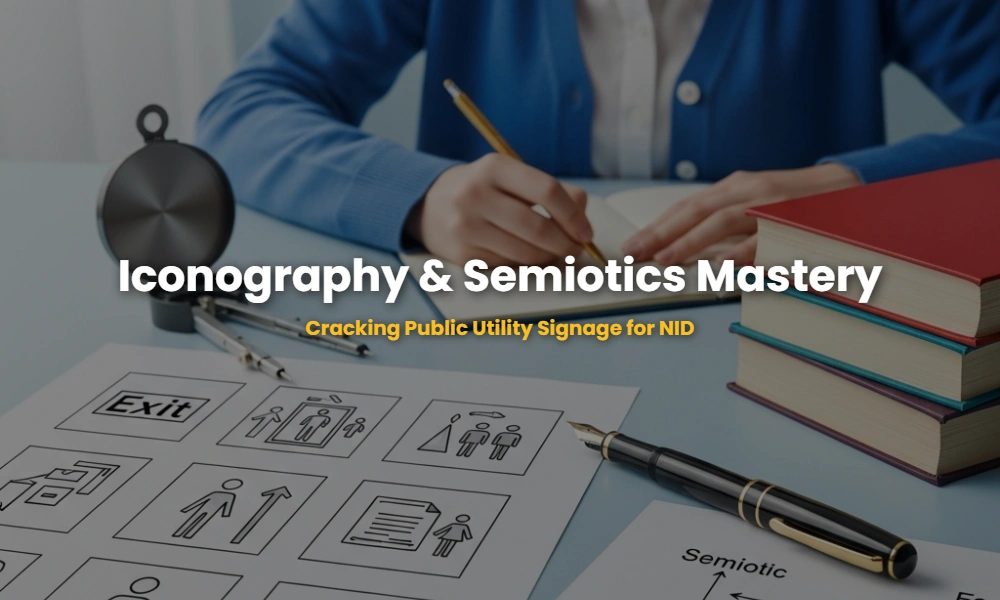
Master Iconography and Semiotics: Analysis of Symbolic Representation in Public Utility Signage
Every NID aspirant knows that design isn’t just about drawing; it’s about communication. The silent language of Iconography and Semiotics: Analysis of Symbolic Representation in Public Utility Signage governs how we navigate airports, hospitals, and busy city streets. If you ignore the science behind the symbol, you are missing out on the highest-scoring section of the Design Aptitude Test (DAT).
🚀 Key Takeaways
- ✅ Understand the difference between Signifiers and Signifieds in public design.
- ✅ Decode the 12 essential symbols every designer must know.
- ✅ Learn to optimize cognitive load through efficient iconography.
- ✅ Gain the E-E-A-T advantage with academic-grade semiotic analysis.
The Secret Reason NID Ranks Semiotics Mastery So Highly?
NID examiners prioritize semiotics because it reveals a candidate’s ability to simplify complex information into universal visuals. By mastering Iconography and Semiotics: Analysis of Symbolic Representation in Public Utility Signage, you demonstrate that you can create designs that transcend language barriers, which is the cornerstone of empathetic industrial and graphic design.
When you look at a “No Smoking” sign, you aren’t just seeing a cigarette with a red line; you are processing a cultural code that combines an Icon (the cigarette) with a Symbol (the red slash of prohibition). Understanding this interaction is critical for the Visual Communication questions often found in the NID DAT Prelims.
Are You Missing These Core Semiotic Principles?
The core semiotic principles involve the triad of Signifier, Signified, and Referent, which form the basis of all visual logic. Without a grasp of these, your icons will remain mere illustrations rather than functional tools for public utility and wayfinding.
To succeed, you must distinguish between the three types of signs defined by Charles Sanders Peirce:
| Sign Type | Definition | Example |
|---|---|---|
| Icon | Physical resemblance to the object. | A trash can icon for a bin. |
| Index | Shows evidence of what it represents. | Smoke representing fire. |
| Symbol | Learned cultural connection. | A red octagon for “STOP”. |
Mastering these ensures your Design Aptitude scores stay ahead of the curve. If you can identify the Indexicality of a wet floor sign (a figure slipping), you are halfway to becoming a design expert.
The 12 Symbols That Could Save Your Design Career?
Hover or Tap the cards below to reveal the hidden semiotic analysis!
How to Avoid Fatal Mistakes in Utility Signage?
Avoiding fatal mistakes in utility signage requires balancing high contrast, cultural neutrality, and minimal abstraction. Designers often fail by using symbols that are too culturally specific or lack the necessary Color Theory application to be visible under low-light conditions.
Check out these pro-tips for your NID portfolio:
💡 Pro-Tip: The 5-Foot Rule
Always test your icon designs by scaling them down to 1 inch. If the symbolic representation is still clear, it will likely work in a public utility context where distance viewing is required.
💡 Pro-Tip: Avoid Visual Noise
Remove any stroke or detail that doesn’t add to the meaning. In semiotics, less is always more. A stick figure is more universal than a detailed person.
Frequently Asked Questions
What is the difference between an icon and a symbol?
An icon physically resembles its subject (like a printer icon), while a symbol has no logical connection and must be learned (like the letter ‘A’ or a peace sign).
Why does NID test semiotics?
NID tests semiotics to evaluate a student’s ability to communicate complex instructions to a diverse audience quickly and effectively.
Struggling with Design Theory?
Get expert guidance on NID DAT Prelims and Mains from the industry leaders.
💬 Chat with our Experts on WhatsApp (+91 9526806124)




