
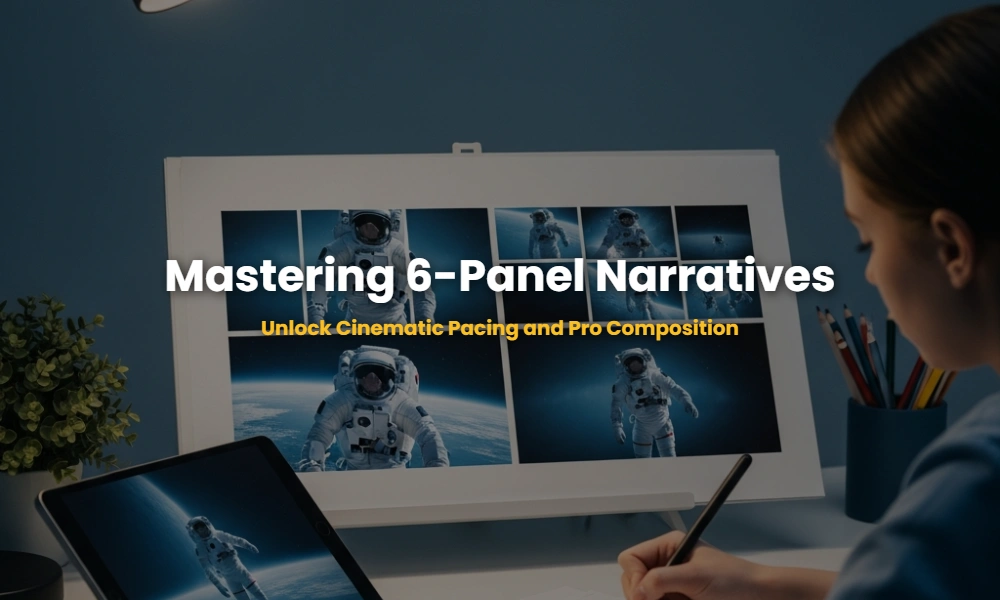
Is Your Narrative Design Strategy Failing NID’s Latest Standards?
Cinematic pacing and frame composition in 6-panel narrative sequences are no longer just ‘artistic choices’—they are the psychological benchmarks NID examiners use to separate the top 1% of candidates from the rest. If your panels feel static or repetitive, you are likely losing critical marks in visual storytelling logic and spatial awareness.
🚀 Key Takeaways
- ✅ The 2-2-2 Rule: Establishing, Escalating, and Resolving within a fixed 6-grid.
- ✅ Rule of Thirds vs. Center: Knowing when to break symmetry for dynamic tension.
- ✅ Variable Aspect Ratios: Using frame width to manipulate the reader’s perception of time.
- ✅ Value Hierarchy: Using light and shadow to guide the eye across panel gutters.
Jump to the Secrets You Need Most:
The Sneaky Psychological Math of Cinematic Pacing You’re Ignoring
Cinematic pacing in a 6-panel narrative refers to the controlled speed at which a story unfolds visually. By varying the complexity of the visual hierarchy and the amount of information in each frame, you can trick the viewer’s brain into perceiving time as either speeding up during a chase or slowing down during an emotional climax.
In NID, students often make the mistake of keeping the ‘beats’ consistent. If panel 1, 2, and 3 all have the same visual weight, the narrative feels flat. To master this, you must apply the concept of Visual Rests and Visual Crescendos. A visual rest is a minimalist frame with lots of negative space, while a crescendo is a hyper-detailed frame that demands longer attention. This push-and-pull is the heart of professional cinematic sequencing.
💡 Pro Tip: The ‘Gutter’ Secret
The space between panels, the gutter, is where the reader’s imagination happens. For high-speed action, keep gutters narrow. For contemplative, slow-paced scenes, increase the gutter width or use ‘borderless’ panels to imply a loss of time boundaries.
The Frame Composition Cheat Sheet for Position Zero Mastery
Frame composition in narrative design is the arrangement of elements within a panel to direct the eye and evoke specific emotions. Using cinematic techniques like low-angle shots for dominance or Dutch tilts for anxiety can transform a standard NID response into an expert-level submission.
Understand that every frame is a compositional anchor. When sketching for NID, prioritize the Lead-in Line. Ensure that an object or character’s movement in panel 2 literally points towards the focal point of panel 3. This ‘Eye-Path’ orchestration ensures that the examiner never feels lost while reviewing your story, boosting your score in the ‘Clarity of Communication’ category.
| Composition Type | Emotional Impact | Best Used For… |
|---|---|---|
| Extreme Close-Up | Intimacy or Panic | Panel 5 (The Twist) |
| Bird’s Eye View | Isolation / Objective | Panel 1 (Setting) |
| Dutch Tilt | Disorientation / Fear | Panel 3 (Conflict) |
5 Lethal PYQ Simulations: Can You Solve These in 20 Minutes?
The NID exam tests your ability to think under pressure. These simulated questions focus on cinematic pacing and frame composition in 6-panel narrative sequences, forcing you to use storyboarding techniques used by professional film directors.
Question 1: The ‘Insignificant Hero’ Sequence
Show a common household ant discovering a sugar cube and leading its colony to it, using a sequence that shifts from micro-horror to epic discovery.
⚡ 30-Second Ninja Shortcut
The Scale Shift: Use a ‘Worm’s Eye View’ in Panel 1 to make the sugar cube look like a mountain. Use Panel 6 to zoom out to a ‘Human View’ where the ant is invisible, highlighting the shift in perspective.
Question 2: The ‘Time Dilation’ Chase
A character is running for a train. Use your 6 panels to make the first 5 panels feel like 5 seconds, and the 6th panel feel like an eternity.
⚡ 30-Second Ninja Shortcut
The Motion Blur Trick: Use heavy horizontal ‘speed lines’ in panels 1-5 with tight crops. For panel 6, remove all lines, use a wide-angle shot with high negative space, showing the character frozen as the train disappears.
Question 3: The ‘Silent Realization’
A scientist realizes their experiment has failed dangerously. The pacing must be slow, agonizing, and purely visual.
⚡ 30-Second Ninja Shortcut
The Focus Pull: In panel 3, focus on a beaker cracking. In panel 4, the crack grows. In panel 5, keep the beaker in focus but blur the scientist’s terrified face in the background. Pacing is controlled by detail density.
Question 4: The ‘Mechanical Metamorphosis’
Depict a vintage watch being repaired, but frame it as if it were a surgical procedure on a living heart.
⚡ 30-Second Ninja Shortcut
Lighting Pacing: Use harsh, overhead ‘surgical’ lighting. Increase the contrast (Value) in each panel until panel 6 is almost pure black and white, symbolizing the moment of ‘life’ returning to the watch.
Question 5: The ‘Gravity Defiance’
An astronaut loses their tether during a spacewalk. The sequence must move from frantic movement to complete stillness.
⚡ 30-Second Ninja Shortcut
The Tangent Trap: Avoid touching objects to the panel edges in the final panels. Centering the astronaut in a vast, empty frame in Panel 6 creates a psychological sense of ‘floating’ and zero-pacing.
Final Verdict: Why You Must Master Frame Composition Now
In the competitive landscape of NID, drawing well is the baseline; thinking like a director is the differentiator. Mastering cinematic pacing and frame composition in 6-panel narrative sequences allows you to command the examiner’s attention. Remember, your goal is to make them ‘feel’ the story, not just ‘see’ it.
Practice these techniques by taking any 3-second mundane action—like pouring a glass of water—and sketching it using these 5-ninja shortcuts. The difference in your portfolio quality will be immediate and undeniable.
Struggling with your narrative flow? Get expert feedback before the next exam!
💬 Chat with our Experts on WhatsApp (+91 9526806124)
Unlimited Mock Exams
Practice unlimited mock tests anytime on myentrance.in. Easy access, detailed answers and performance insights – all from your smartphone.
Free Rapid Revision Notes
Your Ultimate Guide for Last Minute Preparation!

UPSC

SSC

KERALA PSC

NIFT
