
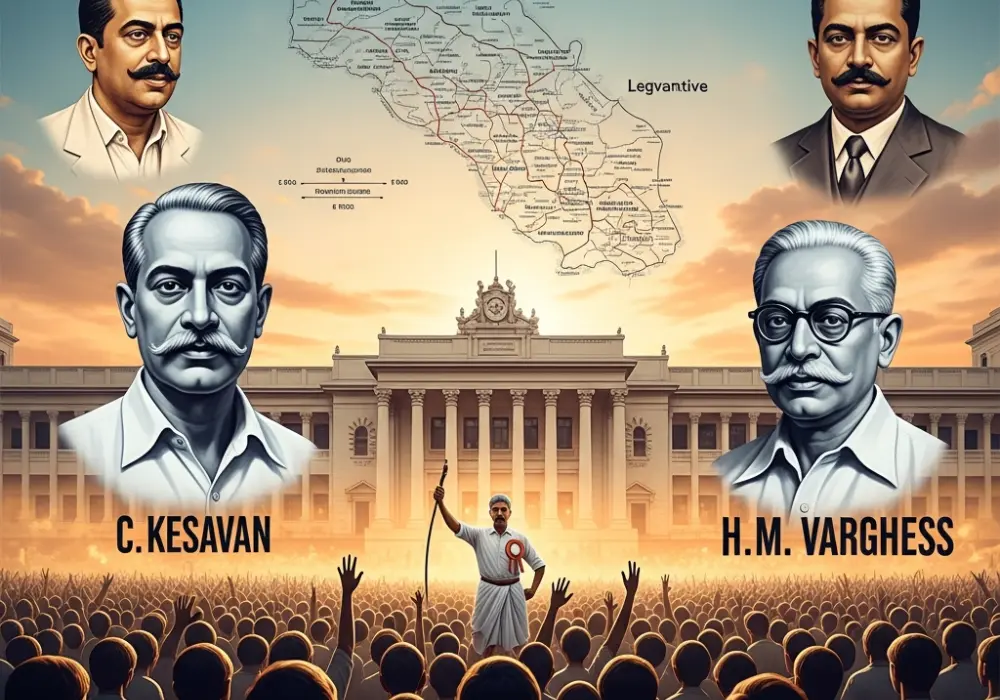
Introduction: The Significance of the Abstention Movement
For any serious Kerala PSC aspirant, the Modern History of Kerala is a goldmine of marks. Among the various socio-political upheavals, the Abstention Movement (or Nivarthana Prakshobham) stands out as a pivotal chapter that shaped the democratic landscape of Travancore. It wasn’t just a protest; it was a demand for equality, representation, and the dismantling of upper-caste hegemony in the administrative machinery. In this exhaustive guide, we will decode the movement through the lens of Previous Year Questions, providing you with ‘Ninja Shortcuts’ to ensure you never forget these facts during the high-pressure exam hours at myentrance.in.
The Genesis: Why did the Movement Occur?
In 1932, the Maharaja of Travancore, Sree Chithira Thirunal Balarama Varma, announced constitutional reforms based on the recommendations of the Lord Willingdon visit. While on paper it looked like progress, the reality was grim for the marginalized communities. The reforms introduced a bicameral legislature: the Sri Mulam Popular Assembly and the Sri Chithira State Council. However, the voting rights were tied to property qualifications and tax-paying status. This effectively meant that the majority of the population—comprising Ezhavas, Muslims, and Latin Christians—were excluded from the legislative process, while the land-owning upper castes dominated.
The term ‘Nivarthanam’ (Abstention) was coined by I.C. Chacko. The movement was not about non-cooperation with the government in a general sense, but specifically ‘abstaining’ from the elections and the newly formed legislature until communal representation was guaranteed based on population strength.
💡 Click to Reveal: The ‘EMC’ Mnemonic
To remember the three main communities involved, use the acronym EMC: Ezhavas, Muslims, and Christians. These three groups formed the backbone of the movement under the banner of the All Travancore Joint Political Congress (ATJPC).
Deep Dive into Simulated Question 1
Question: Which political organization was formed in 1932 to lead the Abstention Movement in Travancore?
- A) Travancore State Congress
- B) All Travancore Joint Political Congress
- C) Nair Service Society
- D) SNDP Yogam
The Traditional Method: A student would try to memorize every single organization formed in the 1930s. This often leads to confusion between the State Congress (formed later in 1938) and the Joint Political Congress.
The 30-Second Ninja Shortcut: Focus on the word “Joint.” Since the movement was a ‘Joint’ effort of Ezhavas, Muslims, and Christians, the organization leading it must have the word ‘Joint’ in its name. All Travancore Joint Political Congress (ATJPC) is your answer. Remember its leaders: N.V. Joseph (Chairman) and C. Kesavan (General Secretary).
Deep Dive into Simulated Question 2
Question: The famous ‘Kozhencherry Speech’ which led to the arrest of C. Kesavan was delivered in which year?
- A) 1932
- B) 1933
- C) 1935
- D) 1938
Core Concept: C. Kesavan was the firebrand orator of the movement. His speech at Kozhencherry on May 11, 1935, was a direct challenge to the Diwan’s authority. He famously declared that the Diwan (Sir C.P. Ramaswamy Iyer) was a ‘beast’ and that the people didn’t need a Diwan who ignored the majority.
The 30-Second Ninja Shortcut: Associate the ‘5’ in 1935 with the ‘S’ in ‘Speech’. The Kozhencherry Speech happened in 1935. This speech was the turning point that intensified the agitation and made C. Kesavan a household name in Kerala politics.
Deep Dive into Simulated Question 3
Question: Who was the first Public Service Commissioner of Travancore, appointed as a result of the Abstention Movement?
- A) G.D. Knox
- B) C.P. Ramaswamy Iyer
- C) T.M. Varghese
- D) P.S. Nataraja Pillai
Traditional Method: Memorizing lists of British officials can be tedious. Students often confuse the first Commissioner with various Diwans.
The 30-Second Ninja Shortcut: Think of the word ‘Knock’. The Abstention Movement ‘Knocked’ on the doors of the government so hard that they had to open a Public Service Commission. Therefore, the first Commissioner was G.D. Knox. This appointment in 1936 was a direct concession to the demand for fair recruitment in government jobs.
💡 Click to Reveal: The Outcome
The movement was successful! In 1936, the government agreed to reserve seats for Ezhavas, Muslims, and Latin Christians in the legislature and established the Public Service Commission to ensure communal representation in jobs.
Deep Dive into Simulated Question 4
Question: The term ‘Nivarthanam’ was suggested by which leader?
- A) C. Kesavan
- B) T.M. Varghese
- C) I.C. Chacko
- D) Sahodaran Ayyappan
Core Concept: While C. Kesavan was the face and T.M. Varghese was the brain (along with N.V. Joseph), the linguistic naming of the movement came from an intellectual. I.C. Chacko proposed ‘Nivarthanam’ to distinguish it from the National Congress’s ‘Non-Cooperation’.
The 30-Second Ninja Shortcut: Remember the ‘C’ connection. I.C. Chacko suggested the name for the movement. I.C. = Intellectual Creator of the name.
Deep Dive into Simulated Question 5
Question: Who was the President of the All Travancore Joint Political Congress during its inception?
- A) C. Kesavan
- B) N.V. Joseph
- C) T.M. Varghese
- D) E. Ikkanda Warrier
The Traditional Method: Students often default to C. Kesavan because he is the most famous leader of the era. However, in PSC exams, specific designations matter.
The 30-Second Ninja Shortcut: Use the hierarchy ‘J-K’. Joseph was the President (Chairman), Kesavan was the Secretary. J comes before K alphabetically, and President is usually the top rank. So, N.V. Joseph = President.
Cheat Sheet: Quick Revision for Abstention Movement
| Key Aspect | Fact to Remember |
|---|---|
| Year of Start | 1932 (Post-Willingdon Reforms) |
| Main Demand | Communal Representation in Legislature/Jobs |
| Term Suggested by | I.C. Chacko |
| Kozhencherry Speech | C. Kesavan (May 11, 1935) |
| Joint Political Congress President | N.V. Joseph |
| Joint Political Congress Secretary | C. Kesavan |
| Result | Public Service Commission (1936) |
| First PSC Commissioner | G.D. Knox |
Conclusion: The Legacy of C. Kesavan
C. Kesavan’s role in the Abstention Movement propelled him to the forefront of Kerala politics, eventually leading him to become the Chief Minister of Travancore-Cochin. The movement proved that the marginalized communities, when united, could force even an autocratic princely state to blink. For your Kerala PSC preparation, remember that questions regarding the Abstention Movement often focus on the leaders, the specific dates of speeches, and the administrative outcomes like the PSC formation. Re-read the Previous Year Questions multiple times to spot patterns in how these facts are tested.
Keep practicing, keep revising, and use these ninja shortcuts to stay ahead of the competition. Success in the Kerala PSC exam is not just about hard work; it is about working smart!
Need More Help with Kerala PSC?
Our mentors are ready to help you navigate the toughest topics in Kerala History and beyond. Don’t let doubts slow you down.
💬 Chat with our Experts on WhatsApp (+91 9526806124)




