
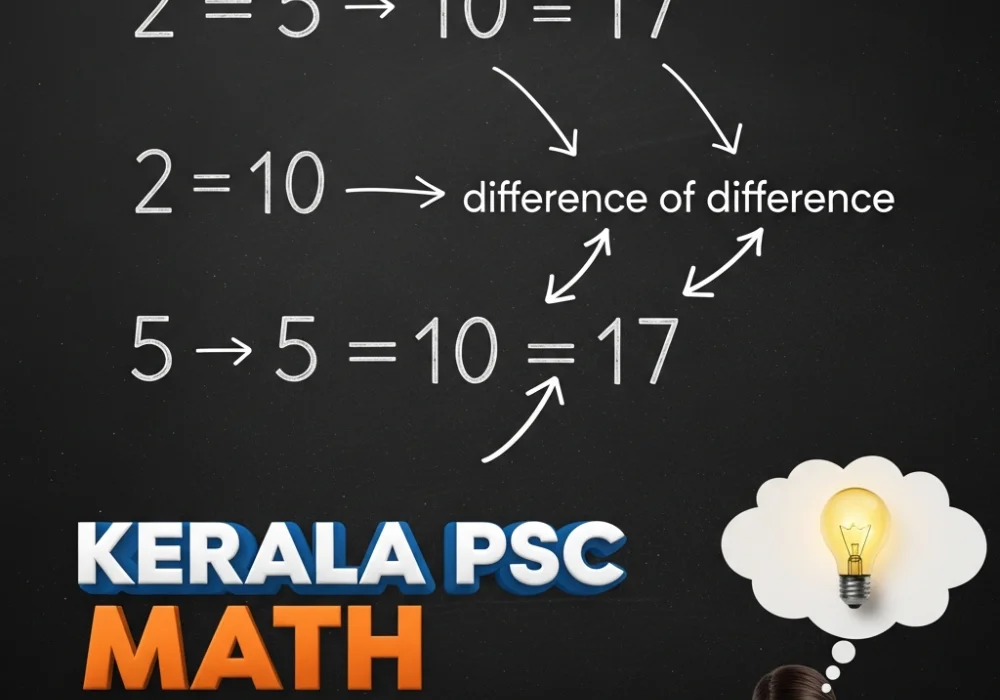
Mastering Variable Difference Arithmetic Sequences for Kerala PSC Exams
When preparing for Kerala PSC competitive examinations, candidates often find themselves comfortable with standard Arithmetic Progressions where the common difference remains constant. However, based on the analysis of Previous Year Questions, a more complex pattern frequently appears: arithmetic sequences with incrementally increasing or decreasing common differences. These patterns, often referred to as second-order arithmetic progressions, require a higher level of analytical thinking. This guide is designed to transform you into a sequence-solving expert on www.myentrance.in.
Understanding the Core Concept: Beyond the Simple ‘d’
In a standard sequence like 2, 4, 6, 8, the common difference is a constant (+2). However, in the sequences we are discussing today, the difference between terms is not constant but follows its own arithmetic progression. For instance, in the sequence 5, 7, 11, 17, 25, the differences are 2, 4, 6, and 8. Notice that the differences themselves are increasing by 2 every time. To master these, you must look at the ‘Difference of the Differences’. If the second layer of subtraction yields a constant number, you are dealing with a second-order sequence.
Question 1: The Incrementally Increasing Pattern
Question: What is the next term in the sequence: 10, 12, 16, 22, 30, …?
The Traditional Method
In the traditional academic approach, we first identify the terms: a1=10, a2=12, a3=16, a4=22, a5=30. We calculate the first-order differences:
12 – 10 = 2
16 – 12 = 4
22 – 16 = 6
30 – 22 = 8
We observe that these differences (2, 4, 6, 8) form an arithmetic progression where the common difference is 2. Therefore, the next difference must be 8 + 2 = 10. Adding this to the last term: 30 + 10 = 40.
The 30-Second Ninja Shortcut
Look at the sequence and quickly scribble the gaps: +2, +4, +6, +8. You immediately see they are even numbers. Without writing complex equations, identify the next even number: 10. Add 10 to 30 to get 40. In Kerala PSC exams, speed is everything. Recognizing the ‘Difference of Differences’ (which is 2 here) allows you to predict the next jump instantly.
Question 2: The Decreasing Jump Challenge
Question: Find the missing number in the sequence: 100, 95, 85, 70, 50, …?
The Traditional Method
We analyze the reduction between terms:
100 to 95 = -5
95 to 85 = -10
85 to 70 = -15
70 to 50 = -20
The differences are -5, -10, -15, -20. This is an arithmetic sequence where the difference is decreasing by 5 each time. The next logical difference in this series is -25. To find the next term, subtract 25 from 50: 50 – 25 = 25.
The 30-Second Ninja Shortcut
Visualize the ‘acceleration’ of the decrease. The gaps are multiples of 5: 5, 10, 15, 20. The next multiple is 25. Since the sequence is descending, simply subtract the next multiple: 50 – 25 = 25. Always keep the ‘Multiplication Table of 5’ in mind for such Previous Year Questions.
Question 3: The Odd Number Increment Pattern
Question: Find the 7th term of the sequence: 2, 3, 6, 11, 18, …?
The Traditional Method
First, find the differences:
3 – 2 = 1
6 – 3 = 3
11 – 6 = 5
18 – 11 = 7
The differences are 1, 3, 5, 7 (Consecutive odd numbers). To find the 7th term, we need two more steps.
The 6th difference will be 9 (next odd number).
6th term = 18 + 9 = 27.
The 7th difference will be 11.
7th term = 27 + 11 = 38.
The 30-Second Ninja Shortcut
Notice that these numbers are actually (n-1)² + 2.
1st term: 0² + 2 = 2
2nd term: 1² + 2 = 3
3rd term: 2² + 2 = 6
…
7th term: 6² + 2 = 36 + 2 = 38.
In Kerala PSC, if the differences are 1, 3, 5, 7, the sequence is almost always related to square numbers. Knowing your squares up to 30 is a prerequisite for any PSC aspirant.
Question 4: Square-Based Increasing Differences
Question: Identify the next term: 5, 6, 10, 19, 35, …?
The Traditional Method
Calculate the differences between the terms:
6 – 5 = 1
10 – 6 = 4
19 – 10 = 9
35 – 19 = 16
The differences are 1, 4, 9, 16. These are the squares of 1, 2, 3, and 4. The next difference must be the square of 5, which is 25. Add 25 to the last term: 35 + 25 = 60.
The 30-Second Ninja Shortcut
Whenever you see differences like 1, 4, 9, 16, or 1, 8, 27, stop calculating and think of powers. Here, the jump is n². The next jump is 5² = 25. Add it to 35 to get 60. This pattern has appeared in several Previous Year Questions for Graduate Level exams.
Question 5: Geometric Progression in Differences
Question: What is the next term in the sequence: 3, 4, 6, 10, 18, …?
The Traditional Method
Check the gaps:
4 – 3 = 1
6 – 4 = 2
10 – 6 = 4
18 – 10 = 8
The differences are 1, 2, 4, 8. This is a geometric sequence where each difference is double the previous one. The next difference will be 8 * 2 = 16. The next term is 18 + 16 = 34.
The 30-Second Ninja Shortcut
This is the ‘Double the Gap’ rule. The gap starts at 1 and doubles every time. 1 -> 2 -> 4 -> 8 -> 16. 18 + 16 = 34. Alternatively, notice the pattern is (2^n) + 2 but shifted. Practice these power-based sequences to save time during the actual exam.
Summary and Study Strategy
To succeed in the Kerala PSC math section, you must move beyond simple addition. The examiners are testing your ability to see the ‘Rate of Change’. When you encounter a number series, your first step should always be to write down the differences. If those differences don’t make sense, write down the differences of those differences. 90% of the time, the second layer will reveal the secret.
Cheat Sheet: Quick Revision for Variable Differences
| Difference Pattern | Next Jump Logic | Example Sequence |
|---|---|---|
| 2, 4, 6, 8… | Next even number | 10, 12, 16, 22… |
| 1, 3, 5, 7… | Next odd number | 2, 3, 6, 11… |
| 1, 4, 9, 16… | Next perfect square | 5, 6, 10, 19… |
| 1, 2, 4, 8… | Double the previous gap | 3, 4, 6, 10… |
| -5, -10, -15… | Next negative multiple | 100, 95, 85, 70… |
Expert Tip for myentrance.in Students
Don’t just solve these questions; time yourself. A variable difference question should take no more than 45 seconds. If you are taking longer, you haven’t memorized your squares and primes well enough. Revisit the basics of number theory to bolster your speed.
Ready to Ace your Kerala PSC Exam?
We provide personalized coaching and the most accurate mock tests based on analysis of Previous Year Questions.
💬 Chat with our Experts on WhatsApp (+91 9526806124)




