
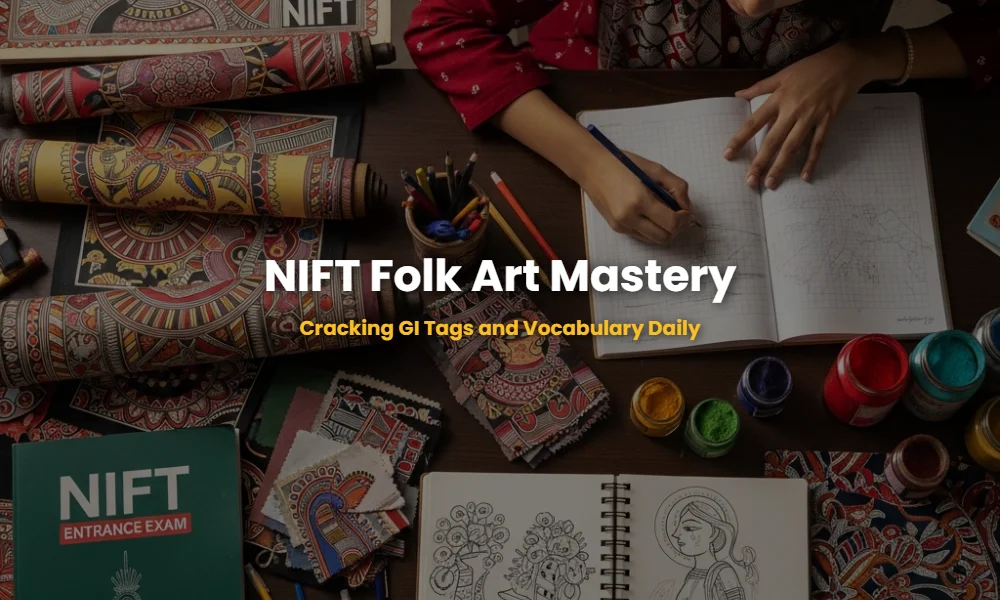
Mastering Indian Folk Art Traditions for NIFT 2025
Are you aware that a single question about a Geographical Indication (GI) tag could be the difference between a top NIFT campus and a missed opportunity? For a design student, folk art isn’t just history; it is the blueprint of contemporary fashion. This guide deconstructs the complex landscape of Indian Folk Art Traditions to ensure your General Ability Test (GAT) and Creative Ability Test (CAT) scores are unbeatable.
The Forbidden Knowledge: 10 High-Yield Art GK Topics
To dominate the GAT section, you must view art through a geographical lens. Here are 10 entities that every NIFT topper knows by heart.
- Phad Painting (Rajasthan): Large scrolls depicting folk deities like Pabuji and Devnarayan. It is essentially a mobile temple.
- Gond Art (Madhya Pradesh): Famous for the use of dots and lines to create a sense of movement. It recently received a GI tag for the Dindori district.
- Cheriyal Scroll Painting (Telangana): A stylized version of Nakashi art, rich in local motifs and used for storytelling.
- Tanjore Painting (Tamil Nadu): Known for its iconic gold foil work and semi-precious stone embellishments.
- Kalighat Pat (West Bengal): Developed in the 19th century near Kalighat Temple; famous for its satirical take on social changes.
- Pichwai (Rajasthan): Intricate paintings on cloth depicting Lord Krishna (Shreenathji), usually hung behind the idol.
- Thangka (Sikkim/Himachal): Tibetan Buddhist paintings on cotton or silk appliqué, usually depicting deities or mandalas.
- Roghan Art (Gujarat): A rare craft of painting on fabric using castor oil-based dyes; only one family in Kutch currently practices it.
- Sohrai and Khovar Art (Jharkhand): Tribal mural arts primarily practiced by women during harvest and weddings; GI tagged in 2020.
- Chamba Rumal (Himachal Pradesh): Known as “needle-painting,” these embroidered handkerchiefs look identical on both sides.
Learning these traditional Indian handicrafts is vital for the NIFT Situation Test where regional aesthetics often influence the final model design.
Stop Guessing Your NIFT Rank!
Join 50,000+ aspirants using our predictive AI mock tests to secure a seat at NIFT Delhi or Mumbai.
🚀 Take Premium Mock Test NowVocab Mastery: 10 Words to Elevate Your NIFT Portfolio
English in NIFT isn’t just about grammar; it’s about describing design. Use these words to sound like a professional designer.
- 1. Aesthetic (Adj): Concerned with beauty or the appreciation of beauty.
Mnemonic: “A-S-Thetic” – Think of a “Set” that is “Athletic” and beautiful. - 2. Intricate (Adj): Very complicated or detailed.
Mnemonic: “In-the-trick” – A design so complex it feels like a trick. - 3. Indigenous (Adj): Originating or occurring naturally in a particular place; native.
Mnemonic: “Indian-Genius” – Local genius/native talent. - 4. Motif (Noun): A decorative image or design, especially a repeated one.
Mnemonic: “Motion-Leaf” – A leaf pattern in motion (repeated). - 5. Pigment (Noun): The natural coloring matter of animal or plant tissue.
Mnemonic: “Paint-Segment” – A small part of paint color. - 6. Contemporary (Adj): Living or occurring at the same time; modern.
Mnemonic: “Con-Tempo” – With the current tempo/time. - 7. Embellish (Verb): To make something more attractive by the addition of decorative details.
Mnemonic: “Bell-ish” – Adding bells to a dress to make it better. - 8. Nuance (Noun): A subtle difference in shade of meaning, expression, or sound.
Mnemonic: “New-Ounce” – A tiny new weight/difference. - 9. Silhouette (Noun): The dark shape and outline of someone or something visible against a lighter background.
Mnemonic: “Silky-Out” – The silky outline of a garment. - 10. Abstract (Adj): Existing in thought or as an idea but not having a physical or concrete existence.
Mnemonic: “Abs-Tract” – An “Absent Track” – you can’t see the real object, just the idea.
Don’t Just Read—Memorize Like a NIFT Topper
Visual learners excel at NIFT. To memorize these art history concepts, create a “Mood Board” for each state. For Bihar, pin a Madhubani fish; for Odisha, a Pattachitra deity. This connects the visual entity to the geographical fact.
Remember, the GAT preparation strategy should always include a 15-minute daily recap of GI tags. These are low-effort, high-reward marks that most students ignore until the last week.
NIFT General Knowledge FAQs
How many GI tags does India have for handicrafts?
As of 2024, India has over 250 GI tags specifically in the handicrafts and textiles category. For NIFT, focus on the major 50 from states like Rajasthan, Odisha, and West Bengal.
Is folk art relevant for the NIFT Situation Test?
Absolutely. The Situation Test often asks you to design products for specific target audiences (e.g., a craft fair). Incorporating elements like Warli motifs or Madhubani patterns can showcase your cultural sensitivity and depth.





