
The 2 AM Panic: Why Your NIFT Model Feels ‘Empty’
You’ve spent hours gluing straws and wire, but your concept note feels like a random list of steps. For a NIFT aspirant, the bridge between material choice and thematic metaphors is the difference between a 40/100 and an 80/100 in the Creative Ability Test (CAT). Don’t let your hard work go to waste because you couldn’t explain ‘why’ you chose jute over silk.
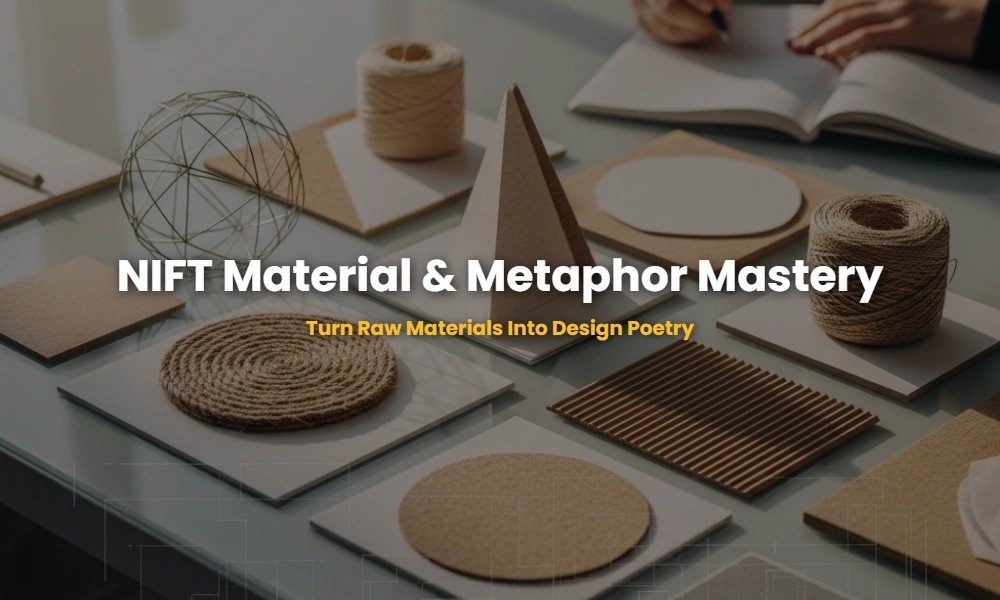
🧱 Material vs. Metaphor Map
Stop describing the material; start describing the feeling. Here is how top rankers bridge the gap:
- Wire: Represents flexibility, tension, or connectivity.
- Corrugated Sheet: Represents layers of protection or urban structure.
- Cotton/Soft Fabric: Represents vulnerability, comfort, or nostalgia.
- Transparent Sheets: Represents clarity, honesty, or barriers.
🧠 The ‘Entity-Attribute’ Hack
Before writing, list the attributes of your material. If it’s stiff, it represents authority. If it’s fragile, it represents human ego. This cognitive mapping is what NIFT examiners look for in a stellar design thinking process.
🚀 Stop Guessing Your NIFT Rank!
Are your concept notes strong enough to beat 30,000 other aspirants? Get real-time feedback and simulate the exam pressure with our premium NIFT Mock Series.
UNLOCK NIFT MOCK TESTS NOW →Trusted by NIFT AIR 1-100 candidates every year.
The 3-Step Pathway to a High-Scoring Concept Note
Step 1: Observation
Identify the ‘Nature’ of the problem. If the theme is ‘Chaos’, look for materials that look tangled or distorted.
Step 2: Manipulation
Show how you transformed the material. ‘I charred the edges of the paper to show the aftermath of a burnout.’
Step 3: Justification
Use the ‘Because’ formula: ‘I chose [Material] BECAUSE its [Physical Property] mirrors the [Thematic Metaphor].’
💡 Pro-Tip: The ‘Contrast’ Technique
Using two materials with opposite textures (e.g., rough stone and soft wool) creates a visual conflict. In your note, explain this as the ‘duality of human nature’ or ‘strength vs. sensitivity’. Examiners love this level of depth!
FAQ: Cracking the NIFT Concept Note
How long should my NIFT concept note be?
Aim for 80-120 words. Keep it punchy, focus on the ‘Why’ rather than the ‘How-to-make’, and use high-impact design vocabulary.
What if I can’t find the ‘right’ material?
It’s not about the material you have, but how you justify it. A simple rubber band can represent ‘resilience’ or ‘elasticity of time’ if explained correctly in your note.





