
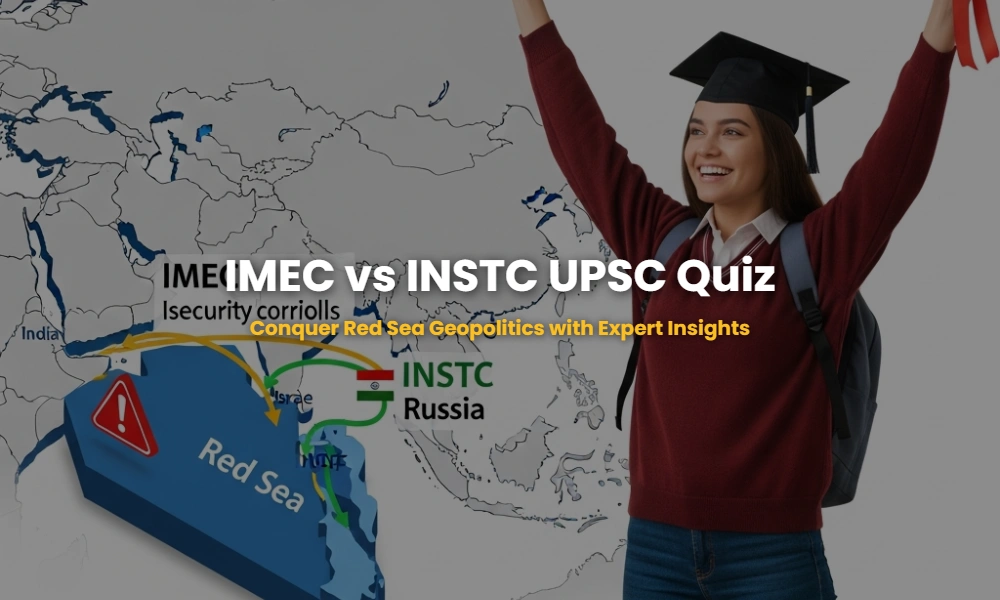
The Geopolitical Tug-of-War: IMEC vs INSTC
IMEC and INSTC are strategic connectivity projects linking India to Europe. While IMEC traverses the Middle East via sea and rail, INSTC utilizes Iran and Russia. Both aim to bypass traditional choke points like the Suez Canal, especially amidst rising Red Sea security threats.
Listen, UPSC Exam Warrior. I know the feeling. It’s 2 AM, your desk is buried under maps of the Bab-el-Mandeb Strait, and you’re wondering if you’ll ever truly grasp the nuance between these two corridors. The syllabus feels like an ocean, and you’re trying to navigate it in a paper boat. But remember, every expert was once a beginner who refused to quit. You are not just studying ‘corridors’; you are learning the new nervous system of global trade. Take a deep breath. We’re going to break this down together, logically and empathetically.
Red Sea Security: The Catalyst for Alternative Routes
Red Sea security involves protecting maritime traffic from asymmetric threats, such as Houthi rebel attacks near the Bab-el-Mandeb. These disruptions increase insurance costs and transit times, making alternative corridors like IMEC and INSTC critical for India’s strategic autonomy and economic resilience.
For a UPSC aspirant, the Red Sea isn’t just a body of water; it’s a geopolitical flashpoint. When the Ever Given got stuck in the Suez, the world felt it. Now, with security concerns rising, India’s push for the India-Middle East-Europe Economic Corridor (IMEC) and the International North-South Transport Corridor (INSTC) is a masterstroke in diversification.
Comparative Analysis: IMEC vs INSTC
| Feature | IMEC | INSTC |
|---|---|---|
| Primary Route | India → UAE → Saudi Arabia → Jordan → Israel → Europe | India → Iran (Chabahar) → Azerbaijan → Russia → Europe |
| Backers | USA, EU, India, Saudi Arabia, UAE | Russia, Iran, India |
| Strategic Goal | Counter BRI; Integrate Middle East | Bypass Suez; Access Central Asia/Russia |
| Current Status | Proposed / MOU Stage | Operational / In-use |
💡 Mentor Hack: How to memorize the routes?
Think of IMEC as the ‘Abraham Accords Route’—it relies on the normalization of ties between Israel and Arab nations. Think of INSTC as the ‘North Star Route’—it literally goes up through Iran and Russia. Visualize them as two distinct pillars holding up India’s trade roof.
The India Factor: Strategic Autonomy in Play
India’s participation in both IMEC and INSTC exemplifies ‘multi-alignment.’ By investing in these corridors, India secures its supply chains against Red Sea volatility while balancing its relations between Western powers (IMEC) and the Eurasian bloc (INSTC) to ensure national interest.
Warrior, don’t get trapped in the ‘Either/Or’ fallacy. In UPSC Mains, you must highlight that India is playing a strategic balancing act. While IMEC brings us closer to the G7, INSTC ensures our energy security and ties with the Global North through the Caspian Sea. This is Strategic Autonomy in its purest form.
UPSC Mock Quiz: IMEC vs INSTC
Q1. Which of the following best describes the ‘multi-modal’ nature of IMEC?
Q2. Which port serves as the critical entry point for the INSTC corridor in Iran?
Q3. How does the Red Sea crisis directly affect the urgency of IMEC?
Q4. The INSTC corridor was originally initiated by which three countries?
Q5. What is the primary geopolitical challenge facing the implementation of IMEC currently?
Q6. Comparative time/cost savings: INSTC is estimated to reduce transit time by what percentage compared to the Suez route?
Q7. Which major European port is envisioned as the end terminal for IMEC?
Q8. The ‘Ashgabat Agreement’ is most closely related to which corridor?
Q9. Which global infrastructure project is IMEC often compared to as a strategic rival?
Q10. What unique environmental feature is integrated into the proposed IMEC plan?
The Warrior’s Final Strategy
You’ve finished the quiz. How did you do? If you missed a few, don’t beat yourself up. Geopolitics is fluid, and the map of tomorrow is being drawn today. Your job is to stay curious, keep linking current events with static syllabus points (like the Ashgabat Agreement), and maintain your mental health.
Daily Routine Hack for UPSC:
- The 5-Minute Map: Spend 5 minutes every morning drawing the IMEC and INSTC routes from memory. Visual memory sticks longer than rote reading.
- The “Why” Filter: Whenever you read news about the Red Sea, ask: “How does this help or hurt India’s corridor strategy?”
- Self-Compassion: Burnout is real. If you’re tired, learn to rest, not to quit.
💡 Click for Expert Advice on UPSC Answer Writing
In Mains, always use a map! Even a rough hand-drawn sketch of the Arabian Sea and the corridors can net you an extra 1-1.5 marks. Use keywords like ‘de-risking’, ‘maritime security architecture’, and ‘strategic autonomy’.





