
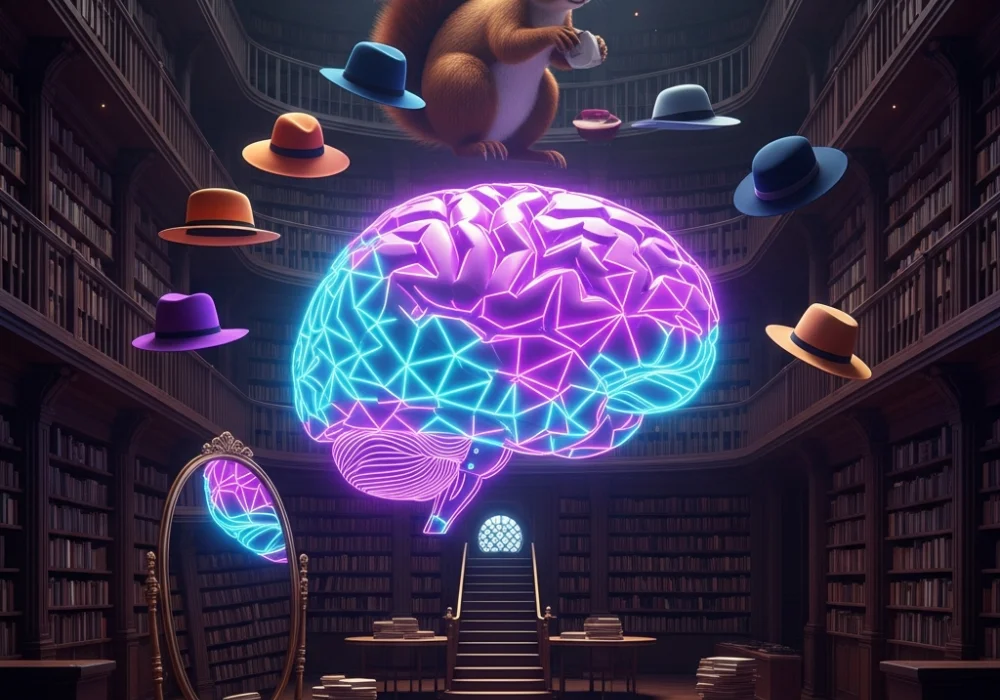
Introduction: Thinking Sideways for NID DAT 2027
Welcome, future designers! If you are preparing for the NID Design Aptitude Test (DAT) 2027, you already know that the examiners aren’t looking for the most logical answer—they are looking for the most unexpected one. This is Lateral Thinking. Unlike vertical thinking, which is a step-by-step logical progression, lateral thinking involves jumping sideways to find new perspectives. At myentrance.in, we know that memorizing these abstract techniques can be tough. That is why we have created this ultimate guide using crazy mnemonics, absurd stories, and memory palaces to ensure you never go blank during the exam. Let’s dive into the weird and wonderful world of design memory hacks!
💡 Quick Quiz: What is Lateral Thinking?
Lateral thinking is solving problems through an indirect and creative approach, typically through viewing the problem in a new and unusual light. It is a term coined by Edward de Bono.
1. The S.C.A.M.P.E.R. Super-Tool
SCAMPER is the holy grail of creative brainstorming. To remember it, imagine a Giant Squirrel named SCAMPER who is frantically redesigning his nest.
- S – Substitute: Swap one part for another. (Imagine replacing the squirrel’s tail with a paintbrush).
- C – Combine: Join two unrelated things. (A squirrel with a jetpack).
- A – Adapt: Use an existing idea for a new purpose. (Using an acorn cap as a helmet).
- M – Modify/Magnify: Change the size or shape. (A squirrel the size of a skyscraper).
- P – Put to other use: Use the object in a completely different way. (Using a tail as a winter blanket).
- E – Eliminate: Remove a part. (A squirrel with no legs that floats).
- R – Rearrange/Reverse: Flip the order. (The squirrel lives in the ground and roots grow in the air).
💡 Pro-Tip: NID Application
If asked to redesign a coffee mug, apply ‘E’ (Eliminate the handle) or ‘C’ (Combine it with a heater).
2. The Rainbow Party (Six Thinking Hats)
Edward de Bono’s Six Thinking Hats help you look at a problem from six different perspectives. Use the mnemonic “White Roses Black Yellow Green Blue” (W.R.B.Y.G.B.). Visualize a clown wearing six different colored hats at a party.
- White Hat (Facts): Pure like snow. Focus only on data and information.
- Red Hat (Feelings): Red for heart. Focus on emotions and intuition.
- Black Hat (Caution): Black for a judge’s robe. Look for risks and why it might fail.
- Yellow Hat (Benefits): Yellow for sunshine. Look for the positives and value.
- Green Hat (Creativity): Green for growth/plants. Generate new, wild ideas.
- Blue Hat (Control): Blue for the sky that covers everything. This is the moderator hat that manages the process.
3. The “P.O.” Poison Trick
In lateral thinking, PO stands for Provocative Operation. It’s a way to move away from established patterns. Think of it as ‘Creative Poison’ that kills boring ideas. Imagine a bottle of poison labeled “PO” that you pour over a problem to make it mutate.
The Technique: Make a statement that is impossible or contradicts experience. Example: “PO: Cars should have square wheels.” This forces your brain to think: How would that work? Maybe for climbing stairs? Or for parking on steep hills? PO breaks the ‘logic’ trap.
4. The “Drunken Monkey” (Random Entry)
Sometimes you need a random word to jumpstart your brain. This is the Random Entry technique. Mnemonic: R.O.A.D. (Random Object Association Discovery). Visualize a Drunken Monkey walking down a ROAD, picking up random objects and throwing them at your design problem.
How to use: If you are designing a chair and get stuck, pick a random word like ‘Cloud’. Association: Chairs that are soft? Chairs that float? Chairs that change shape based on weight? The monkey’s random ‘Cloud’ just gave you three new ideas!
5. The Vampire Mirror (Reversal)
Vampires have no reflection. In the Reversal Technique, you take a situation and look at its ‘non-reflection’ or the opposite. Imagine looking into a mirror and seeing the back of your head instead of your face.
Example: Instead of ‘How can the company make the customer happy?’, reverse it to ‘How can the customer make the company happy?’. This leads to ideas like user-generated content or co-creation. For NID DAT, if the task is ‘Design a water bottle’, reverse it: ‘Design a bottle that drinks the water’. This could lead to a self-cleaning or filtering mechanism.
6. The Lego Smasher (Fractionation)
Fractionation involves breaking a problem into tiny parts and then rearranging them. Mnemonic: B.A.S.H. (Break, Analyze, Shift, Hybridize). Visualize a giant hammer smashing a Lego castle into individual bricks.
The Process: Don’t look at a ‘Bicycle’ as one thing. Break it: Pedals, Chain, Rubber, Air, Balance, Two-wheels. Now, change one ‘brick’. What if the ‘Air’ part (tires) was replaced by ‘Springs’? You’ve just invented a puncture-proof lunar bike. By smashing the whole, you see the potential of the parts.
7. The Bio-Mimicry Story (Analogy)
Nature has already solved most design problems. Use the Analogy Technique. Mnemonic: N.A.P.S. (Nature’s Awesome Problem Solvers). Imagine you are taking a NAP in a forest and the trees start whispering solutions to you.
Story: George de Mestral went for a walk and saw burrs sticking to his dog’s fur. Instead of getting annoyed, he used an analogy. ‘How does it stick?’ This led to the invention of Velcro. In NID, if you need to design a cooling system, look at how termites cool their mounds. Nature is your ultimate lateral thinking partner.
💡 Brain Exercise
Think of a Kingfisher bird. How did its beak help in designing the Japanese Bullet Train? (Answer: Aerodynamics and noise reduction when entering tunnels!)
8. The Alien Hybrid (Visual Synthesis)
This is a common NID question: ‘Combine a toaster and a turtle’. Mnemonic: M.U.T.A.N.T. (Merge Unusual Things And Note Transformations). Visualize a mad scientist in a lab creating a MUTANT.
How to practice: Draw two circles. In one, write ‘Object A’ (Toaster). In the other, ‘Object B’ (Turtle). In the overlapping section, list shared traits: Hard shell (outer casing), heat (inner mechanism), slow (careful browning). The result? A ‘Shell-Toaster’ that keeps bread warm inside its insulated dome. This visual lateral thinking is key for DAT Part B.
9. The Prison Break (Escape Technique)
We are all prisoners of our ‘assumptions’. The Escape Technique helps you break out. Mnemonic: B.O.L.T. (Break Out of Logical Tracks). Imagine you are wearing handcuffs labeled ‘Common Sense’ and you need to BOLT away.
Example: Assumption: ‘A restaurant must have food.’ Escape: ‘A restaurant with NO food.’ Lateral Idea: A place where you pay for the atmosphere and bring your own food, or a ‘Digital Restaurant’ where you eat virtually. By escaping the most basic assumption, you find the most innovative concepts.
10. The Memory Palace of Design
To remember all these techniques during the high-pressure NID exam, build a Memory Palace. Close your eyes and imagine your childhood bedroom.
- On your Bed, there is a Giant Squirrel (SCAMPER).
- On your Desk, there are 6 Colorful Hats (De Bono).
- In the Mirror, you see the back of your head (Reversal).
- A Drunken Monkey is jumping on your wardrobe (Random Entry).
- A Lego Castle is smashed on the floor (Fractionation).
- A Mutant Turtle-Toaster is making breakfast on your nightstand (Visual Synthesis).
When you sit in the exam hall, just walk through this room in your mind. Every object will trigger a technique!
Quick Revision Summary Table
| Technique | Mnemonic / Key Image | Core Concept |
|---|---|---|
| SCAMPER | Giant Squirrel | Substitute, Combine, Adapt, Modify, Put, Eliminate, Rearrange |
| Six Hats | W-R-B-Y-G-B (Rainbow) | Facts, Feelings, Caution, Benefits, Growth, Process |
| Random Entry | Drunken Monkey / ROAD | Use unrelated words to spark new ideas |
| Reversal | Vampire Mirror | Flip the problem or the objective upside down |
| PO | Provocative Poison | Make an impossible statement to break patterns |
| Analogy | NAPS (Nature’s Solvers) | Look for solutions in biology or other fields |
Confused about Lateral Thinking questions?
Don’t let the NID DAT 2027 surprise you. Our experts at myentrance.in are here to help you master the art of creative problem solving with personalized feedback and mock tests.
💬 Chat with our Experts on WhatsApp (+91 9526806124)




