
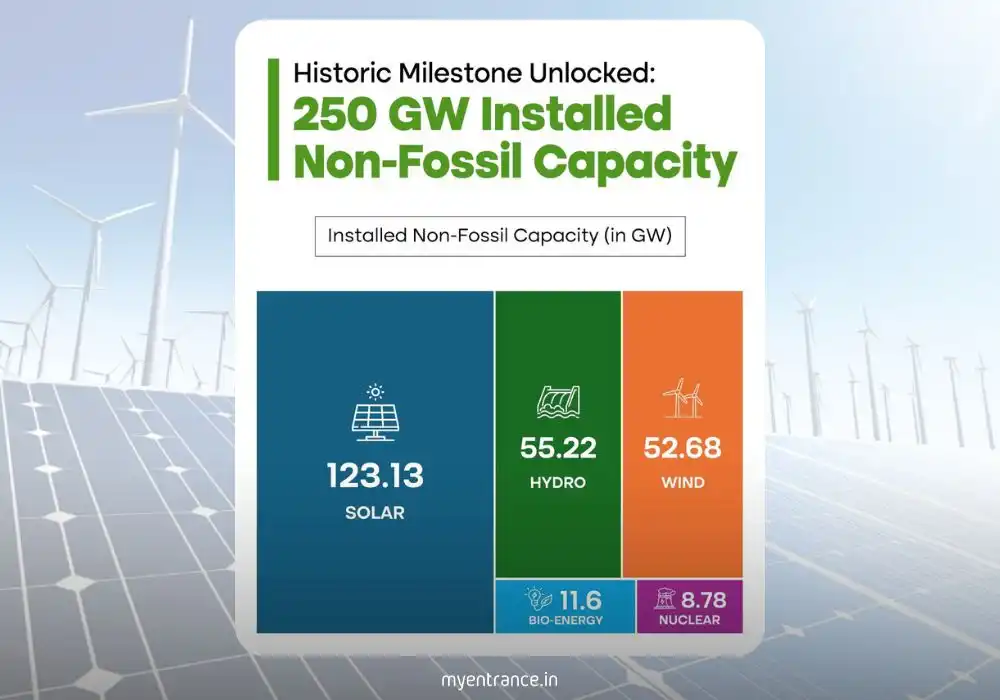
A Landmark Achievement: India’s 250 GW Non-Fossil Fuel Capacity
India has recently achieved a monumental feat in its energy sector, successfully crossing the 250 Gigawatt (GW) mark for non-fossil fuel-based electricity generation capacity. This significant milestone was announced by Union Minister Pralhad Joshi, who leads the vital Ministry of New and Renewable Energy. This development is far more than just a statistic; it signals India’s accelerating transition towards a cleaner, more sustainable energy future, directly impacting our environmental goals, energy independence, and international climate commitments. For every aspiring candidate preparing for examinations like UPSC, SSC, PSC, NID, NIFT, and other government recruitment tests, understanding this achievement is crucial, as it forms a bedrock for current affairs, general knowledge, and environmental policy questions.
Demystifying Non-Fossil Fuels: What Sources Are We Talking About?
When we discuss “non-fossil fuel” capacity, we are referring to electricity derived from sources that do not rely on burning traditional fossil fuels such as coal, petroleum, or natural gas. This broad category primarily encompasses renewable energy sources – chiefly solar power, which captures energy from sunlight; wind energy, harnessing the force of moving air; hydroelectric power, generated from flowing water; and biomass, which uses organic matter. Additionally, nuclear energy, while not renewable, is also classified as a non-fossil fuel source due to its zero greenhouse gas emissions during operation. India’s robust and strategic push in these diverse sectors is rapidly transforming its energy portfolio, moving decisively away from conventional, carbon-intensive methods towards greener, more resilient alternatives.
The ‘Why’: Unveiling the Critical Importance of This Green Shift
The imperative to shift towards non-fossil fuel energy is driven by a confluence of compelling factors, both domestic and global. Environmentally, this transition is absolutely essential for mitigating the severe impacts of climate change by substantially reducing greenhouse gas emissions. India, as a responsible global actor, is deeply committed to its Nationally Determined Contributions (NDCs) under the Paris Agreement, which include targets to lower its emissions intensity and significantly increase the share of non-fossil fuels in its total energy mix. From an economic perspective, this strategic shift bolsters India’s energy security, minimizing its susceptibility to the often volatile global fossil fuel markets and saving substantial foreign exchange. Moreover, it actively stimulates domestic innovation, catalyzes the creation of new ‘green jobs,’ and fosters sustainable economic growth, firmly establishing India as a pioneering leader in the global energy transition landscape.
India’s Ambitious Trajectory: Present Milestones and Future Aspirations
The remarkable achievement of 250 GW non-fossil fuel capacity stands as a powerful testament to India’s concerted and focused efforts over the past several years. This significant milestone places India firmly among the world’s leading nations in terms of renewable energy deployment and expansion. However, this is not the ultimate destination but merely a crucial stepping stone. Union Minister Pralhad Joshi underscored India’s even more ambitious target: to achieve a staggering 500 GW of renewable energy capacity by the year 2030. This forward-looking goal signals a profound and unwavering commitment to dramatically accelerate the green energy transition, necessitating sustained investment, groundbreaking technological advancements, and robust policy support. This far-reaching vision ensures a truly sustainable energy future for the nation and unequivocally demonstrates India’s resolve to meet its burgeoning energy demands without compromising environmental integrity.
The ‘How’: Powering Progress Through Strategic Policy and Innovative Solutions
Achieving such an immense expansion in non-fossil fuel capacity demands a comprehensive and multi-pronged approach. The Indian government, through the proactive leadership of the Ministry of New and Renewable Energy, has diligently implemented a diverse array of policies, pioneering schemes, and financial incentives designed to vigorously promote the establishment of large-scale solar parks, expansive wind farms, and various other renewable energy projects across the nation. These initiatives include meticulously crafted regulatory frameworks, targeted financial subsidies, and crucial programs aimed at enhancing and integrating grid infrastructure to seamlessly accommodate the increasing influx of renewable energy. Furthermore, innovation in critical areas such as advanced battery storage technologies, intelligent smart grids, and cutting-edge hybrid renewable energy projects plays an indispensable role, ensuring the unwavering reliability and optimal efficiency of India’s rapidly expanding non-fossil fuel network.
The Direct Relevance for Your Competitive Exam Preparation
For serious aspirants of civil services and other professional examinations, this topic serves as an invaluable resource. It comprehensively covers critical domains such as current affairs, environmental studies, economics (focusing on energy security and investment patterns), and even elements of geography (pertaining to resource distribution and project locations). Questions pertaining to India’s renewable energy targets, key governmental initiatives, the names of involved ministries and ministers, and the broad environmental implications of energy policies are frequently encountered across various competitive examinations. Therefore, staying thoroughly updated on such pivotal developments is not merely about accumulating marks, but fundamentally about grasping the critical challenges, progress, and strategic directions that are actively shaping our nation’s future.
Frequently Asked Questions (FAQs)
Q1: What is the significance of India reaching “250 GW non-fossil fuel power capacity”?
A1: Reaching 250 GW non-fossil fuel power capacity signifies that India now possesses the capability to generate this massive amount of electricity from clean sources like solar, wind, hydro, biomass, and nuclear energy, rather than burning fossil fuels. This represents a monumental leap towards reducing carbon emissions, combating climate change, and enhancing the nation’s energy security.
Q2: Which Union Minister and Ministry are at the forefront of India’s renewable energy drive?
A2: Union Minister Pralhad Joshi announced this achievement. The Ministry of New and Renewable Energy (MNRE) is the central government body responsible for formulating and implementing policies and programs related to new and renewable energy in India.
Q3: What is India’s ambitious future target for renewable energy capacity, and by when is it aimed to be achieved?
A3: India has set an ambitious target to achieve 500 Gigawatts (GW) of renewable energy capacity by the year 2030. This goal underscores the nation’s profound commitment to accelerating its green energy transition and leadership in sustainable development.
Q4: How does India’s non-fossil fuel capacity expansion contribute to its international climate commitments?
A4: This expansion is crucial for India to fulfill its Nationally Determined Contributions (NDCs) under the Paris Agreement. By increasing its non-fossil fuel capacity, India is actively working to reduce its carbon emissions intensity and enhance the share of non-fossil fuel-based electricity, directly contributing to global efforts in combating climate change.
Q5: Why is it important for candidates preparing for competitive exams to study India’s non-fossil fuel energy achievements?
A5: This topic is highly relevant for competitive exams such as UPSC, SSC, PSC, NID, and NIFT because it covers essential areas like current affairs, environmental studies, general knowledge, government policies, and economic development. Questions on India’s energy targets, climate action, and sustainable development are frequently asked, making it a critical area for comprehensive preparation.





