
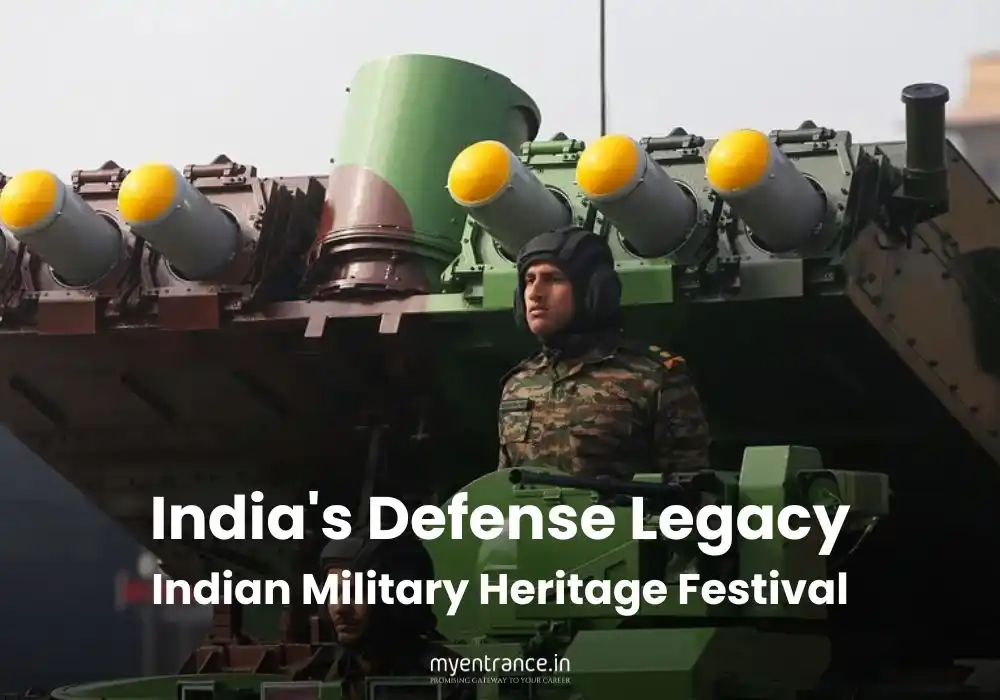
The strength of a nation is an intricate tapestry, woven with the robust threads of its present capabilities and the golden, enduring strands of wisdom from its past. For India, a civilization with a millennia-spanning history of statecraft and warfare, this dynamic is particularly profound. The nation’s contemporary strategic posture is a conscious effort to balance an illustrious, often overlooked, military heritage with the relentless imperative of modern technological advancement and self-reliance. Events like the Indian Military Heritage Festival are not merely ceremonial gatherings; they are vital, dynamic platforms where this critical interplay is dissected and displayed. For the discerning aspirant preparing for competitive examinations—be it the UPSC, SSC, PSC, NID, NIFT, or other government recruitment tests—understanding this synergy offers more than just facts; it provides a crucial framework for decoding India’s strategic identity, a theme that permeates the syllabus of these prestigious exams.
The Confluence of Past and Future: Decoding the Indian Military Heritage Festival
The recent convening of the third Indian Military Heritage Festival at the United Service Institution of India in New Delhi serves as a perfect case study. This event brought into sharp relief a foundational principle of India’s national security philosophy: the indispensable, symbiotic relationship between preserving our invaluable military legacy and aggressively driving forward the agenda of self-reliance and technological innovation. The inaugural address by the Minister of State for Defence, Sanjay Seth, underscored this very duality. For an exam aspirant, moving beyond the headline to grasp the “why” behind this philosophy is the key. It reflects a mature strategic thought process that values national character and historical context as much as it does hardware and software. This holistic view is precisely what examiners look for in essay papers, personality tests, and answers on security and governance.
Why Military Heritage is More Than Just History: The Bedrock of National Character
The imperative to preserve military heritage is multifaceted, extending far beyond the act of remembrance. It is about institutionalizing the memory of valor, sacrifice, and strategic brilliance that has defined the subcontinent for centuries. This narrative begins not in 1947, but in the ancient treatises of Chanakya’s Arthashastra, which detailed sophisticated statecraft and war strategies. It flows through the tactical genius of Chandragupta Maurya, the naval prowess of the Chola dynasty that dominated the Indian Ocean, the resilient resistance of kings like Shivaji Maharaj against overwhelming odds, and the complex martial traditions of the Sikh Empire.
For the competitive exam student, this rich tapestry is a treasure trove of static General Knowledge. It provides essential content on:
Historical Battles and Leaders: The strategies of the Battle of Hydaspes, the tenacity in the Sieges of Panipat, the leadership of Lachit Borphukan in the Battle of Saraighat, and the heroism of the 1971 war.
Evolution of Warfare: Understanding the shift from elephant corps and fortifications to modern combined arms operations provides context for current defense structures.
National Identity and Geopolitics: The historical struggles for sovereignty directly inform India’s current geopolitical stance, its non-aligned roots, and its commitment to strategic autonomy.
This knowledge is not passive. It forms the bedrock for crafting powerful essays on topics like “India’s Strategic Culture” or “Lessons from History for National Security.” In interviews, referencing a historical example to justify a contemporary policy stance demonstrates depth of understanding and analytical ability, setting a candidate apart.
The Imperative of Self-Reliance (Atmanirbhar Bharat): From Strategic Vulnerability to Strategic Autonomy
The festival’s emphasis on ‘Atmanirbharata’ taps into the most critical theme in India’s contemporary defense discourse. The “what” and “how” of this shift are central to understanding the government’s policy direction. For decades, India was one of the world’s largest importers of defense equipment. While this filled immediate gaps, it created long-term strategic vulnerabilities, exposing the nation to supply chain disruptions, geopolitical pressures from supplier nations, and a stunting of the domestic industrial and technological base.
The push for self-reliance, therefore, is a paradigm shift aimed at:
Enhancing National Security: A domestically sourced supply chain for critical defense equipment is less susceptible to international political fluctuations, ensuring operational readiness during crises.
Building a Defense Industrial Base: Initiatives like ‘Make in India’ in defense, the establishment of two Defence Industrial Corridors in Uttar Pradesh and Tamil Nadu, and the positive indigenization lists are designed to create a vibrant ecosystem of large corporations, MSMEs, and start-ups.
Spurring Economic and Technological Growth: A robust defense manufacturing sector creates high-skilled jobs, attracts foreign direct investment (FDI) through joint ventures, and drives innovation in materials science, engineering, and computing.
For exam preparation, this is a high-yield area. Aspirants must be conversant with:
Key Policies: Defence Acquisition Procedure (DAP) 2020, Mission DefSpace.
Major Projects: Indigenous Aircraft Carrier (IAC) Vikrant, TEJAS Mk-1A & Mk-2 jets, ASTRA missile system, Project 75I submarines.
Institutions & Initiatives: The role of DRDO, DPSUs (like HAL, BEL), and the private sector. The iDEX (Innovations for Defence Excellence) scheme, which crowdsources innovation, is a particularly forward-looking initiative to note.
Questions on these topics are staples in the current affairs and general awareness sections of SSC, PSC, and UPSC exams, often asking candidates to discuss the significance, challenges, and progress of the Atmanirbhar Bharat mission in defence.
Technology: The New Vanguard in Modern Warfare
Alongside heritage and self-reliance, technological advancement constitutes the third, and perhaps most dynamic, pillar of India’s defense modernization. The festival’s focus on this area underscores a stark reality: the future of warfare is being rewritten by technology. It is no longer just about numerical superiority or sheer firepower, but about information dominance, network-centric warfare, and asymmetric capabilities.
India’s commitment is evident in its push to integrate cutting-edge technologies:
Artificial Intelligence (AI): For predictive maintenance, unmanned systems, and decision-support systems.
Cyber Warfare: To protect critical infrastructure and develop offensive capabilities in the digital domain.
Quantum Computing & Communications: For unbreakable encryption and advanced sensing.
Space Technology: For intelligence, surveillance, reconnaissance (ISR), navigation (through NAVIC), and communication.
Autonomous Systems: From drones (UAVs) to unmanned ground vehicles, reducing risk to human life and increasing operational efficiency.
For the exam aspirant, this transcends the “Science & Technology” section of the UPSC prelims. It demands an understanding of the strategic, ethical, and policy implications. How does AI change the rules of engagement? What are the challenges of regulating cyber warfare? How is India’s Defence Space Agency shaping its capabilities? Answering such questions requires connecting technological facts with strategic analysis, a skill highly valued in the UPSC Mains and in PSC interviews.
Connecting the Dots: A Strategic Framework for Exam Success
An event like the Indian Military Heritage Festival is, therefore, a microcosm of India’s strategic vision. It seamlessly weaves together history, political science, economics, science & technology, and current affairs. For an aspirant, understanding this interconnectedness is the ultimate key to success.
For Essay Writing: A question on “National Security in the 21st Century” can be powerfully addressed by structuring the answer around the triad of Heritage (as a source of strategic culture and lessons), Self-Reliance (as the foundation of economic and strategic autonomy), and Technology (as the tool for future-proofing defense).
For General Studies (GS) Papers: In GS Paper III (Internal Security and Disaster Management), knowledge of cyber warfare and space security is direct. In GS Paper I (History) and GS Paper II (Governance), the evolution of strategic thought and the policy framework for defense indigenization are relevant.
For Interviews: Demonstrating an understanding that national security is not just about buying weapons, but about building a holistic ecosystem rooted in national identity and innovation, shows a mature and nuanced perspective.
In essence, the Minister’s remarks at the festival are a blueprint. The “past” provides the context and the “why,” the push for self-reliance defines the “what” of our present strategy, and the focus on technology illuminates the “how” of our future preparedness. By internalizing this framework, you move beyond rote learning. You equip yourself with a lens through which you can analyze a wide array of questions, making your preparation not just about accumulating information, but about cultivating the wisdom to use it effectively. In the competitive arena of examinations, as in defense, it is this strategic integration of legacy and innovation that ultimately paves the way for victory.





