
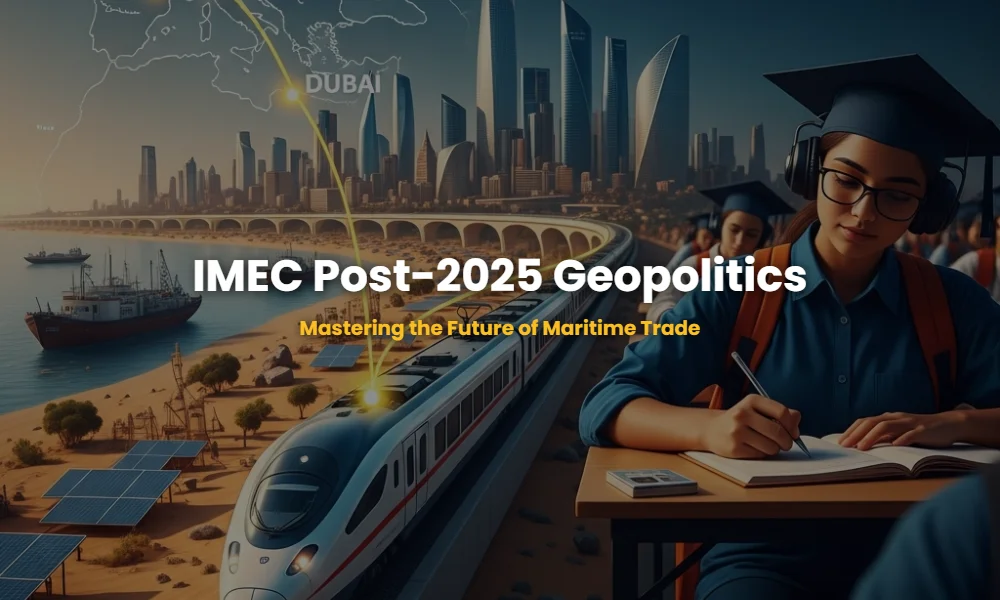
The Hidden Strategic Masterstroke: Why IMEC is More Than Just a Trade Route
The India-Middle East-Europe Economic Corridor (IMEC) is a transformative geopolitical project aimed at integrating India with Europe through a sea-rail multimodal network. Beyond commerce, it serves to counter China’s regional influence, stabilize the Middle East through economic interdependence, and provide a faster, more secure alternative to the Suez Canal.
As we approach 2025, the global trade landscape is undergoing a seismic shift. The traditional dominance of the Suez Canal is being challenged by new, multimodal corridors that promise not just speed, but also resilience. For a UPSC aspirant, understanding the IMEC is not just about memorizing routes; it is about comprehending the Strategic Autonomy that India seeks in a multipolar world. This corridor, part of the Partnership for Global Infrastructure and Investment (PGII), is designed to enhance economic integration between Asia, the Arabian Gulf, and Europe.
ፂ Key Takeaways
- Reduced Transit Time: Expected 40% reduction in trade time compared to the Suez Canal route.
- Counter-BRI Strategy: Offers a transparent, debt-sustainable alternative to China’s Belt and Road Initiative.
- Energy Integration: Includes hydrogen pipelines and high-speed data cables for future-ready infrastructure.
- Geopolitical Realignment: Strengthens the ‘I2U2’ and Abraham Accords framework.
ፁ Click to Reveal: The ‘Insider’ View on IMEC’s Challenges
While the rhetoric is positive, the conflict in West Asia and the normalization of ties between Israel and Saudi Arabia remain significant hurdles. Aspirants must focus on the ‘de-risking’ strategy of the G7 nations as a primary driver for this corridor.
The Suez Canal Dilemma: Is IMEC the Death Knell for Traditional Maritime Hegemony?
IMEC provides a crucial strategic hedge against the vulnerabilities of the Suez Canal, which handles nearly 12% of global trade. By utilizing a rail link across the Arabian Peninsula, IMEC avoids maritime chokepoints, reducing dependency on a single point of failure that has historically been prone to blockages and piracy.
In the post-2025 era, maritime security will be defined by the ability to bypass traditional bottlenecks. The Suez Canal, while vital, has shown its fragility (e.g., the Ever Given crisis). IMEC’s multimodal nature—comprising the East Corridor (India to Arabian Gulf) and the Northern Corridor (Arabian Gulf to Europe)—creates a diversified supply chain. This is a classic example of supply chain resilience. Below is a comparison of IMEC versus existing trade routes:
| Feature | IMEC Corridor | Suez Canal Route | BRI (Maritime Silk Road) |
|---|---|---|---|
| Transit Speed | 40% Faster | Standard | Variable |
| Geopolitics | US-India-EU Led | Egypt-Neutral | China-Centric |
| Infrastructure | Multimodal (Rail/Sea) | Purely Maritime | Mixed Ports/Roads |
China’s BRI vs. IMEC: The High-Stakes Geopolitical Rivalry You Must Understand
The rivalry between IMEC and the Belt and Road Initiative (BRI) is the defining feature of 21st-century geoeconomics. While BRI is often criticized for ‘debt-trap diplomacy’ and lack of transparency, IMEC emphasizes high-quality infrastructure standards, environmental sustainability, and financial viability to attract global private capital and institutional investors.
For India, IMEC represents a way to bypass the China-Pakistan Economic Corridor (CPEC) while simultaneously building deep strategic ties with the Middle East. It aligns with the ‘Look West’ policy and the ‘Link West’ strategy. However, aspirants must note that IMEC is not just a ‘counter-China’ tool; it is an affirmative agenda for shared prosperity. The involvement of the UAE and Saudi Arabia highlights their desire to diversify their economies away from oil, making them indispensable partners in this corridor.
The Post-2025 Energy Security: The Invisible Hydrogen Backbone of IMEC
Post-2025 trade is not just about containers; it is about energy and data. IMEC integrates a green hydrogen pipeline and high-speed digital cables, positioning the corridor as a primary artery for Europe’s energy transition and digital economy, thereby reducing reliance on traditional Russian and Chinese technological and energy nodes.
As Europe pushes for ‘de-risking’ from China and ‘de-coupling’ from Russian gas, the Middle East emerges as a hub for renewable energy. The IMEC will facilitate the export of green hydrogen from India and the Gulf to European markets. This ‘invisible’ infrastructure is what makes IMEC a comprehensive economic corridor rather than a simple transit route. It ensures that India is not just a participant in global trade but a central node in the future green energy grid.
ፔ Interactive Mock Quiz: Test Your UPSC Mastery on IMEC
Think you have mastered the nuances of IMEC and post-2025 maritime trade? These questions are designed to challenge your analytical depth and conceptual clarity, mimicking the difficulty of the UPSC Civil Services Examination.
Q1. Which of the following best describes the ‘multimodal’ nature of IMEC?
Q2. The IMEC is often viewed as a part of which larger global initiative?
Q3. Which major Mediterranean port is expected to be the primary gateway for IMEC into Europe?
Q4. How does IMEC contribute to ‘De-risking’ global supply chains?
Q5. Which country’s exclusion from IMEC led to its leadership proposing an alternative ‘Dry Canal’ project?
Q6. What is the ‘Abraham Accords’ connection to the IMEC?
Q7. The ‘Northern Corridor’ of IMEC connects which two regions?
Q8. Which of the following is NOT a planned component of the IMEC?
Q9. In the context of IMEC, what does ‘Interoperability’ refer to?
Q10. What is the expected reduction in logistics costs for trade between India and Europe via IMEC?
The Roadmap for Aspirants: How to Write the Perfect IMEC Answer in UPSC Mains
To score high in UPSC Mains, you must address the multi-dimensional impacts of IMEC: geoeconomic, geopolitical, and environmental. Focus on how IMEC enhances India’s Strategic Autonomy and its role as a Net Security Provider in the Indian Ocean Region, while also acknowledging the complex security dynamics of the Middle East.
Remember to mention the EU’s Global Gateway strategy and how it dovetails with IMEC. Concluding with a forward-looking statement on how IMEC facilitates the ‘India-Middle East’ integration as a new pole in the global order will earn you extra marks. The post-2025 world will see trade corridors becoming the new ‘battlegrounds’ of influence, and IMEC is India’s most significant bet on this future.
Need personalized guidance or more mock tests?
ፓ Chat with our Experts on WhatsApp (+91 9526806124)




