
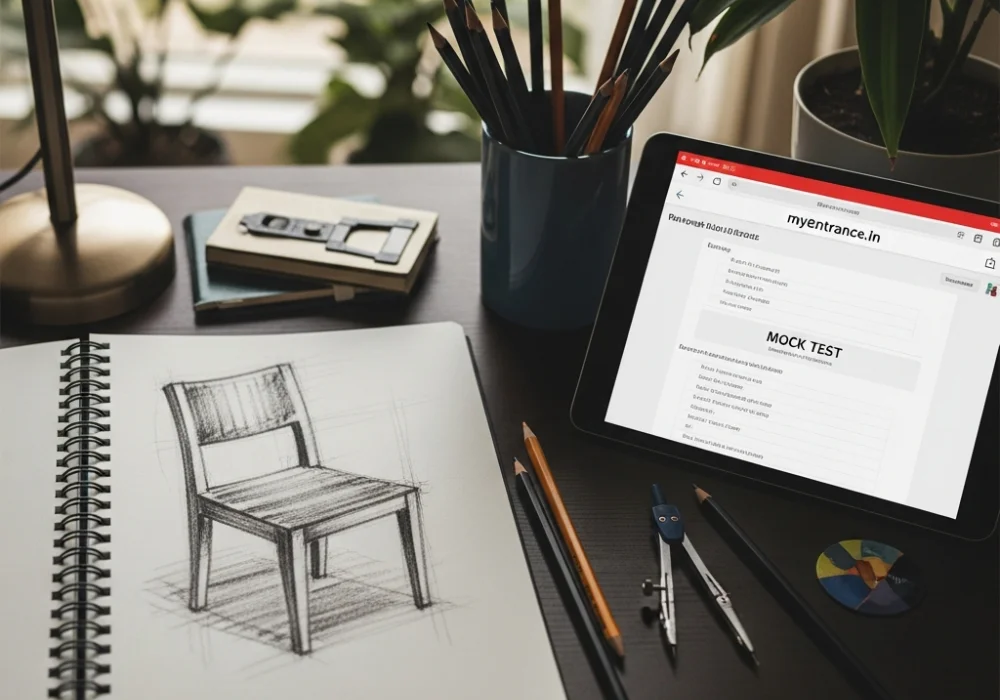
Understanding the NID Entrance Exam (DAT)
The National Institute of Design (NID) conducts the Design Aptitude Test (DAT) to select the most creative minds in the country. Preparing for the NID Entrance Exam without professional coaching is not only possible but can also foster a more authentic and original design perspective. Success depends on mastering two main stages: the DAT Prelims and the DAT Mains. The Prelims evaluate cognitive abilities and creative skills, while the Mains focus on studio-based tasks and portfolio reviews.
Table of Contents
Decoding the NID Exam Pattern
Before diving into your preparation, it is crucial to understand what NID is looking for. The exam is designed to test your visual literacy, spatial awareness, and empathy-driven design approach.
| Exam Phase | Focus Areas | Skills Evaluated |
|---|---|---|
| DAT Prelims | CAT (Creative Ability) & GAT (General Aptitude) | Observation, Visualizing, Logical Reasoning |
| DAT Mains | Studio Test & Personal Interview | Model Making, Material Handling, Communication |
💡 Pro-Tip: The ‘Why’ over ‘How’
NID examiners prioritize your ideation process over technical perfection. Always explain the logic behind your designs if space is provided!
Developing Sketching and Observation Skills
Without coaching, your greatest teacher is your environment. NID values observational drawing over stylized illustration. Focus on the following:
- Object Drawing: Practice drawing everyday items like a pressure cooker, a bicycle, or a stapler from different angles (one-point, two-point, and three-point perspective).
- Human Anatomy: Sketch people in motion. Understand how joints move and how proportions change with perspective.
- Memory Drawing: Close your eyes and try to recreate a busy marketplace or a scene from a railway station. This builds your ability to recall details.
- Light and Shadow: Master the art of shading to give your 2D drawings a 3D feel. Use varied pencil grades (HB to 6B).
Consistently practicing these fundamentals will give you an edge over candidates who rely on memorized templates.
Mastering Design Thinking
Design is about solving problems. The NID Creative Ability Test (CAT) often asks you to redesign existing products or create posters and comic strips. To excel without coaching:
- Exercise Lateral Thinking: Think of 10 alternative uses for a paperclip or a brick. This expands your creative horizon.
- Storyboarding: Practice sequential drawing. Tell a story in 3, 4, or 6 panels. Focus on emotion and narrative flow.
- Social Awareness: Many NID questions revolve around social issues. Analyze how design can solve problems like water scarcity, urban pollution, or elderly care.
💡 Pro-Tip: Scampi Technique
Use the SCAMPER method (Substitute, Combine, Adapt, Modify, Put to another use, Eliminate, Reverse) to brainstorm new design ideas rapidly.
Acing the General Aptitude Test (GAT)
While the CAT is visual, the GAT tests your intellect. Do not ignore this section! Key topics include:
- Visual Spatial Ability: Paper folding, pattern recognition, and mirror images.
- General Knowledge: Focus on famous designers, Indian craft traditions, award-winning logos, and major art movements.
- Logical Reasoning: Solving puzzles that test your analytical speed.
To prepare effectively, use high-quality study materials and solve previous years’ papers available on myentrance.in.
The Power of Mock Tests
The biggest challenge of self-study is time management. In the NID exam, you have to ideate and execute high-quality sketches within minutes. This is where myentrance.in becomes your best ally. By practicing our curated NID Mock Tests, you can:
- Simulate the actual exam environment.
- Identify your strengths and weaknesses in the GAT section.
- Improve your speed in the CAT section.
- Access the latest pattern questions designed by design experts.
Consistency is key. Set aside at least two hours daily for sketching and one hour for general aptitude and theory.
Frequently Asked Questions (FAQs)
Can I really crack NID without coaching?
Yes! Many successful NIDians have cleared the exam through self-study by focusing on observation, consistent sketching, and practicing mock tests from platforms like myentrance.in.
What stationary do I need for NID preparation?
Essential tools include a range of graphite pencils (HB, 2B, 4B, 6B), mechanical pencils, erasers, sharpeners, waterproof liners (0.1, 0.5, 0.8), and good quality A4 or A3 sketchbooks.
How important is GK for NID DAT?
GK is significant in the GAT section. Focus specifically on the history of art, design culture, current affairs in the creative industry, and famous Indian artists.
Quick Knowledge Check
Test your understanding of the NID entrance process with these quick questions:
1. Which section of the NID DAT Prelims focuses on drawing and creative problem-solving?
See Answer
The CAT (Creative Ability Test).
2. What is ‘Perspective’ in sketching?
See Answer
The technique used to represent three-dimensional objects on a two-dimensional surface to give the right impression of their height, width, depth, and position in relation to each other.
3. What stage follows the DAT Prelims for shortlisted candidates?
See Answer
The DAT Mains, which typically includes the Studio Test and Interview.
Need Personalized Guidance?
Self-studying can be challenging, but you don’t have to do it alone. If you have questions about the latest exam pattern, study materials, or our comprehensive mock tests, our experts are here to help!
💬 Chat with our Experts on WhatsApp (+91 9526806124)




